
TON Pay aims to turn Telegram into a crypto checkout layer for TON

The Open Network Foundation has launched TON Pay, a new payments software development kit (SDK) designed to make cryptocurrencies usable for everyday consumer transactions within the Telegram ecosystem.
In a Monday release shared with Cointelegraph, the product is positioned as a simple, wallet-agnostic payment layer that allows merchants and Mini App developers to accept crypto directly through Telegram, aiming to turn the app into a hub for seamless blockchain-based commerce.
According to the TON Foundation, TON Pay provides developers with a single software kit that integrates with Telegram Mini Apps, removing much of the friction associated with managing wallet infrastructure, settlement, and checkout flows.
TON Foundation’s vice president of payments, Nikola Plecas, said the tool allows merchants to “accept payments seamlessly and natively on TON through a simple SDK integration,” adding that it works across various wallets and tokens, including Toncoin (TON) and Tether’s USDt (USDT).
The system was designed for scale, he said, with targeted sub-second transaction times and average fees below one cent. According to Plecas, the ultimate goal is to “power transactions for Telegram’s global audience of over 1.1 billion monthly active users.”
By embedding payments directly into Telegram, TON Pay seeks to reduce common barriers to crypto adoption, such as multi-step checkouts, pre-paying gas fees, and the lack of straightforward merchant tools.
Related: Telegram's Durov slams Spain's online age verification proposal
TON Pay targets everyday payments inside Telegram
Initially, TON Pay will operate within Telegram Mini Apps, with plans to expand to web environments and other platforms over time.
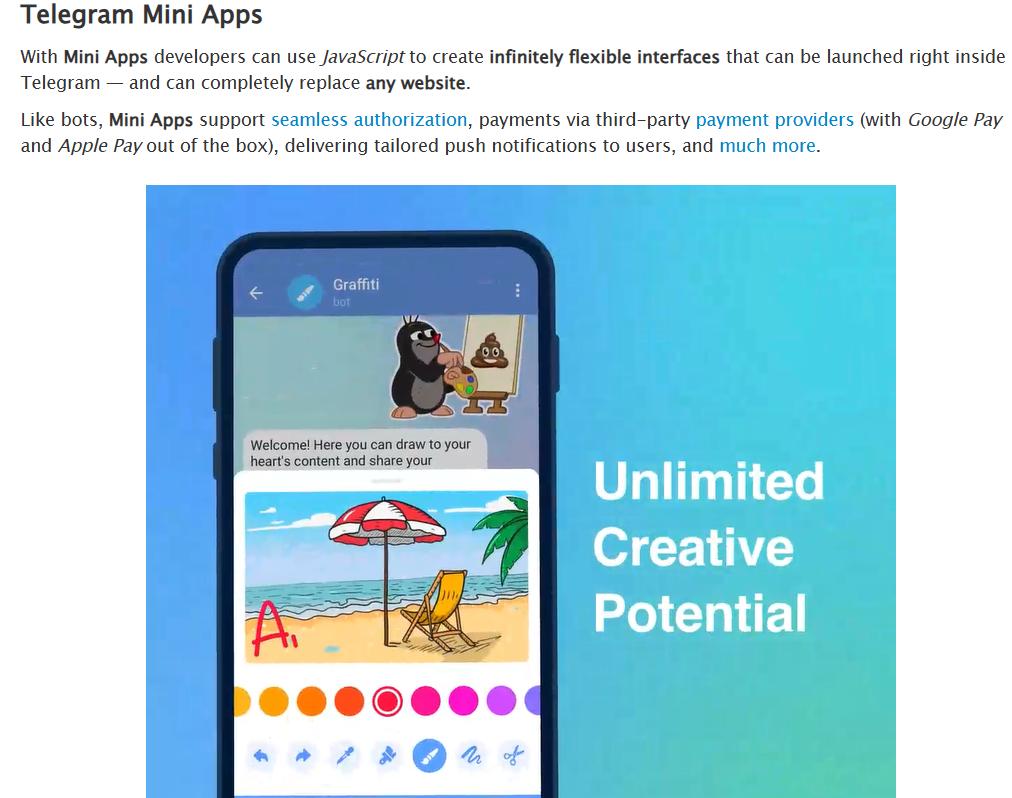 Telegram Mini Apps. Source: Telegram
Plecas said the Foundation was focused on refining the in-app experience first, noting that “onchain Telegram-based commerce is an enormous opportunity.”
Future updates, he said, will add support for subscriptions, gasless transactions, and region-specific off-ramps.
The team also plans to partner with local third-party providers for custody, compliance, and fiat conversion services, an approach meant to balance decentralization with regulatory demands.
Optional merchant tools, including analytics and multiparty-computation wallets, are also in development.
Related: Telegram is not a neobank — it’s the platform where the next ones are born
TON Pay enters crowded ‘everything app’ race
TON Pay’s rollout comes as other major platforms move into integrated payments. Elon Musk’s X has announced plans for X Money as part of a broader push into financial services, and a shift toward building so-called “everything apps” that can handle messaging, commerce, and payments in one interface.
Coinbase is pursuing a similar strategy, rebranding Coinbase Wallet as the Base app, a crypto everything app that combines a wallet with social features, payments, trading, and support for onchain mini apps running on its Base layer-2 network.
TON faces longstanding skepticism tied to its deep integration with Telegram, which has previously been criticized for its lack of decentralization, unclear governance, and scams tied to unofficial projects.
The TON Foundation maintains that TON remains an open, permissionless network where developers can build freely.
Merchants using TON Pay, Plecas said, must comply with “platform-specific terms and policies” set by Telegram, with additional requirements applying as the SDK expands beyond the app.
“We are designing a system that addresses key challenges in crypto payments,” Plecas said, such as friction, gas fees, and onboarding, while staying competitive with fiat systems.
Magazine: Crypto lawyers — Did Telegram’s Pavel Durov commit a crime?
Disclaimer: The content of this article solely reflects the author's opinion and does not represent the platform in any capacity. This article is not intended to serve as a reference for making investment decisions.
You may also like
Jensen Huang steps down, and the "biggest patron" of new AI players is gone too
Anthropic's tens-of-billions IPO investment, Figure AI's additional $1 billion, and Nscale's over $5 billion credit guarantee are all in negotiations but their outcomes remain uncertain. Meanwhile, its $500 billion AI financing platform has stalled, and some clients are considering switching to AMD or Google. Successor Kress has a conservative style and has repeatedly vetoed deals aggressively promoted by Jensen Huang, signaling the possible end of Nvidia's era of bold investments.
Applied Materials (AMAT.US) Q4 Earnings Call: CEO Responds to Capacity Mismatch Concerns, Says No Customer Delayed Delivery; System Capacity Expected to Double by 2028
Applied Materials released its financial results for the fourth quarter of fiscal year 2026 (ending October 25, 2026) after the US stock market closed on November 12.
The End of an Era! Semianalysis: Without Jensen Huang, Nvidia Will Become the Next Apple
Semianalysis believes that Jensen Huang’s departure marks the end of a founder-driven era. Nvidia is highly likely to replicate the "post-Steve Jobs Apple model"—shifting from aggressive bets to stock buybacks—which is not beneficial for either technological advancement or shareholders. A greater concern is that the supply chain advantages, customer trust system, and open-source ecosystem moat personally built by Jensen Huang will be difficult for his successor to replicate. By 2028, over 70% of total production capacity may shift to non-Nvidia players.
Crypto prices
More


