
3 Best Bitcoin ETFs with High Volumes for Risk-Taking Investors

In the fast-evolving world of cryptocurrency investing, Bitcoin (BTC-USD) ETFs (exchange-traded funds) have become a cornerstone for traders seeking exposure without directly handling digital assets. High-volume ETFs, like iShares Bitcoin Trust Registered (IBIT), Fidelity Wise Origin Bitcoin Fund (FBTC), and ARK 21Shares Bitcoin ETF (ARKB), offer great liquidity, small spreads, and low trading costs for everyone from small traders to big institutions.
- Unlock hedge fund-level data and powerful investing tools for smarter, sharper decisions
- Stay ahead of the market with the latest news and analysis and maximize your portfolio's potential
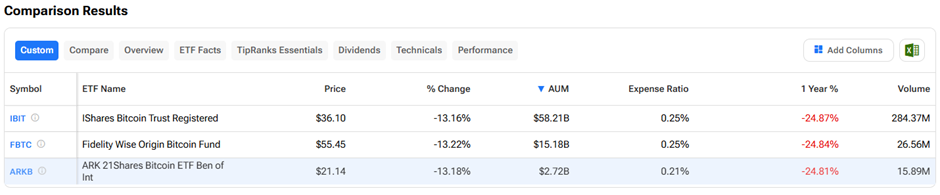
We identified these top three ETFs by trading volume, using TipRanks’ ETF Comparison Tool for the Best Bitcoin ETFs. These ETFs have billions in assets and huge daily trades. Since all these ETFs invest in Bitcoin, their returns remain similar. Hence, trading volumes and expense ratios become key measures for comparison.
Let’s take a closer look at each ETF.
iShares Bitcoin Trust (IBIT)
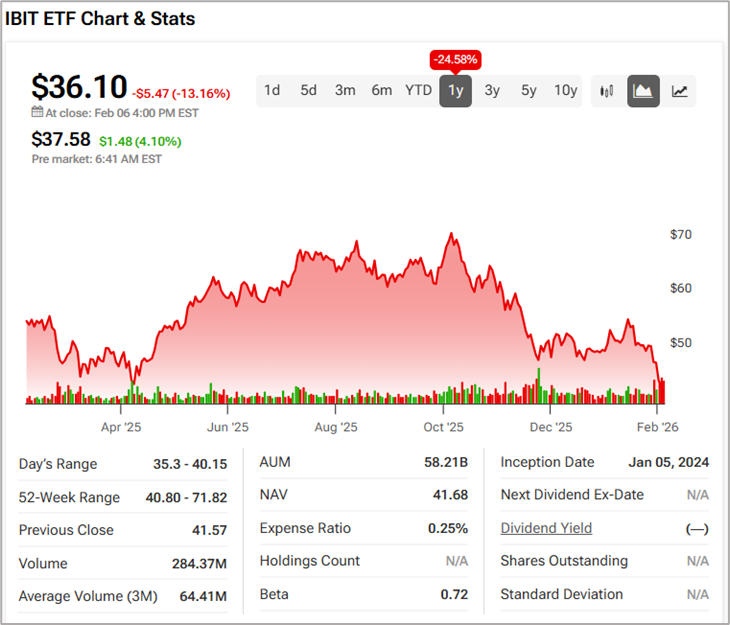
The iShares Bitcoin Trust is a spot ETF that directly holds Bitcoin for pure price exposure. IBIT has one of the highest trading volume of 284.37 million and carries an expense ratio of 0.25%. Its assets under management (AUM) are also among the highest, at $58.21 billion.
The IBIT is categorized as a “Pair focused” fund, with a specialized approach that emphasizes a long position in Bitcoin (BTC) while simultaneously shorting the U.S. Dollar (USD), offering a hedge against fiat currency volatility. This transparent fund suits bullish Bitcoin investors seeking liquidity and direct crypto access.
Fidelity Wise Origin Bitcoin Fund (FBTC)
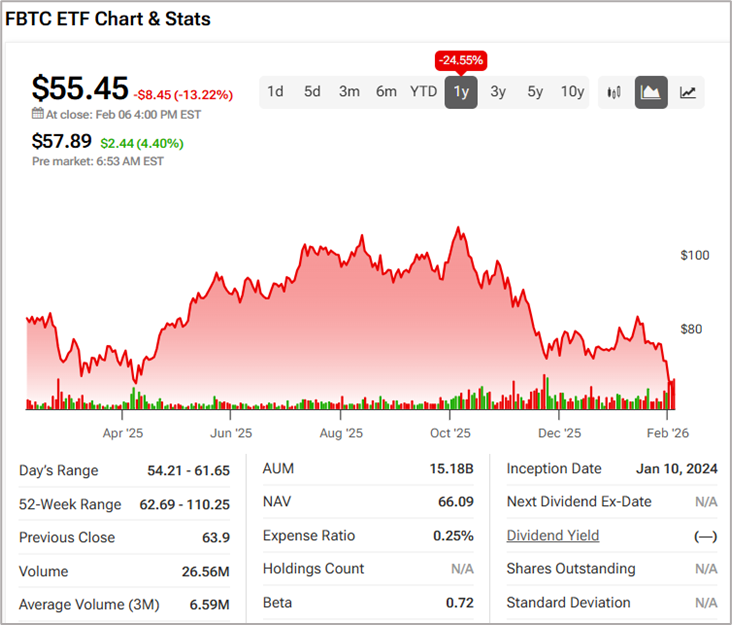
Fidelity Wise Origin Bitcoin Fund also follows the pair-focused investment approach, capitalizing on Bitcoin’s potential appreciation while mitigating exposure to the U.S. dollar’s fluctuations. The fund’s distinct approach leverages Fidelity’s deep expertise in both traditional financial markets and digital assets, ensuring robust management and oversight.
FBTC also has high trading volumes of 26.56 million, but significantly lower than IBIT. FBTC carries an expense ratio of 0.25% and has an AUM of $15.18 billion.
ARK 21Shares Bitcoin ETF (ARKB)
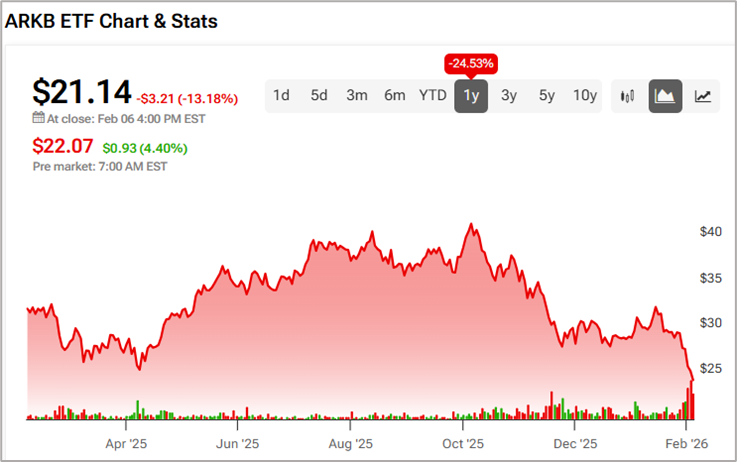
ARK 21Shares Bitcoin ETF is also categorized under pair-focused ETFs, standing out in the “In Specie niche,” and providing investors with a sophisticated avenue to capitalize on Bitcoin’s potential upside while hedging against the depreciation of the U.S. Dollar.
ARKB has a high trading volume of 15.89 million, but a comparatively lower expense ratio of 0.21%. ARKB’s AUM stands at $2.72 billion.
Copyright © 2026, TipRanks. All rights reserved.
Disclaimer: The content of this article solely reflects the author's opinion and does not represent the platform in any capacity. This article is not intended to serve as a reference for making investment decisions.
You may also like
Goldman Sachs 2027 Macro Outlook: Global Economy to Accelerate Slightly, but the Path Remains Rocky and Downside Risks Cannot Be Ignored
Goldman Sachs expects global GDP growth to rise from 2.7% in 2026 to 2.8% in 2027, with energy price shocks shifting from a headwind to a tailwind, and AI investment remaining the main growth driver. The three major downside risks stem from energy impacts related to the Iran situation, the bond market, and the AI cycle. Annual inflation is expected to decline, though upside risks persist. The Federal Reserve is projected to raise rates once each in December and March 2027, while the European Central Bank is expected to begin rate cuts in December 2027 and Q4, respectively. Both equities and bonds are expected to generate positive returns in 2027, though volatility risks are increasing, and returns on commodities are expected to be close to zero.

AI Cloud Service Provider Nscale Sees Surging Debt Before IPO, Increasing Dependence on Nvidia (NVDA.US) for Funding and Chip Supply
In its latest regulatory filing submitted prior to its initial public offering, Nscale disclosed that the company's debt level has risen significantly, and it will need to raise substantial funds in the future to fulfill customer contracts. Additionally, Nscale's dependence on Nvidia is higher than previously disclosed.
Besent and Federal Reserve Officials Clash: Is Inflation Caused by Energy Shocks or Overheated Demand? Debate Intensifies Over Fed Rate Hike Path
U.S. Treasury Secretary Besent believes the current inflation primarily stems from energy supply shocks triggered by the Iran war, and considers the current inflation data to be essentially "noise," stating that the Federal Reserve should not raise interest rates because of it. However, Chicago Federal Reserve President Goolsbee argues that inflation has now spread to sectors including services and healthcare, and warns that the risk of overheated demand cannot be ignored, indicating that the Federal Reserve still needs to take action.
Flare Extends Its Data Infrastructure to LayerZero With New DVN

Crypto prices
More


