
The Fed does not lower rates… The dollar plunges

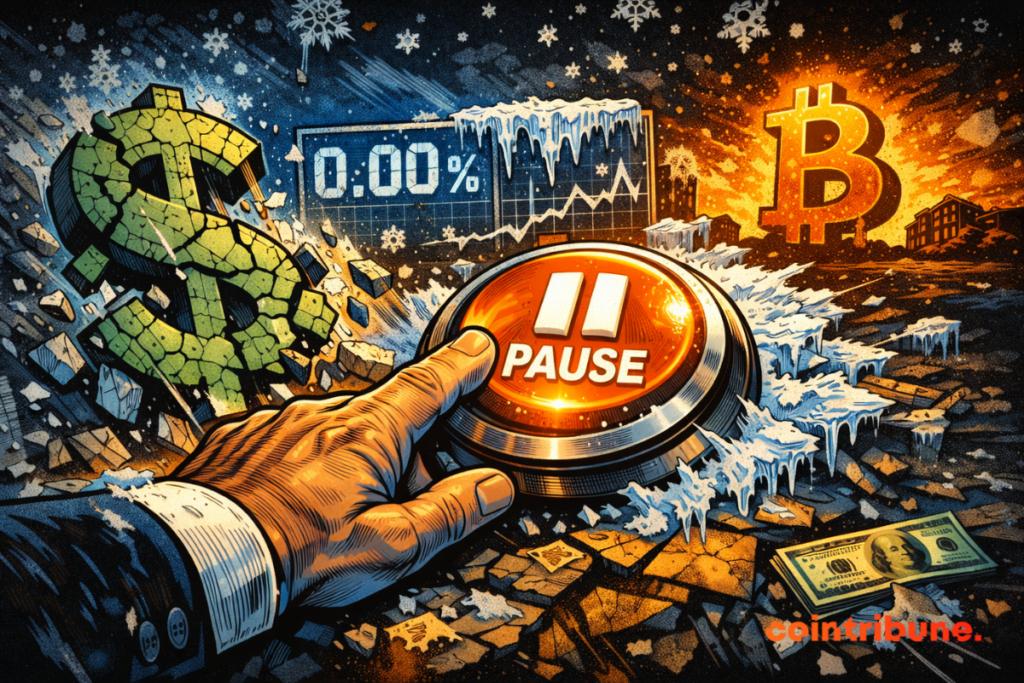
The dollar, once a symbol of stability and a pillar of the global economy, is faltering. Yet, neither Beijing nor Moscow is largely to blame this time. The fragility has settled in Washington. Between hesitant decisions by the Federal Reserve and political calculations of the White House, the monetary balance is cracking. The pause decided by the Fed has opened a breach: that of a market now operating without it. And into this gap, speculation, gold, and even bitcoin rush in.
In brief
- The Fed decided to keep its key rates unchanged despite political pressures.
- The Fed decided to keep its key rates unchanged despite political pressures.
- Analysts observe an inverse correlation between the strength of the dollar and the bitcoin price.
- Trump says he is satisfied with the dollar, but markets fear a new prolonged weakening.
The Fed presses “pause”, but the market keeps running
The Federal Reserve kept its key rates between 3.5% and 3.75%, the first pause since last July. Jerome Powell invokes a “data-dependent” approach, preferring to observe before acting. Yet this status quo masks a split: Stephen Miran and Christopher Waller voted for an additional cut.
But the earthquake comes from elsewhere. While the Fed delays, the dollar falls apart. After a disastrous 2025, it reaches its lowest level in four years. A phrase from Donald Trump, dropped offhandedly, was enough to intensify the fall: “The value of the dollar is excellent“.
This message immediately made the currency slip. For David Ingles, from Bloomberg TV:
President Trump might, in practice, be lowering rates instead of the Fed, by letting the dollar slide.
The market acts as if monetary easing had already begun.
The economy reacts: a weak dollar, wavering confidence
Far from press releases, the impact is felt in the real economy. Growth remains solid and unemployment stable at 4.4%, but household confidence drops to its lowest level since 2014. The weakening of the dollar, perceived as a political choice, increases uncertainty.
A weak dollar makes exports more competitive, but raises import prices and sustains inflation. This double effect puts the Fed in an untenable position. Jerome Powell acknowledged it:
If people lose faith that we make our decisions solely based on our assessment of what is best for the public as a whole, rather than favoring one group or another, it will be difficult to preserve that independence.
In this context, safe havens soar: gold reaches $5,350 per ounce, silver rises by 10%. These increases reflect a loss of confidence in institutions. And when investors doubt central banks, they turn to bitcoin.
The dollar wavers, bitcoin regains its role as a free asset
The weakness of the dollar acts like hidden monetary easing. As monetary policy weakens, the crypto-sphere comes back to life. Bitcoin, in particular, regains its role as a free asset: it trades around $88,000, a symbol of renewed confidence.
Analysts at Global Macro Investor remind us that “a strong dollar is a bludgeon for risk assets“. Conversely, its decline favors the return of cryptos to portfolios. This inverse correlation between the DXY and BTC asserts itself again: when the currency falls, bitcoin thrives.
In a world where markets doubt the Fed, bitcoin becomes a thermometer of economic credibility. It obeys no bank but perfectly reflects global investors’ confidence.
Key figures and facts to remember
- Fed rates: 3.5% – 3.75%;
- Dollar: lowest in 4 years, -10% in 2025;
- Gold: historic record at $5,350 per ounce;
- Bitcoin price (BTC): $88,046 at the time of writing.
The Fed delays, but markets emancipate themselves. The dollar wobbles, confidence erodes, and bitcoin regains its place as an alternative asset. An analyst already mentions an unprecedented seasonality for the queen of cryptos — proof that the global economy, more than ever, is seeking new landmarks.
Maximize your Cointribune experience with our "Read to Earn" program! For every article you read, earn points and access exclusive rewards. Sign up now and start earning benefits.
Disclaimer: The content of this article solely reflects the author's opinion and does not represent the platform in any capacity. This article is not intended to serve as a reference for making investment decisions.
You may also like
Cisco (CSCO.US) Q1 revenue up 24%, strongest in 15 years; AI infrastructure revenue expected to double to $9 billion, shares surged over 8% after hours
Network equipment giant Cisco released its financial report for the first quarter of fiscal year 2027 after the US market closed on November 12, with both revenue and profit exceeding expectations, and raised its full-year guidance.
A Record 27 Trillion Yen Intervention Fails as Yen Once Again Approaches 160: The Tug-of-War Dilemma for the World's Most Difficult Currency to Trade
In recent months, the exchange rate has remained tightly anchored within a narrow range around 1 USD to 158 JPY. However, on Wednesday, it broke through again: unexpectedly for traders, the yen weakened and approached the 160 mark.
Overnight US Stocks | The Three Major Indices Closed Lower, Nvidia (NVDA.US) Closed Down 4.3%
At the close, the Dow Jones Industrial Average fell by 189.40 points, or 0.36%, to 52,297.09 points. The S&P 500 Index declined by 26.98 points, or 0.35%, to 7,592.40 points. The Nasdaq Composite Index dropped 100.10 points, or 0.39%, to 25,366.09 points.
Tim Draper predicts Bitcoin will integrate altcoin innovations, boost market dominance

Crypto prices
More


