
The weakening of the US dollar may not be a mild adjustment, but a global repricing of risk.

Hello everyone, this is You Dou.
Recently, the US Dollar Index has continued to fall, reaching its lowest point since early 2022.
At the market level, the term "weak dollar" is being discussed with increasing frequency, and is even being regarded as a policy direction favorable to the US economy and manufacturing sector.
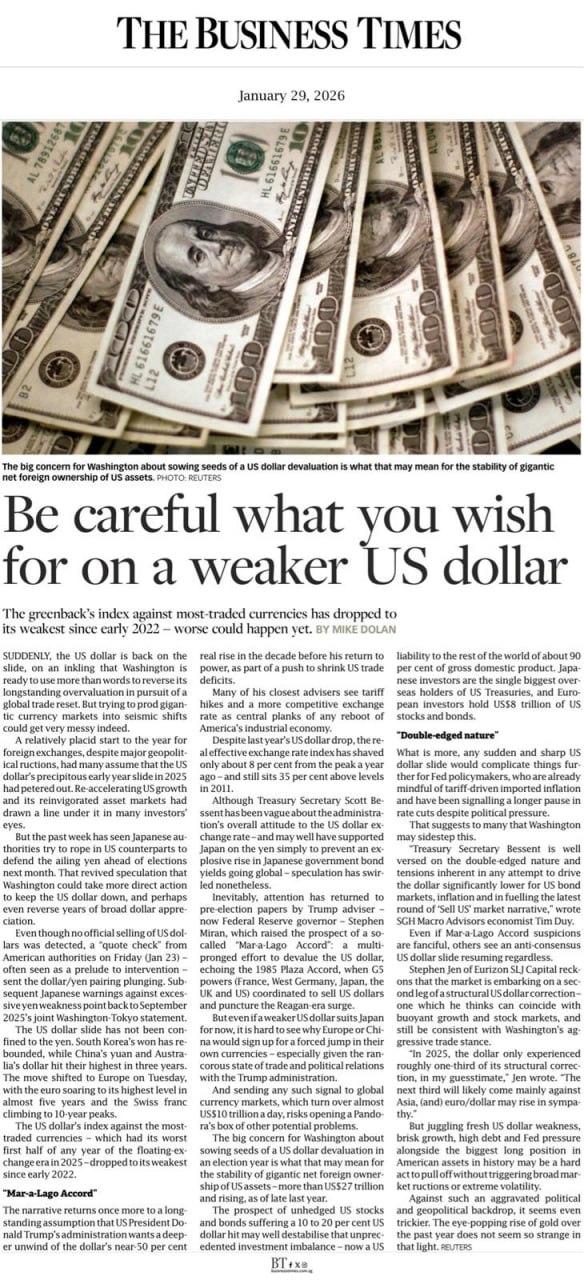
However, an opinion article in The Business Times on January 29 presented a much more cautious and long-term perspective:
The weakening of the dollar itself is not frightening; what is truly worth being vigilant about is the dollar weakening in an "out-of-control" manner.
This is not a simple exchange rate commentary, but rather a reminder about the stability of the global financial system.
I. Why has the market suddenly started to seriously discuss the "weak dollar"?
On the surface, there are real reasons behind the weakening dollar:
The US Dollar Index has fallen from its highs
US fiscal deficits and debt pressures continue to rise
The market is reassessing the relative advantages of the US economy
However, the article points out that the key to recent changes in market sentiment is not just the data itself, but the change in narrative.
In Washington policy circles, a term called "Mar-a-Lago Accord" is being repeatedly mentioned. This term alludes to the "Plaza Accord" of 1985, with the core logic as follows:
Guidance or implicit coordination through policy
Promoting a systematic weakening of the dollar
Improving US export competitiveness and alleviating structural imbalances
The article particularly emphasizes:
The point is not whether this plan will actually be implemented, but that the market has already started trading on this possibility.
II. The dollar is not an ordinary currency—this is the core of the issue
The article repeatedly emphasizes a basic fact:
The dollar is not just America's own currency, but the anchor of the global financial system.
Several key figures are worth confirming repeatedly:
The dollar still accounts for about 60% of global foreign exchange reserves
Foreign investors hold:
About $8 trillion in US Treasury bonds
About $9 trillion in US stocks and bond assets
What does this mean?
Changes in the dollar are not just internal adjustments within the US, but simultaneous changes to global balance sheets.
Once there is a significant and rapid depreciation of the dollar, the impact is not limited to US exporters, but extends to the stability expectations of the entire international capital system.
III. The real risk is not a "slow weakening"
The article does not deny:
A moderate and orderly adjustment of the dollar is not necessarily a bad thing in itself.
But what the author truly worries about is another scenario:
The dollar falls too quickly
With an obvious policy signal
Triggering overseas investors to reassess the safety of dollar assets
In this scenario, potential consequences include:
A reduction in overseas funds allocated to US Treasuries
An involuntary rise in US financing costs
A tightening of financial conditions instead
Further compression of policy space
The article offers a very critical reminder:
The "weak dollar" you hope for may appear in the way you least wish to see.
IV. The "double-edged sword" effect of a weak dollar
The article clearly defines the impact of a weak dollar as a "double-edged sword".
Short-term potential benefits:
Improved export competitiveness
Increased overseas profits for multinational companies when converted back to dollars
Apparent benefits for manufacturing
But the costs are equally clear:
Rising imported inflationary pressures
Reduced room for Federal Reserve rate cuts
Increased volatility in financial markets
Policy credibility faces a test
The article points out that if the weak dollar is regarded as a policy tool rather than a market outcome, its long-term side effects may far outweigh the short-term gains.
V. Why is this particular moment especially sensitive?
The author specifically mentions that the current context is not the same as any previous dollar adjustments in history:
US politics is highly polarized
Fiscal conditions are more fragile than in the past
The global trust in the dollar system is less solid than it was ten years ago
In this environment, once the market begins to question whether the US is still willing to assume the role of "system maintainer", the risk is no longer at the exchange rate level, but becomes institutional.
The dollar is not a policy variable that can be easily "rebalanced", but a global public good.
For investors, it is more important not to bet on the "weak dollar trade", but to observe:
Is the weakening of the dollar moderate and controllable?
Is it accompanied by a systemic withdrawal of overseas funds?
Is it beginning to affect the US's own financing capabilities?
If the dollar is only undergoing a cyclical decline, that is an adjustment;
If the dollar begins to waver in its role as a global anchor, that is the real source of risk.
Disclaimer: The content of this article solely reflects the author's opinion and does not represent the platform in any capacity. This article is not intended to serve as a reference for making investment decisions.
You may also like
Cisco Q1 revenue grows 24% year-on-year, fastest in over 15 years, AI infrastructure income expected to double|Earnings Report Highlights
Cisco's first-quarter revenue reached $18.5 billion, with adjusted earnings per share at $1.40, both exceeding market expectations. The company raised its full-year revenue guidance to $74.8 billion-$75.8 billion, and expects AI infrastructure revenue to reach $9 billion this fiscal year, doubling from the previous year. The CEO stated that the company is in the early stages of a multi-year networking supercycle.
Jensen Huang has left, what will happen to the $500 billion financing platform? The "trust fulcrum" of Nvidia (NVDA.US) AI credit platform is collapsing
Nvidia's $500 billion AI financing platform has seen no deals materialize for several months, as clients are requesting a 25% increase in the guaranteed ratio.
Cisco (CSCO.US) Q1 revenue up 24%, strongest in 15 years; AI infrastructure revenue expected to double to $9 billion, shares surged over 8% after hours
Network equipment giant Cisco released its financial report for the first quarter of fiscal year 2027 after the US market closed on November 12, with both revenue and profit exceeding expectations, and raised its full-year guidance.
A Record 27 Trillion Yen Intervention Fails as Yen Once Again Approaches 160: The Tug-of-War Dilemma for the World's Most Difficult Currency to Trade
In recent months, the exchange rate has remained tightly anchored within a narrow range around 1 USD to 158 JPY. However, on Wednesday, it broke through again: unexpectedly for traders, the yen weakened and approached the 160 mark.
Crypto prices
More


