
Crypto ETF capital outflows: Can issuers like BlackRock still make money?

BlackRock's crypto ETF fee revenue fell by 38%, indicating that the ETF business is not immune to market cycles.
BlackRock crypto ETF fee income drops 38%, ETF business cannot escape market cycle curse.
Written by: Prathik Desai
Translated by: Luffy, Foresight News
In the first two weeks of October 2025, bitcoin spot ETFs attracted $3.2 billion and $2.7 billion in inflows, setting the highest and fifth-highest single-week net inflow records for 2025.
Prior to this, bitcoin ETFs were expected to achieve a "no consecutive weeks of net outflows" record in the second half of 2025.
However, the most severe crypto liquidation event in history occurred unexpectedly. This $19 billion asset evaporation still haunts the crypto market.
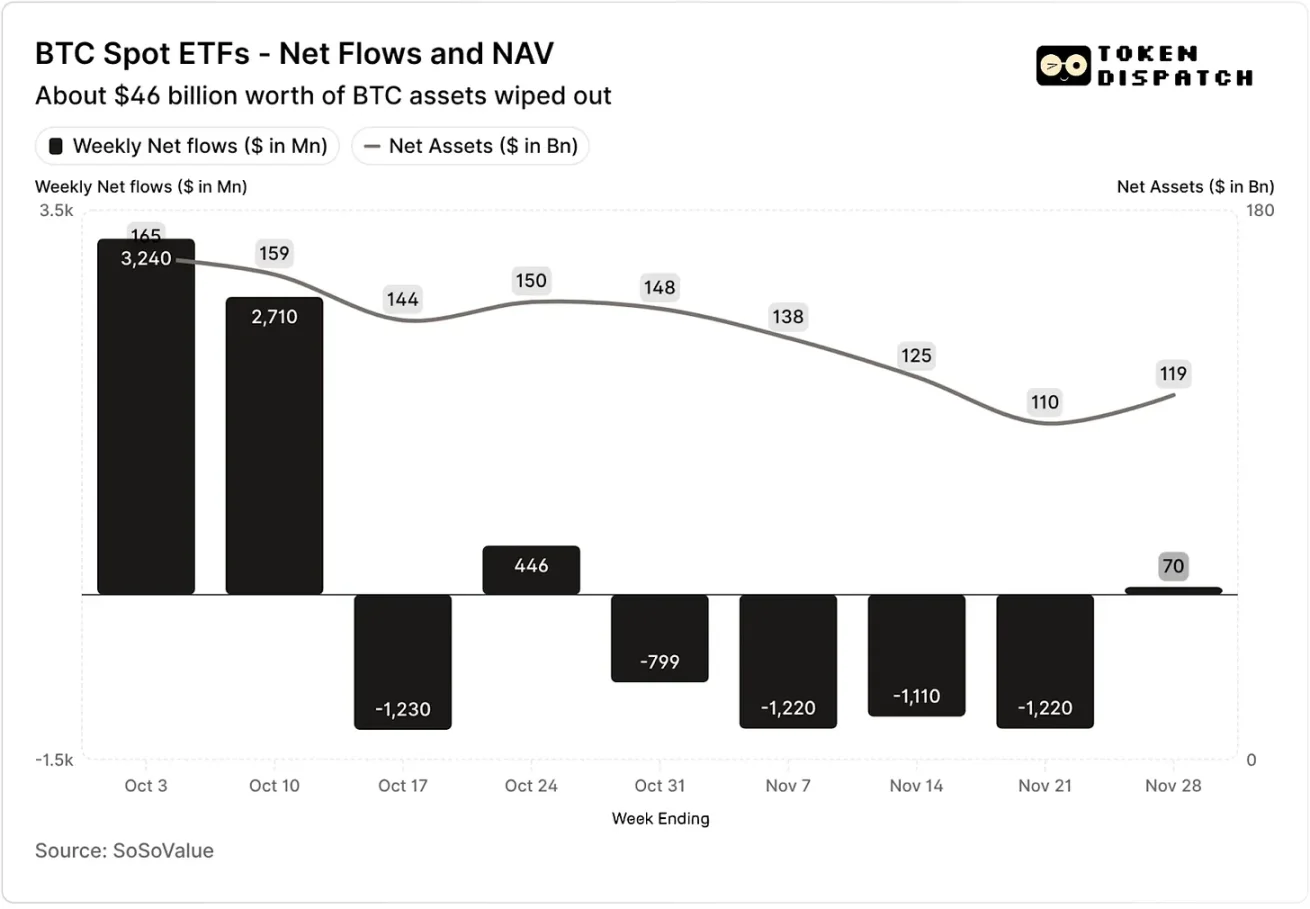
October and November, bitcoin spot ETF net inflows and net asset value
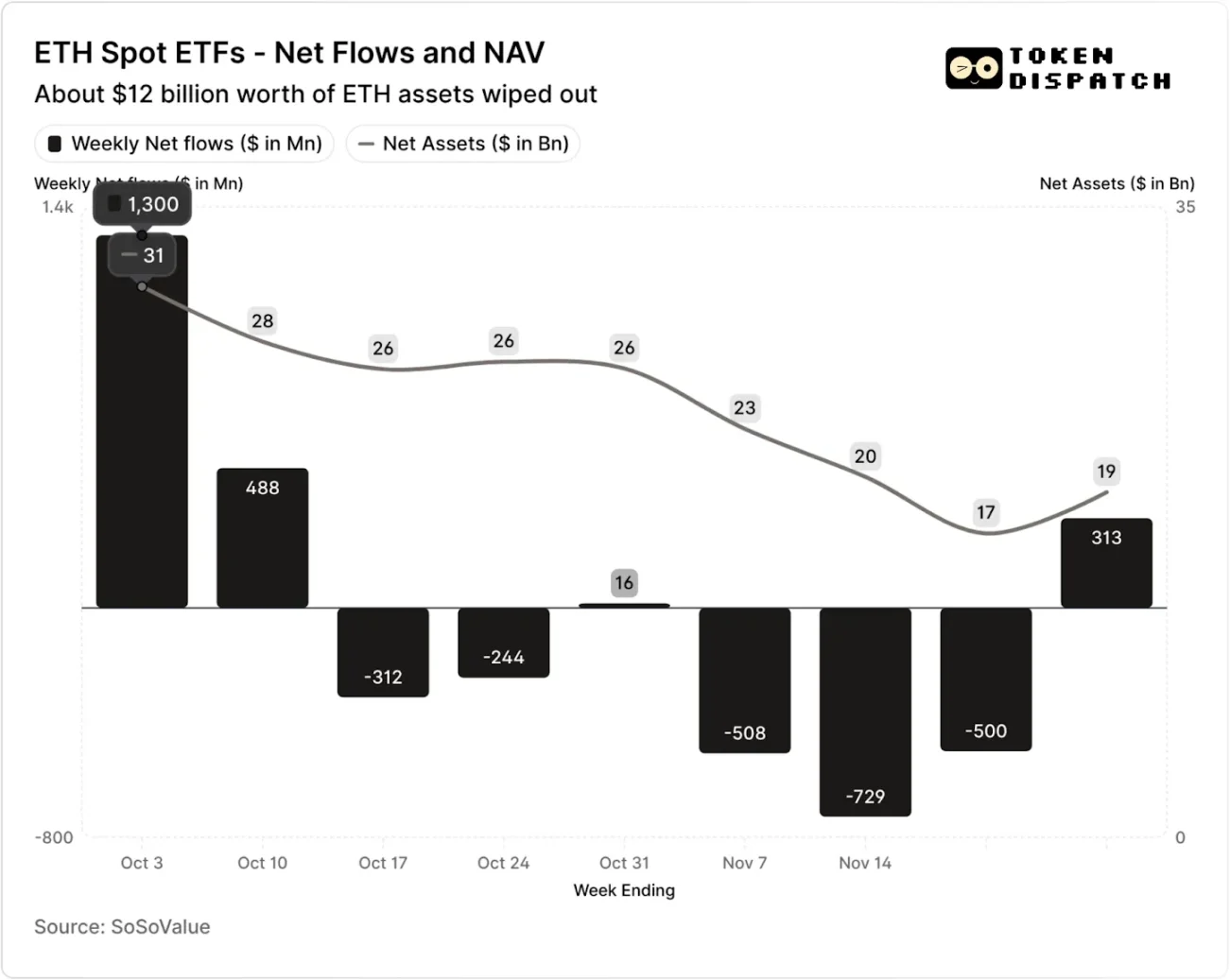
October and November, ethereum spot ETF net inflows and net asset value
But in the seven weeks following the liquidation event, bitcoin and ethereum ETFs saw outflows in five weeks, totaling over $5 billion and $2 billion, respectively.
As of the week ending November 21, the net asset value (NAV) managed by bitcoin ETF issuers shrank from about $164.5 billion to $110.1 billion; ethereum ETF NAV was nearly halved, dropping from $30.6 billion to $16.9 billion. This decline was partly due to the drop in bitcoin and ethereum prices themselves, as well as some tokens being redeemed. In less than two months, the combined NAV of bitcoin and ethereum ETFs evaporated by about one-third.
The decline in fund flows reflects not only investor sentiment but also directly affects ETF issuers' fee income.
Bitcoin and ethereum spot ETFs are "money printers" for issuers such as BlackRock, Fidelity, Grayscale, and Bitwise. Each fund charges fees based on the scale of assets held, usually announced as an annual rate but actually accrued daily based on NAV.
Every day, trust funds holding bitcoin or ethereum shares sell part of their holdings to pay fees and other operating expenses. For issuers, this means their annual revenue is roughly equal to assets under management (AUM) multiplied by the fee rate; for holders, this means the number of tokens they hold is gradually diluted over time.
ETF issuer fee rates range from 0.15% to 2.50%.
Redemptions or outflows themselves do not directly cause issuers to profit or lose, but outflows will ultimately reduce the scale of assets managed by issuers, thereby reducing the asset base from which fees can be collected.
On October 3, the total assets managed by bitcoin and ethereum ETF issuers reached $195 billion. Combined with the above fee rates, the fee pool was considerable. But by November 21, the remaining asset scale of these products was only about $127 billion.
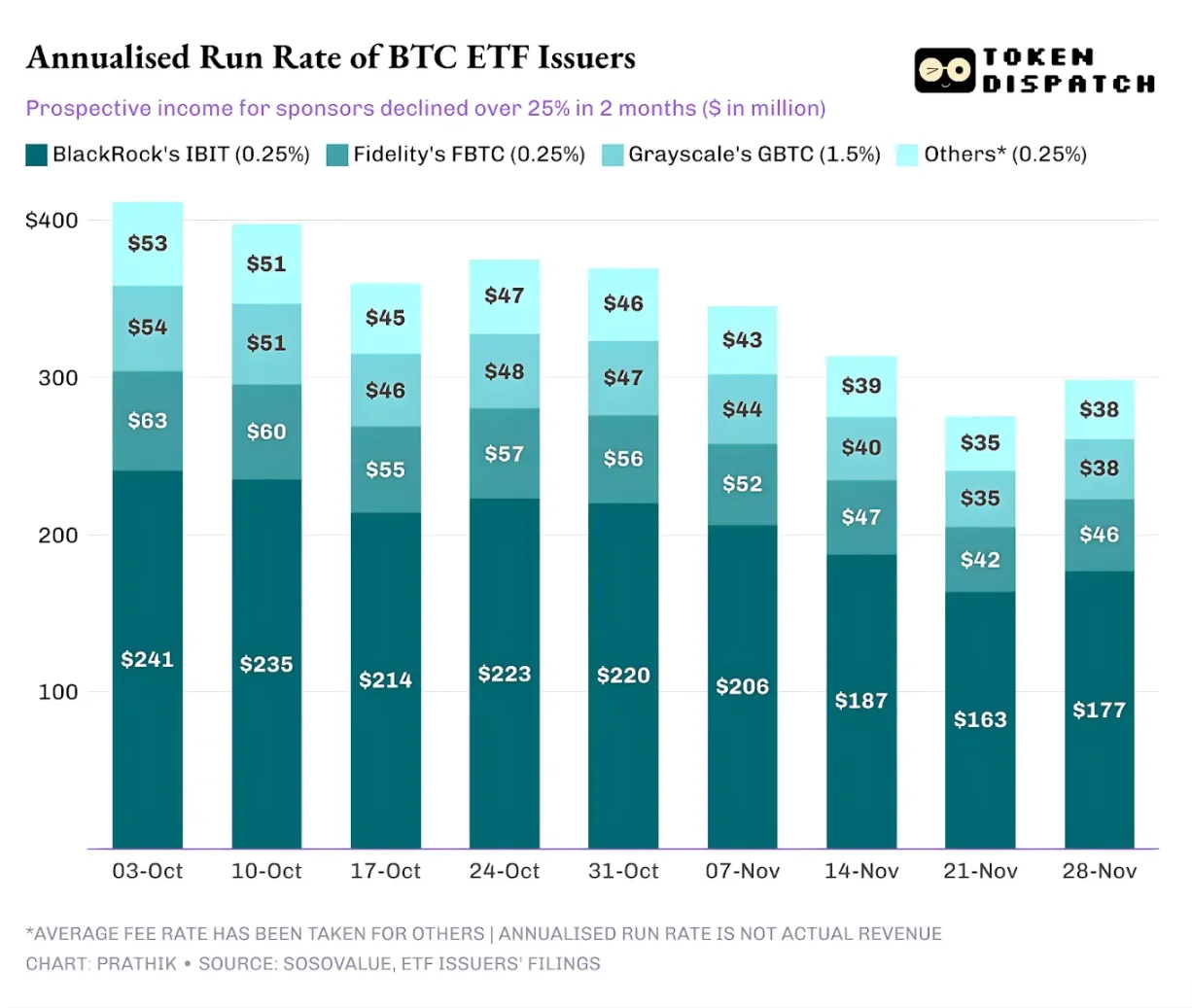
If annualized fee income is calculated based on weekend AUM, in the past two months, the potential income of bitcoin ETFs dropped by more than 25%; ethereum ETF issuers were hit even harder, with annualized revenue over the past nine weeks down 35%.
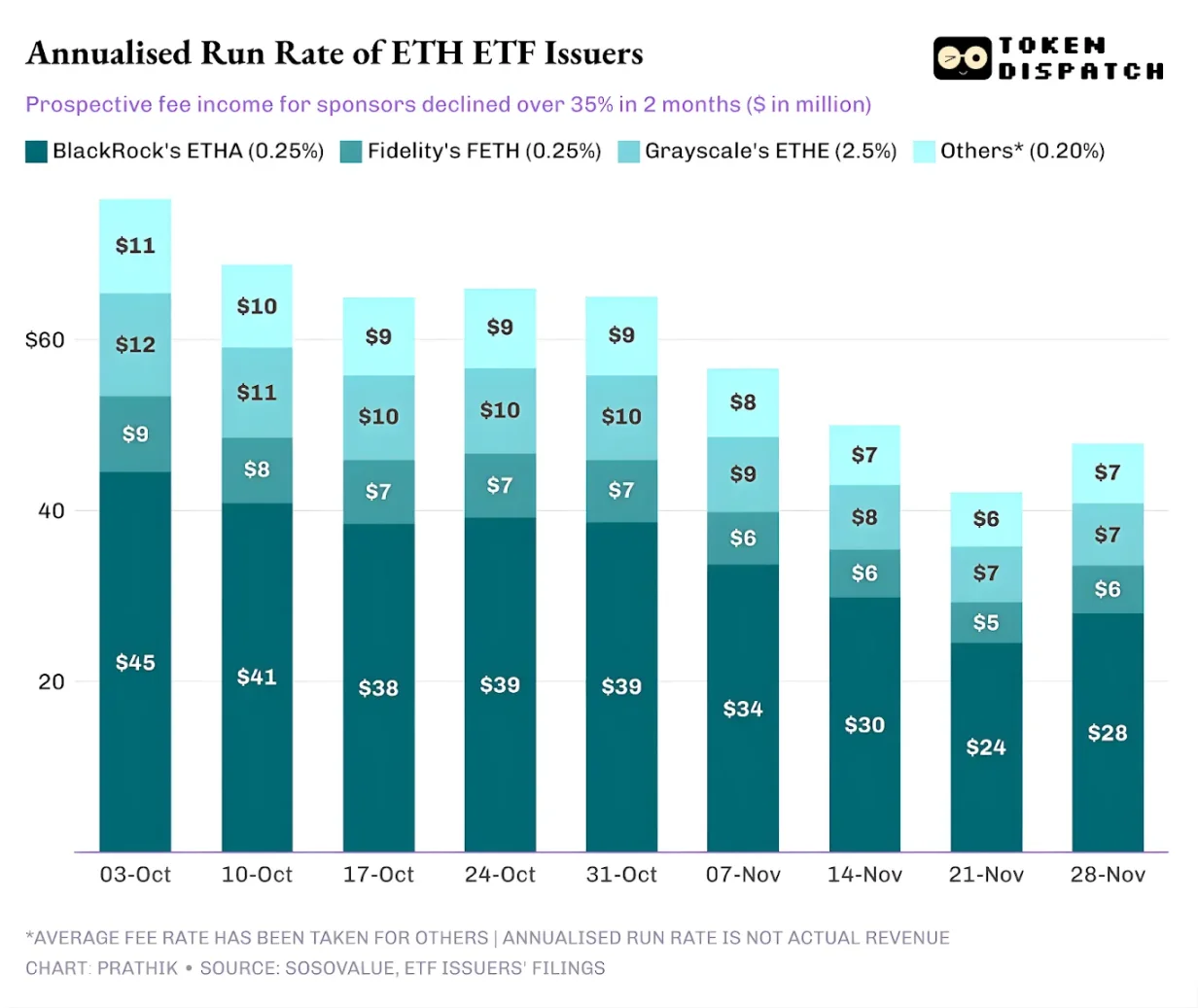
The larger the issuance scale, the harder the fall
From the perspective of a single issuer, the flow of funds shows three slightly different trends.
For BlackRock, its business features both "scale effect" and "cyclical fluctuations." Its IBIT and ETHA have become the default choices for mainstream investors to allocate bitcoin and ethereum through ETFs. This allows the world's largest asset manager to charge a 0.25% fee based on a huge asset base, especially when AUM hit record highs in early October, resulting in very lucrative returns. But this also means that when large holders chose to reduce risk in November, IBIT and ETHA became the most direct targets for selling.
The data is convincing: BlackRock's bitcoin and ethereum ETF annualized fee income dropped by 28% and 38%, respectively, both exceeding the industry average declines of 25% and 35%.
Fidelity's situation is similar to BlackRock's, just on a smaller scale. Its FBTC and FETH funds also followed the "inflow first, outflow later" rhythm, with October's market enthusiasm eventually replaced by November's outflows.
Grayscale's story is more about "historical legacy issues." Once upon a time, GBTC and ETHE were the only large-scale channels for many U.S. investors to allocate bitcoin and ethereum through brokerage accounts. But as BlackRock, Fidelity, and other institutions took the lead in the market, Grayscale's monopoly no longer exists. To make matters worse, the high fee structure of its early products has led to continued outflow pressure over the past two years.
The market performance in October and November also confirms this investor tendency: when the market is good, funds shift to lower-fee products; when the market weakens, holdings are comprehensively reduced.
The fee rates of Grayscale's early crypto products are 6-10 times those of low-cost ETFs. Although high fees can boost revenue figures, the high expense ratio continues to drive away investors, shrinking the asset base from which fees are earned. The remaining funds are often constrained by frictional costs such as taxes, investment mandates, and operational processes, rather than active investor choice; and every outflow reminds the market: once a better option is available, more holders will abandon high-fee products.
These ETF data reveal several key features of the current institutionalization process of cryptocurrencies.
The spot ETF market in October and November shows that crypto ETF management businesses are as cyclical as the underlying asset markets. When asset prices rise and market news is positive, inflows push up fee income; but once the macro environment changes, funds quickly withdraw.
Although large issuers have built efficient "fee channels" on bitcoin and ethereum assets, the volatility in October and November proves that these channels are also subject to market cycles. For issuers, the core issue is how to retain assets during a new round of market shocks and avoid large fluctuations in fee income as macro trends change.
Although issuers cannot prevent investors from redeeming shares during a sell-off, income-generating products can cushion downside risks to some extent.
Covered call option ETFs can provide investors with premium income (Note: A covered call option is an options investment strategy in which an investor sells call option contracts while holding the underlying asset. By collecting premiums, this strategy aims to enhance portfolio returns or hedge some risks.), offsetting part of the price decline of the underlying asset; staking products are also a feasible direction. However, such products must first pass regulatory review before they can be officially launched.
Disclaimer: The content of this article solely reflects the author's opinion and does not represent the platform in any capacity. This article is not intended to serve as a reference for making investment decisions.
You may also like
Bitcoin’s MA200 at $73,200 — Inverse H&S Neckline Is the Only Level Left

Bitcoin Supply Velocity Hits 10-Year Low as ETH Supply Diverges

Just bet on AI and already faced a market blow! Berkshire reports earnings tonight, Abel faces a major test in his transformation
Greg Abel has been leading Berkshire Hathaway for less than a year, yet he has already made a bet of over $10.9 billion on the AI sector, marking a complete break from Buffett’s traditional avoidance of tech stocks. However, Alphabet’s stock price has fallen below their initial purchase cost, and Bending Spoons continues to decline, putting this bold AI gamble to the test. At the same time, third-quarter earnings per share are expected to drop 6% year-over-year, and the share repurchase program is likely to plummet from $4.5 billion to $1.6 billion. How to deploy $358 billion in cash will be a major challenge for the new leader’s capital allocation skills.

Has the AI bubble burst? Goldman Sachs: It's more like 1998 than 2000 right now
The Goldman Sachs trading desk stated that the current wave of sell-offs resembles the 1998 liquidity crisis more than the bursting of the 2000 bubble. It is a forced deleveraging rather than a refutation of business fundamentals. The market is drastically repricing construction financing and timeline expectations, rather than underlying demand. Moreover, the issues currently drawing the most attention from the market—electricity and licensing—are actually the least important, as limited supply does not equate to disappearing demand. The real question that needs to be answered is whether long-term revenues can ultimately justify the capital invested.

Crypto prices
More


