
Czech Bank Tests Crypto Assets In Pilot Program

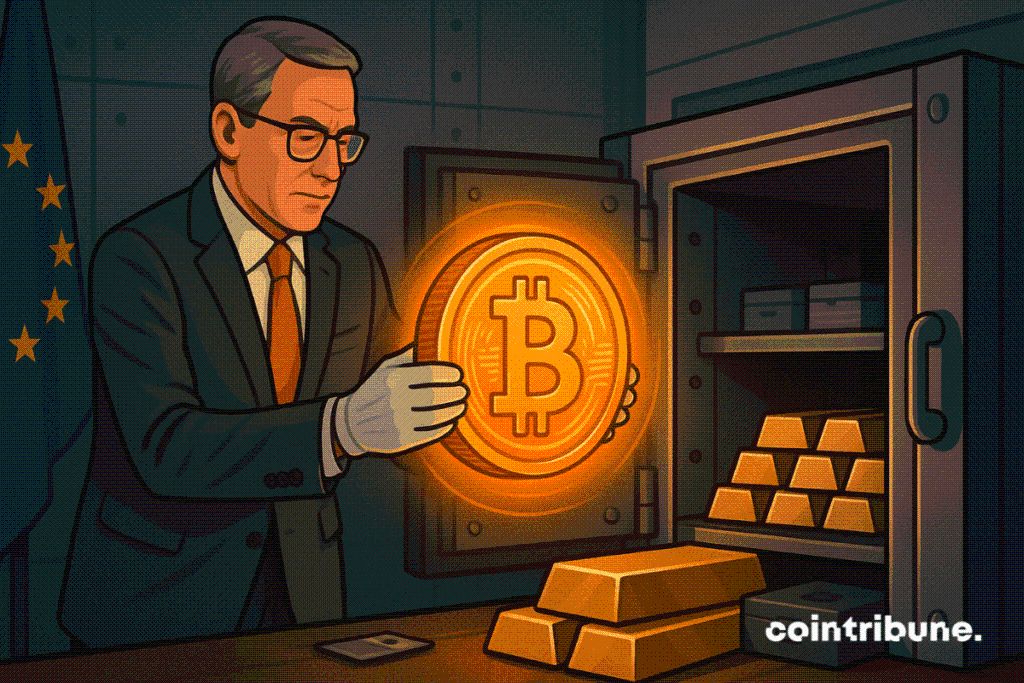
The Czech National Bank has just reached an unprecedented milestone: the purchase of 1 million dollars in cryptos, including bitcoin. This is a first for a European central bank, at a time when many institutions remain cautious about cryptos. Behind this symbolic amount, it is a strong declaration of intent because the country wants to understand and test the future of finance. A discreet gesture, but one that could well announce a turning point in monetary policies in the era of these assets.
In Brief
- The Czech National Bank makes a historic purchase of 1 million dollars in cryptos, including Bitcoin.
- This test aims to gain practical experience in managing cryptocurrencies, without signaling immediate adoption.
- The experimental portfolio includes three types of assets: Bitcoin, a dollar-backed stablecoin, and a tokenized bank deposit.
- This project is part of the CNB Lab, an innovation program dedicated to blockchain and financial technologies.
A first regulated, cautious but unprecedented crypto acquisition
While crypto treasuries are evolving , the Czech National Bank (CNB) officially announced on Thursday, November 7, 2025, the purchase of cryptos worth 1 million dollars as part of a testing phase.
The institution specifies that this initiative aims to gain “practical experience” in crypto management, without signaling an immediate change in monetary policy. The experimental portfolio established by the CNB includes Bitcoin, a US dollar-backed stablecoin, and a tokenized bank deposit.
The bank governor, Aleš Michl, highlighted the symbolic and forward-looking scope of the operation: “it is realistic to imagine that one day, one could buy tokenized Czech bonds or a coffee with a simple digital transaction”. This statement places this approach within a long-term vision of the monetary system’s evolution.
Such experimentation is part of the broader CNB Lab program, an innovation structure launched by the bank to study the uses of blockchain and other emerging financial technologies. Far from limiting itself to bitcoin, this initiative aims to equip the central bank to face structural transformations of the sector. Here is exactly what this test portfolio contains :
- Bitcoin (BTC) : chosen for its diversification potential and low correlation with traditional assets, notably bonds ;
- A US dollar-backed stablecoin : used to assess stability dynamics in digital transactions ;
- A tokenized bank deposit: included to observe the tokenization mechanisms of classic banking assets.
By creating this portfolio, the CNB is not looking for immediate returns but is preparing for possible international developments, notably in exchange standards or accounting practices related to cryptos. Thus, understanding these assets can no longer remain theoretical for a central bank wishing to stay competitive globally.
A broader exposure strategy, between ambition and restraint
The November crypto initiative is not the CNB’s first foray into the crypto world. Last January, Aleš Michl had proposed buying bitcoin for an amount equivalent to 5 % of the bank’s international reserves, about 7.3 billion dollars.
This bold proposal, aimed at diversifying reserves due to the zero correlation between bitcoin and bonds, was not however approved by the CNB’s board of directors.
Michl then justified his approach using portfolio logic : “bitcoin could one day be worth either zero or a colossal amount”. This stance, both realistic about risks and open about potential, illustrates a constant tension between innovation and caution within the Czech central bank.
Moreover, the CNB has also explored a form of indirect exposure to cryptos. In July, it invested in 51,732 shares of Coinbase, the American giant of crypto exchange platforms. This investment, valued at 18 million dollars at purchase, is now worth 15.7 million dollars.
Although not cryptos per se, this investment reflects a desire to integrate into the ecosystem without directly assuming the volatility of assets. By combining a technological approach (via CNB Lab), direct experimentation (with the BTC purchase), and indirect exposure (with Coinbase), the CNB is thus building an active monitoring strategy on the sector, without a sharp break from its traditional monetary doctrine.
Through these moves, the Czech National Bank shows a posture that could inspire other central banks in Europe, especially those of medium-sized countries more inclined to experimentation, while the ECB has often reaffirmed a critical position towards bitcoin . Far from a model of dollarization or adoption of the flagship crypto as legal tender, the Czech case illustrates a pragmatic approach aimed at anticipating rather than enduring upcoming changes.
Disclaimer: The content of this article solely reflects the author's opinion and does not represent the platform in any capacity. This article is not intended to serve as a reference for making investment decisions.
You may also like
Biotech Insider Trading in US Stocks Diverges: ImmunityBio (IBRX.US) Cashes Out the Most, Sellas (SLS.US) Director Bought In Before a 5x Surge
Insider trading in US-listed biotech companies shows divergence.
AI investment and consumer spending drive growth! UK Q3 GDP growth rate hits highest in two and a half years
As the widespread adoption of artificial intelligence (AI) continues to drive growth in corporate and consumer spending, and the economy demonstrates resilience in the face of an energy shock caused by the Iran war, the UK economy has achieved its fastest growth rate in two and a half years.

MSCI drops Strategy, Bitcoin eyes $70,000 as ETF outflows hit $300 million

AI servers + iPhone Duo dual engines drive, Foxconn Q3 net profit surges 34%, exceeding expectations
The financial report shows that Hon Hai's net profit for the third quarter reached TWD 77.5 billion, exceeding expectations, while revenue hit a record high of TWD 3.03 trillion. AI servers have become the primary growth engine, with the goal of capturing 50% of the global market share within two years and raising the gross margin to 10%. iPhone Duo sales are expected to reach up to 16 million units. Hon Hai Chairman Liu Yangwei stated that the shortage of memory chips and components will continue until 2027, and the performance forecasts for the company's four major product categories have been raised.
Crypto prices
More


