
Keyrock + Glassnode: Bitcoin and Ethereum as Competing Store-of-Value
In partnership with Keyrock, we examine how Bitcoin and Ethereum exhibit store-of-value traits by analysing their supply structure and usage profiles through Glassnode’s on-chain lens.
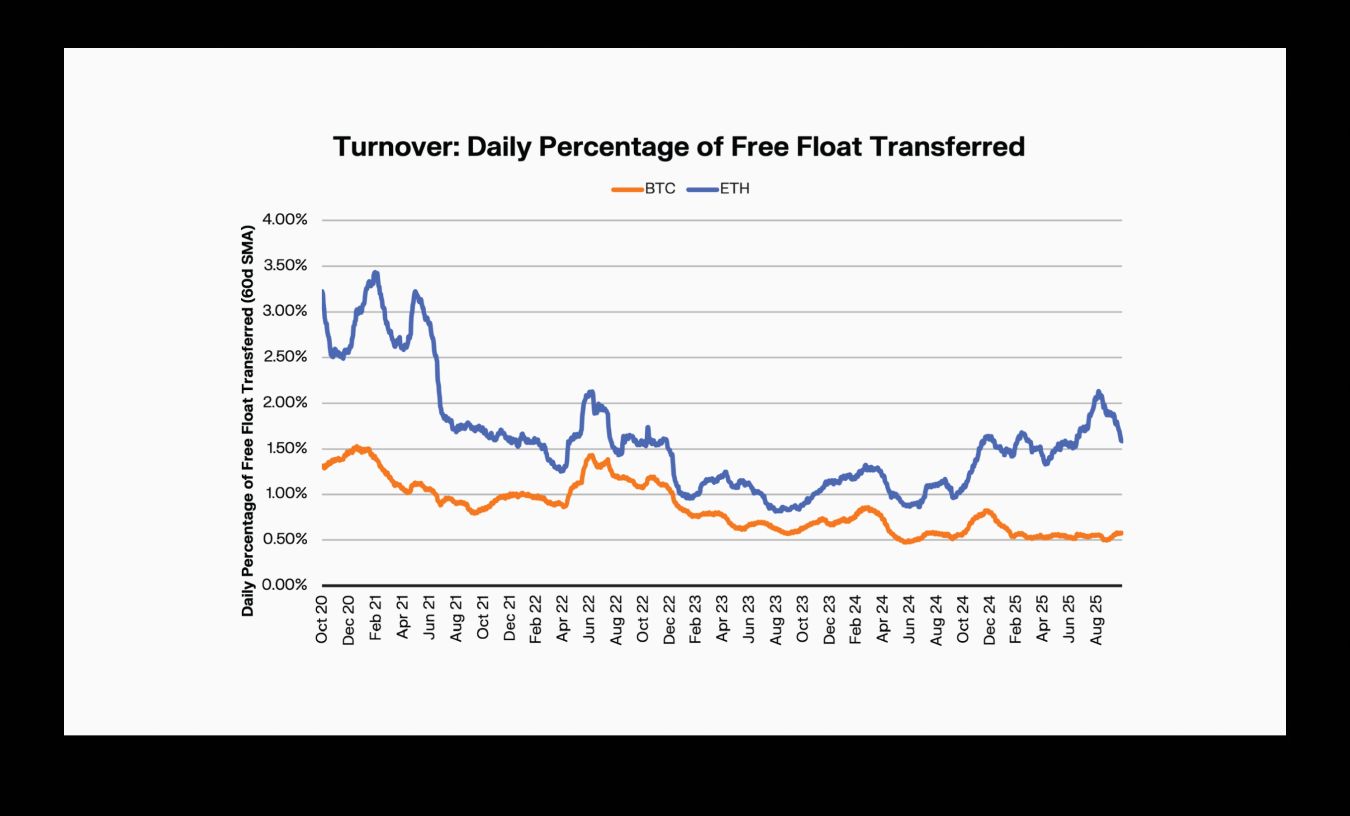
Bitcoin remains one of the lowest-velocity major assets, with over 61% of supply held dormant for more than a year. Ethereum, by contrast, rotates supply at roughly twice Bitcoin’s rate, reflecting a more active capital base. At the same time, exchange balances for both assets continue to contract, giving way to growing ETF holdings and institutional custody.
In our latest collaborative analysis with Keyrock , we unpack these shifts, examining how BTC and ETH are used today — and what that implies about their roles in the digital asset economy. Grounded in on-chain data, the report assesses where each asset sits on the Store-of-Value to Utility continuum, showing Bitcoin’s dominant savings-asset profile and Ethereum’s hybrid position as both reserve capital and working collateral within DeFi.
Key highlights from the report:
- Bitcoin diamond hands remain strong: More than 61% of supply hasn’t moved in over a year, and daily turnover sits at just 0.61%, reinforcing Bitcoin’s role as the market’s dominant store of value.
- Ethereum shows both utility and store of value behaviour: 1 out of 4 ETH is locked in native staking and ETFs. Yet it turns over at roughly twice BTC’s rate, reflecting the dual nature of ETH as a hoarded, yet productive asset.
- Dormancy between Bitcoin and Ethereum is diverging: ETH’s long-term holders are mobilising their old coins at a rate that’s 3x faster than BTC’s long-term holders, pointing to utility-driven behaviour.
- Ethereum powers the DeFi ecosystem: Around 16% of ETH supply is now deployed within liquid staking, and collateralised structures, highlighting Ethereum’s dual role as a reserve asset and working collateral underpinning DeFi.
- Exchange balances are falling as institutional wrappers expand: Exchange-held BTC has declined by ~1.5% and ETH nearly 18%, as assets move into ETFs and DATs.
Context: Behavioural Framework & Definitions
Traditional economics defines Store-of-Value (SoV) as an asset that maintains purchasing power over time and can be saved and retrieved without significant depreciation. To evaluate BTC and ETH through a “store-of-value to utility” lens, we apply a behavioural framework using core Glassnode metrics and on-chain data:
- Dormancy – how long coins are held, assessed through Average Coin Dormancy and HODL waves .
- Turnover – how frequently coins move, or percentage of circulating or free float that changes addresses per day.
- Exchange-held supply – share of circulating supply held in centralised-exchange addresses, assessed using Glassnode's entity-adjusted exchange balance metrics.
- Anchored float – supply held in slow-mobilisation wrappers (staking, institutional custody, ETFs).
- Productive float – supply deployed as collateral, in lending protocols, liquidity pools or restaked structures.
Assets exhibit store-of-value traits when they show: high dormancy, low turnover, low exchange readiness, higher anchored float, and limited productive float.
Dormancy: Bitcoin's and Ethereum's Patterns Diverge
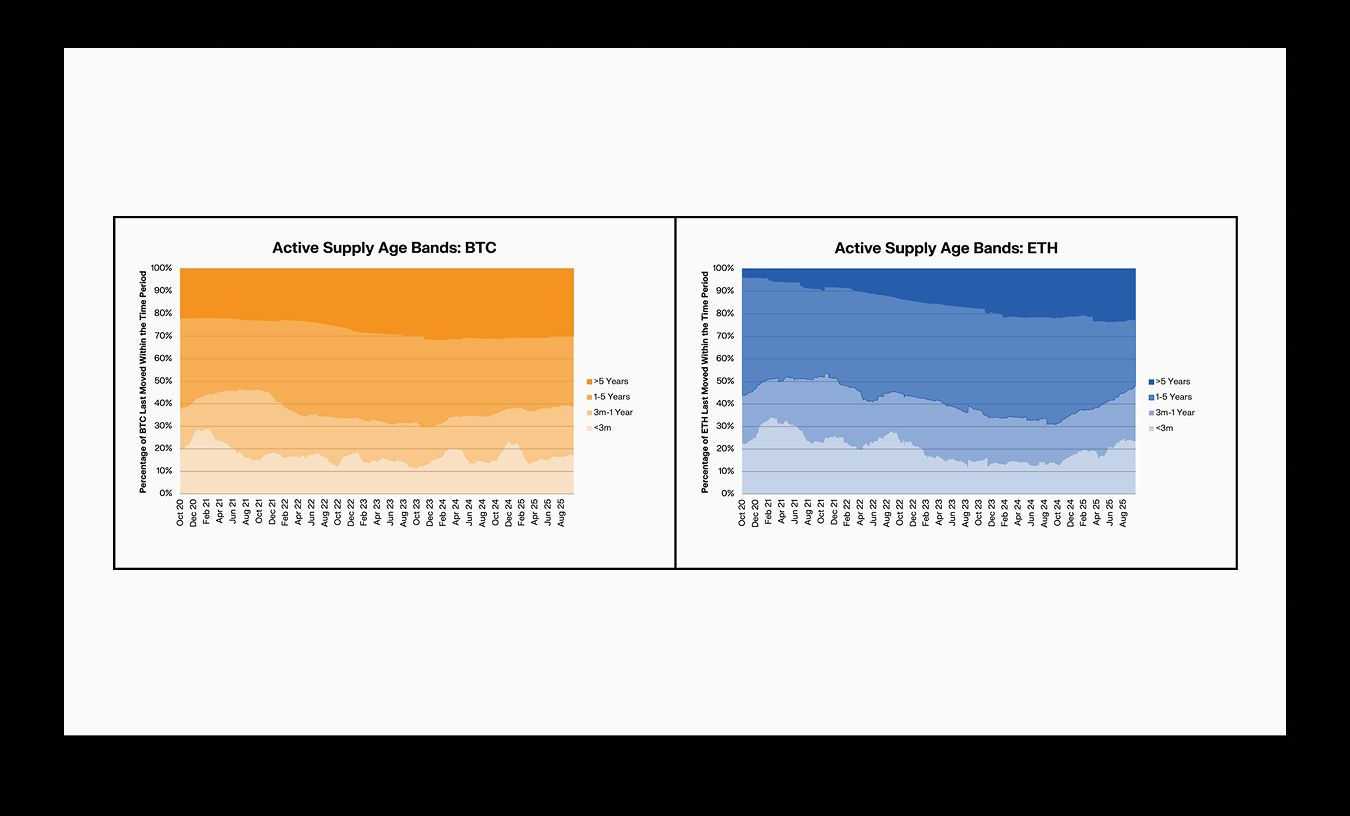
Bitcoin’s supply continues to age, while Ethereum’s supply continues to mobilise. Bitcoin’s ≥1-year supply share is stable near 61%, indicating persistent long-term holding. Average coin dormancy for BTC has doubled over the past five years, despite temporary spikes driven by isolated legacy wallet movements.
Ethereum’s ≥1-year share declined more notably — from ~56% to ~52% — and average dormancy increased sharply into late-2025. This shows that older ETH is being re-activated more frequently, consistent with staking rotations, collateral shifts, and arbitrage activity.
Ethereum: A Productive Form of Collateral
Ethereum’s supply dynamics tell a different story. Long-term holders are mobilising older coins at three times the rate of Bitcoin’s, a trend captured in age-band shifts and rising dormancy.
ETH combines SoV-like anchoring (through native staking and ETF holdings) with productive use across DeFi. A large share of ETH participates in collateralised lending, perpetuals, restaking, LST/LRT structures, and liquidity pools — making it both a reserve asset and the operational capital of the on-chain economy.
Exchange-Held Balances Decline as Institutional Wrappers Expand
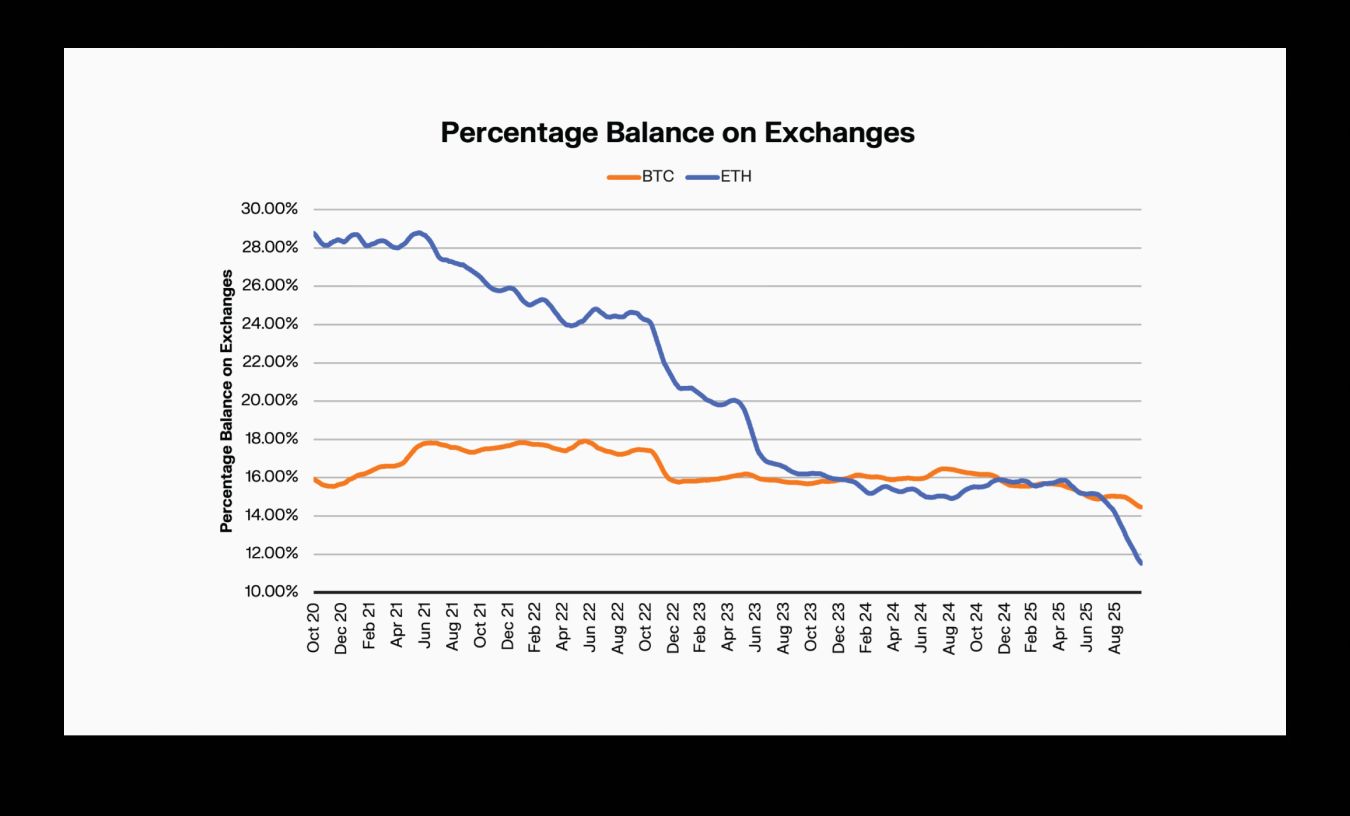
Both BTC and ETH continue to see supply migrate off centralised exchanges and into institutional wrappers and long-term custody. Exchange-linked BTC balances have declined by ~1.5%, while ETH’s exchange share has fallen sharply — from ~29% to ~11.3%.
This reduction is paired with the rise of spot ETFs and DATs. Bitcoin ETFs now hold ~6.7% of supply, with DAT structures accounting for ~3.6%. For ETH, ETFs hold ~5.2% and DATs ~4.9%. This shift reallocates supply out of highly liquid venues and into structures with slower mobilisation, narrowing effective float. For Bitcoin, this supports its low-turnover, savings-asset profile. For Ethereum, it complements its role as productive collateral.
Implications for Institutional Allocators
For institutions seeking a low-velocity, capital-preservation asset, Bitcoin remains behaviourally optimal. For entities looking for reserve exposure plus ecosystem participation, Ethereum offers a differentiated profile. Institutions modelling liquidity risk should also account for the structural migration of supply that is currently underway.
The clear divergence in usage patterns suggests that portfolio frameworks should treat Bitcoin and Ethereum as distinct exposure buckets rather than interchangeable ‘crypto’ risk. One is reserve-grade, the other is hybrid-growth.
🔗 Download your copy of the report
Disclaimer: The content of this article solely reflects the author's opinion and does not represent the platform in any capacity. This article is not intended to serve as a reference for making investment decisions.
You may also like
MSCI drops Strategy, Bitcoin eyes $70,000 as ETF outflows hit $300 million

AI servers + iPhone Duo dual engines drive, Foxconn Q3 net profit surges 34%, exceeding expectations
The financial report shows that Hon Hai's net profit for the third quarter reached TWD 77.5 billion, exceeding expectations, while revenue hit a record high of TWD 3.03 trillion. AI servers have become the primary growth engine, with the goal of capturing 50% of the global market share within two years and raising the gross margin to 10%. iPhone Duo sales are expected to reach up to 16 million units. Hon Hai Chairman Liu Yangwei stated that the shortage of memory chips and components will continue until 2027, and the performance forecasts for the company's four major product categories have been raised.
Applied Materials (AMAT): Can Earnings Extend a 24% Rebound?
With CoreWeave fueling the AI frenzy, can Nebius (NBIS.US) defend the AI computing power rally with explosive performance?
At Wednesday’s US stock market close, strong earnings reports and financing plans from CoreWeave drove collective gains in the storage chip, AI chip, optical interconnect, and new cloud sectors. CoreWeave and Nebius surged by approximately 24.7% and 15.4%, respectively. However, after the bell, media reports regarding another extramarital affair involving Jensen Huang and discussions by the board about his tenure caused Nvidia to drop more than 8%, putting pressure on the prices of most AI computing power-related stocks.

Crypto prices
More


