
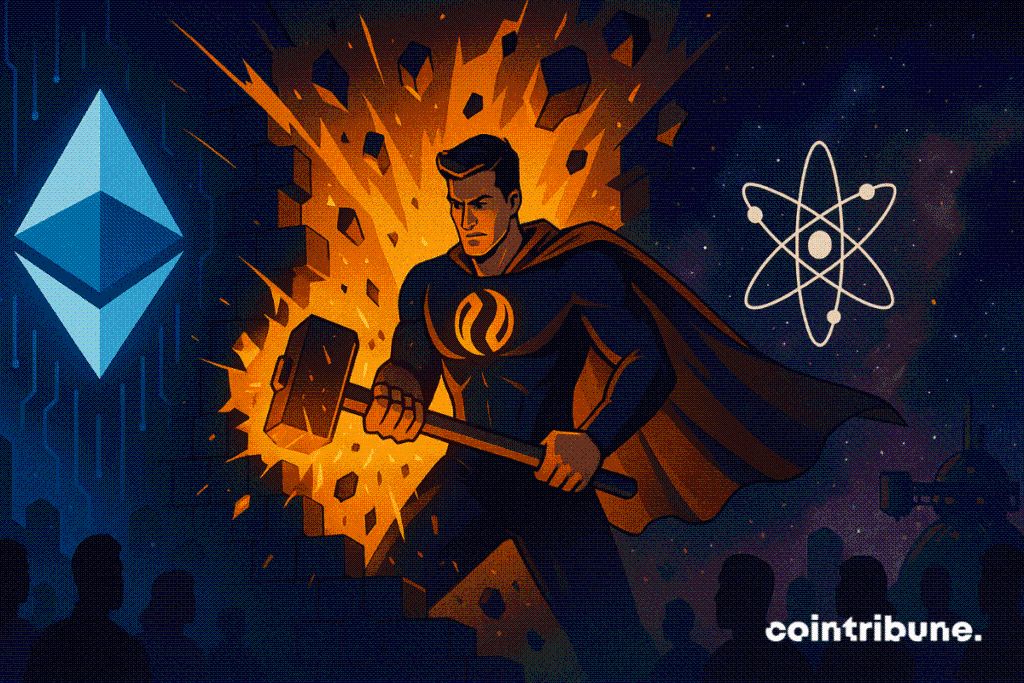
Injective breaks down walls between Ethereum and Cosmos with its EVM

Injective has just deployed its native EVM mainnet, marking a turning point in the evolution of layer 1 blockchains. This integration allows Ethereum developers to leverage the power of Cosmos without sacrificing performance. But will this technical feat be enough to reverse the downward trend of the INJ token, down more than 60%?
In brief
- Injective officially launches its native EVM mainnet on its high-performance Cosmos blockchain.
- The platform aims for a MultiVM approach unifying WebAssembly, EVM, and soon the Solana virtual machine.
- Developers benefit from full Ethereum compatibility without sacrificing the execution speed of 0.64 seconds per block.
- The architecture allows sharing liquidity and resources between different virtual machine environments.
Injective deploys native EVM support on Cosmos
Injective took a major step forward in its roadmap on Tuesday with the activation of its EVM mainnet.
Specifically, the blockchain inherited from Binance now allows developers to deploy Ethereum applications directly on its Cosmos infrastructure without any code adaptation. This technical feat creates a bridge between two previously isolated worlds.
The innovation lies in the “MultiVM” environment that Injective has been methodically building since 2023. After months of testing on its layer 2 inEVM, the team succeeded in its bet: making WebAssembly and EVM coexist on the same platform .
Developers can now choose their preferred virtual machine, with Solana’s expected soon, while sharing liquidity, resources, and modules.
This unified architecture eliminates usual frictions. “No more manual interventions between user environments“, explains the Injective team.
The MultiVM Token Standard guarantees a consistent representation of assets throughout the ecosystem, removing duplicate token versions that cause confusion. Transactions become atomic: they execute fully or are canceled, thus protecting user funds.
Performance demonstrates the system’s efficiency. With block times of 0.64 seconds and fees dropping to $0.00008, Injective positions itself as a serious alternative for decentralized applications hungry for transactions. This speed, combined with Ethereum compatibility, could attract developers tired of other networks’ prohibitive fees.
Institutional appeal confirms itself
The activation of the EVM comes in a favorable context for Injective. Indeed, in October, 21Shares filed a spot ETF application with the SEC, joining Canary Capital in this effort.
The network has multiplied strategic partnerships with Google Cloud, T-Mobile, and Deutsche Telekom, consolidating its credibility.
Its capacity to handle more than 25,000 transactions per second via a DPoS consensus mechanism attracts professional players’ attention. The preexisting infrastructure for pre-IPO markets and the creation of the Injective Council strengthen this institutional dimension.
The INJ token price, although far from its $52.75 peak in March 2024, remains around $8.75. This relative stability, despite crypto volatility, reflects underlying investor confidence.
Potential ETF approval could catalyze a new dynamic, offering institutional investors regulated exposure to the layer 1 DeFi ecosystem.
In short, native EVM integration positions Injective at the crossroads between technical innovation and mainstream adoption. By unifying several virtual machines while preserving exceptional performance, the blockchain is shaping an environment where Ethereum, Cosmos, and soon Solana developers can collaborate without compromise.
Disclaimer: The content of this article solely reflects the author's opinion and does not represent the platform in any capacity. This article is not intended to serve as a reference for making investment decisions.
You may also like
Applied Materials (AMAT): Can Earnings Extend a 24% Rebound?
With CoreWeave fueling the AI frenzy, can Nebius (NBIS.US) defend the AI computing power rally with explosive performance?
At Wednesday’s US stock market close, strong earnings reports and financing plans from CoreWeave drove collective gains in the storage chip, AI chip, optical interconnect, and new cloud sectors. CoreWeave and Nebius surged by approximately 24.7% and 15.4%, respectively. However, after the bell, media reports regarding another extramarital affair involving Jensen Huang and discussions by the board about his tenure caused Nvidia to drop more than 8%, putting pressure on the prices of most AI computing power-related stocks.

Morgan Stanley: The expansion value of BHP South Australia copper mine is still underestimated, on-site inspection may become a catalyst for revaluation, “Overweight” rating maintained.
Morgan Stanley released a research report, maintaining an "Overweight" rating on BHP Group Limited (Australian shares) and a target price of 68 AUD.

Deutsche Bank remains bullish on Palo Alto Networks (PANW.US) ahead of earnings: Q1 results expected to be solid, platform advantages will help expand market share.
Deutsche Bank's latest research report predicts that Palo Alto Networks will deliver solid performance in the first quarter, with all key metrics exceeding market expectations, although the margin of outperformance may narrow compared to the previous quarter.
Crypto prices
More


