

i’m lowering my BTC bullish EOY target to $120k (prev $185k) 👀
— Alex Thorn (@intangiblecoins) November 5, 2025
just sent this note to clients
whale distribution, non-BTC investments, treasury company malaise, and other factors contributed to BTC headwinds in 25
(long-term future still bullish, of course) pic.twitter.com/2aj1eoJlno
JP Morgan Forecasts BTC At $170K Amid Market Doubts
By:Cointribune
Bitget offers one-stop trading for cryptocurrencies, stocks, and gold. Trade now!
A welcome pack worth 6200 USDT for new users! Sign up now!
Summarize this article with:
ChatGPT Perplexity Grok
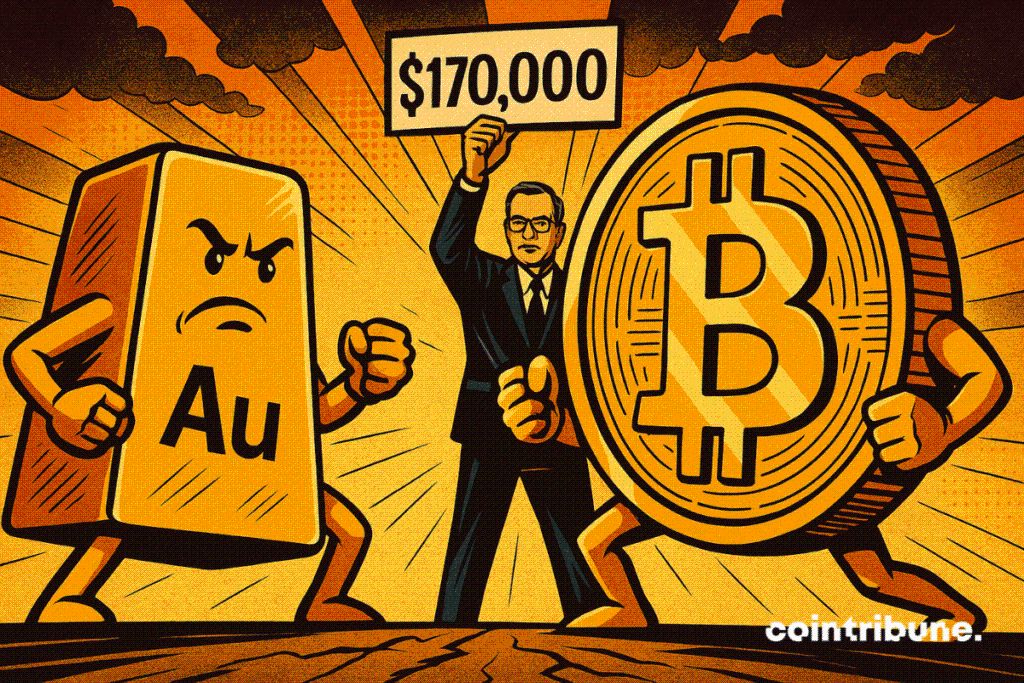
While bitcoin has just fallen below 100,000 dollars, JP Morgan reignites the debate on the valuation of the flagship asset. In a document published Wednesday, the American bank estimates that BTC is greatly undervalued compared to gold. In its view, the fair price of bitcoin would be around 170,000 dollars. This analysis rekindles the debate on the real valuation of the asset, in a context of increased volatility and a market searching for direction.
In brief
- JP Morgan estimates that Bitcoin is currently undervalued compared to gold, based on an analysis of the volatility ratio.
- The bank sets a theoretical target of $170,000 for BTC, considering a mechanical revaluation of its capitalization.
- This projection relies on a quantitative methodology comparing the ‘relative risk’ between Bitcoin and gold.
- The analysis comes as Bitcoin has fallen back below $100,000, amidst high uncertainty in the crypto market.
JP Morgan sees an undervalued bitcoin compared to gold : towards a potential of 170,000 dollars ?
In a note addressed to its clients on Wednesday, November 6, JP Morgan surprised the market with a bold projection. Bitcoin would be largely undervalued compared to gold, according to a comparative approach based on volatility, despite a correlation that reached 0.85 .
More specifically, the bank explains that the BTC/gold volatility ratio has fallen to 1.8, meaning that bitcoin is considered 1.8 times riskier than gold. Applying this ratio to the relative valuation of the two assets, analysts estimate there is a significant mechanical upside margin for BTC.
“Taking this ratio into account, which implies that bitcoin currently consumes 1.8 times more risk capital than gold, then mechanically, the market capitalization of bitcoin at 2.1 trillion dollars should increase by nearly 67 %, implying a theoretical price close to 170,000 dollars”, can be read in the report.
This analysis is based on a quantitative methodology specific to the bank and founded on market dynamics between so-called safe haven assets. In support of its reasoning, JP Morgan highlights several findings :
- The historic gold rally in October led to an increase in its own volatility, temporarily making it riskier than usual ;
- The BTC/gold volatility ratio, which dropped to 1.8, makes bitcoin appear relatively more stable than expected compared to gold’s evolution ;
- The risk-adjusted valuation of BTC should theoretically reflect this dynamic, hence the projected target of 170,000 dollars over a 6 to 12 month horizon ;
- The model used relies on a mechanical approach, without integrating speculative or narrative elements around bitcoin, which according to JP Morgan strengthens the robustness of this estimate.
For the American bank, this configuration creates a strategic opportunity window for investors seeking uncorrelated and rationally valued assets.
Divergent perspectives : when other players lower their ambitions
In the face of this optimistic reading, several market players present a completely different diagnosis. On the very day the JP Morgan report was published, bitcoin dropped below the $100,000 threshold, breaking a major psychological support for the first time in four months.
This decline is interpreted by some as a sign of persistent vulnerability. Following this, Galaxy Digital announced a downward revision of its BTC price projections for the end of the year, lowering its target from 185,000 to 120,000 dollars.
To justify this adjustment, the firm cites several factors: persistent macroeconomic pressure, notably trade tensions and tariff policies, as well as the October 10 crash , considered the largest 24-hour liquidation episode in crypto history.
Adding to this is a worrying figure: according to Galaxy, nearly 400,000 BTC were dumped on the market by whales in October, contributing to increasing selling pressure. This capital movement fits into a general trend of repositioning by institutional investors, who now seem to diversify their exposures towards other competing assets or themes.
“Bitcoin has entered a new phase, what we call the era of maturity”, explains Alex Thorn, head of research at Galaxy. He believes that ETFs, by absorbing a growing share of liquidity, now slow down the pace of increases.
This interpretative divergence between JP Morgan and other institutions like Galaxy illustrates the current complexity of the crypto market. While some see a structural medium-term opportunity, others favour a more cautious reading based on immediate market data. For investors, the challenge is now to arbitrate between these two narratives: that of an undervalued asset ready to rebound, and that of a market transitioning to more moderate growth. In any case, these divergences highlight that the BTC price is no longer reduced to a bubble or speculative exuberance logic: it is becoming an asset analyzed, compared, and scrutinized through classic financial methodologies.
0
0
Disclaimer: The content of this article solely reflects the author's opinion and does not represent the platform in any capacity. This article is not intended to serve as a reference for making investment decisions.
Understand the market, then trade.
Bitget offers one-stop trading for cryptocurrencies, stocks, and gold.
Trade now!
You may also like
USD/JPY Price Forecast: Enters fresh upside leg on consolidation breakout
FXStreet•2026/11/12 06:21

CoreWeave's quarterly report hits record highs, but Bernstein and HSBC still maintain "sell" ratings
The main concerns focus on three major issues: management claims an annual price of $20-25 million per megawatt, while actual financial data shows only $9.2 million; independent calculations by two institutions both indicate a financing gap of about $33 billion; by 2028, the market will see an influx of 55 gigawatts of new computing power, 20 times CoreWeave’s own capacity. With current debt at $46.9 billion and equity only $4 billion, and no free cash flow within this decade—the question of whether its scarce performance can last until the loans are repaid is something even strong quarterly reports cannot answer.
华尔街见闻•2026/11/12 06:18

The AI boom may follow the path of the 19th-century railway bubble, and builders may not be the ultimate winners
Goldman Sachs analyst Bobby Molavi compared the current situation to the 19th-century British railway mania: 500 companies spent more than the nation's annual income building 8,000 miles of railway, with most early investors losing out, while the real beneficiaries were the later "passengers." He pointed out that the current AI craze is driven by both debt and momentum, and that the S&P 500’s forward P/E ratio of 18x is only "a bit cheaper." Whether the builders can retain value is uncertain, and history does not offer an optimistic answer.
华尔街见闻•2026/11/12 03:56

If Anthropic's IPO goes smoothly and the stock price rises next week, then everything remains the same for AI. Otherwise, some companies will go bankrupt.
The shrinking valuations of two major giants have triggered a chain reaction—investors are adopting more conservative revenue multiples for AI startups and are directly halting high-valuation financing for companies with zero revenue. Multiple venture capital firms have advised their portfolio companies to lower valuation expectations and to quickly build up cash reserves. Market participants warn that the outcome of Anthropic’s IPO will be a barometer for the industry: if successful, the boom will continue; if it fails, some companies may face elimination.
华尔街见闻•2026/11/12 03:46
Crypto prices
More
Bitcoin
BTC
$73,621.71
-0.18%

Ethereum
ETH
$2,050.28
-0.69%

Tether USDt
USDT
$0.9987
+0.01%

BNB
BNB
$674.07
-0.96%

USDC
USDC
$0.9997
+0.00%

XRP
XRP
$1.04
-1.60%

Solana
SOL
$83.06
+0.03%

TRON
TRX
$0.3171
-0.12%

Hyperliquid
HYPE
$71.59
-0.46%

Zcash
ZEC
$987.65
-1.61%
How to buy BTC
Bitget lists BTC – Buy or sell BTC quickly on Bitget!
Trade now
Become a trader now?A welcome pack worth 6200 USDT for new users!
Sign up now