
Japanese Regulators Back Major Banks’ Push to Issue Yen-Backed Stablecoins

Quick Breakdown
- Japan’s FSA is backing a unified effort by major banks to issue yen-backed stablecoins.
- The initiative aims to modernize corporate payments and reduce settlement costs.
- The move aligns with broader regulatory steps aimed at deepening oversight while encouraging innovation in Japan’s digital asset ecosystem.
Japan’s Financial Services Agency (FSA) has thrown its weight behind a collaborative project involving some of the country’s largest financial institutions to issue yen-backed stablecoins, aiming to transform corporate payments.
Payment innovation project launched
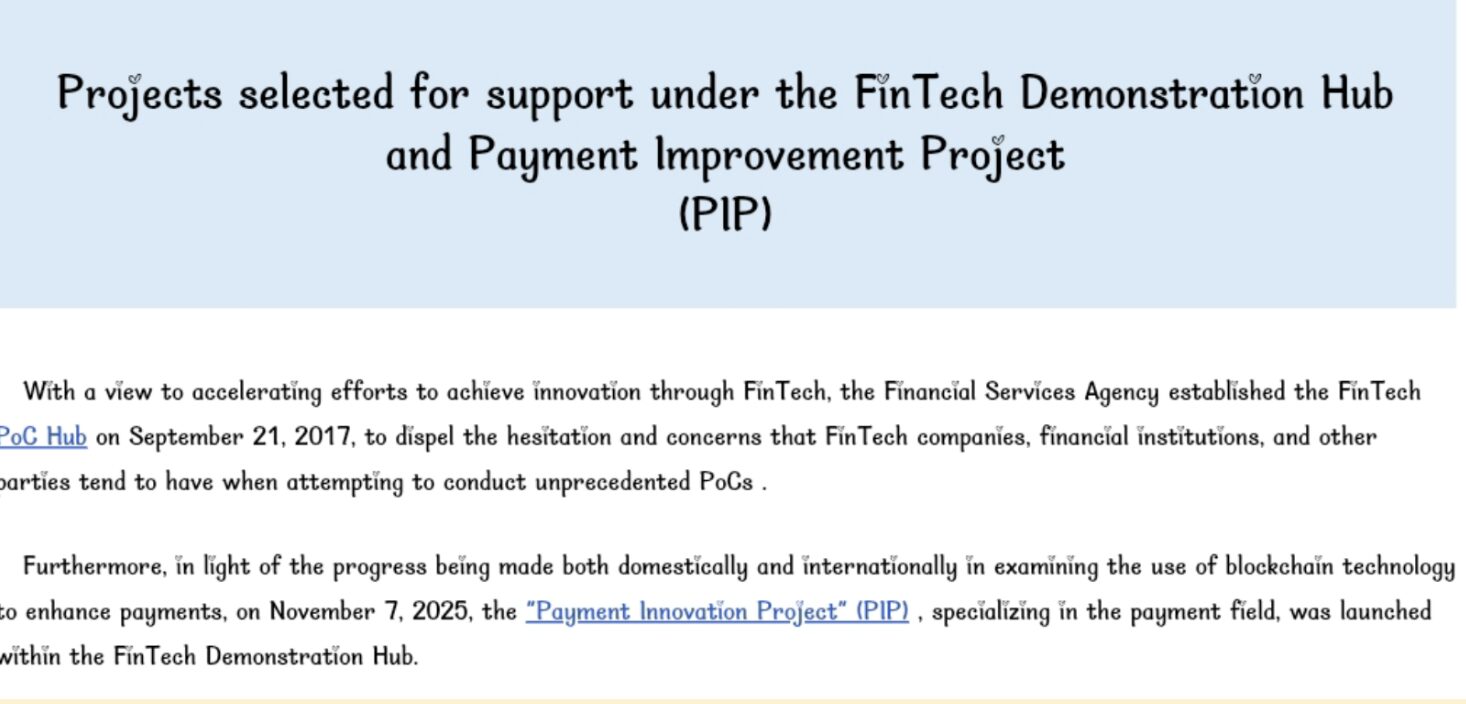
In a statement released Friday, the regulator confirmed the launch of the Payment Innovation Project, which brings together Mizuho Bank, Mitsubishi UFJ Bank, Sumitomo Mitsui Banking Corporation, Mitsubishi Corporation and its financial subsidiary, alongside Progmat — MUFG’s blockchain-based stablecoin issuance platform.
 Source:
FSA
The move follows earlier reports indicating that these financial heavyweights are working to overhaul corporate settlement infrastructure. By leveraging yen-based stablecoins issued on the Progmat platform, they aim to reduce transaction costs and enhance the efficiency of business payments. Together, the involved institutions serve more than 300,000 corporate clients, positioning the initiative to have a meaningful influence on Japan’s financial system.
Beginning this month, the participating firms will start issuing payment-focused stablecoins designed to streamline operations, improve user convenience, and boost overall corporate productivity in the country. The FSA noted that once the pilot concludes, it will release findings and policy considerations to the public.
Growing stablecoin momentum in Japan
The announcement comes shortly after Tokyo-based fintech JPYC launched what it called Japan’s first approved yen-backed stablecoin, with seven companies reportedly preparing to integrate the token into their services.
Japan’s regulators have increasingly engaged with digital asset frameworks in recent months. The FSA is reportedly evaluating possible adjustments to allow banks to hold cryptocurrencies such as Bitcoin for investment purposes. Meanwhile, the country’s securities watchdog is preparing rules to identify and penalize crypto insider trading, expanding its oversight in the market.
At the same time, the tightening regulatory environment has influenced some market participants. Crypto exchange Bybit has recently paused new user sign-ups in Japan as it works to comply with evolving regulatory requirements. “It has always been Bybit’s commitment to operate responsibly and in compliance with local laws and regulatory expectations,” the exchange said.
Take control of your crypto portfolio with MARKETS PRO, DeFi Planet’s suite of analytics tools.”
Disclaimer: The content of this article solely reflects the author's opinion and does not represent the platform in any capacity. This article is not intended to serve as a reference for making investment decisions.
You may also like
CoreWeave's quarterly report hits record highs, but Bernstein and HSBC still maintain "sell" ratings
The main concerns focus on three major issues: management claims an annual price of $20-25 million per megawatt, while actual financial data shows only $9.2 million; independent calculations by two institutions both indicate a financing gap of about $33 billion; by 2028, the market will see an influx of 55 gigawatts of new computing power, 20 times CoreWeave’s own capacity. With current debt at $46.9 billion and equity only $4 billion, and no free cash flow within this decade—the question of whether its scarce performance can last until the loans are repaid is something even strong quarterly reports cannot answer.

The AI boom may follow the path of the 19th-century railway bubble, and builders may not be the ultimate winners
Goldman Sachs analyst Bobby Molavi compared the current situation to the 19th-century British railway mania: 500 companies spent more than the nation's annual income building 8,000 miles of railway, with most early investors losing out, while the real beneficiaries were the later "passengers." He pointed out that the current AI craze is driven by both debt and momentum, and that the S&P 500’s forward P/E ratio of 18x is only "a bit cheaper." Whether the builders can retain value is uncertain, and history does not offer an optimistic answer.

If Anthropic's IPO goes smoothly and the stock price rises next week, then everything remains the same for AI. Otherwise, some companies will go bankrupt.
The shrinking valuations of two major giants have triggered a chain reaction—investors are adopting more conservative revenue multiples for AI startups and are directly halting high-valuation financing for companies with zero revenue. Multiple venture capital firms have advised their portfolio companies to lower valuation expectations and to quickly build up cash reserves. Market participants warn that the outcome of Anthropic’s IPO will be a barometer for the industry: if successful, the boom will continue; if it fails, some companies may face elimination.
After the Brazilian election, political discount deepens; Morgan Stanley remains bullish on Petrobras (PBR.US), focusing on fuel pricing and dividends
Morgan Stanley still maintains its most optimistic "Overweight" rating, but has lowered its year-end 2027 target price from $31 to $25.

Crypto prices
More


