
Whales Quietly Buy the Dip as Bitcoin Tests $100,000 Support

Large Bitcoin holders are buying the dip, adding nearly 30,000 BTC even as prices test $100,000. Their quiet accumulation contrasts with retail fear and ETF outflows, suggesting the market’s biggest players are preparing for the next move.
Large Bitcoin holders are quietly accumulating again, signaling renewed confidence despite a sharp market correction that erased over 20% from recent highs.
At the time of writing, Bitcoin trades at just above $101,000, after briefly dipping to $99,600 two days ago.
Whales Signal New Hope For Bitcoin Price
According to CryptoQuant data, wallets holding between 1,000 and 10,000 BTC added around 29,600 Bitcoin in the last seven days.
noted that the combined balance of these whale wallets rose from 3.436 million to 3.504 million BTC. This marks the first major accumulation phase since late September.
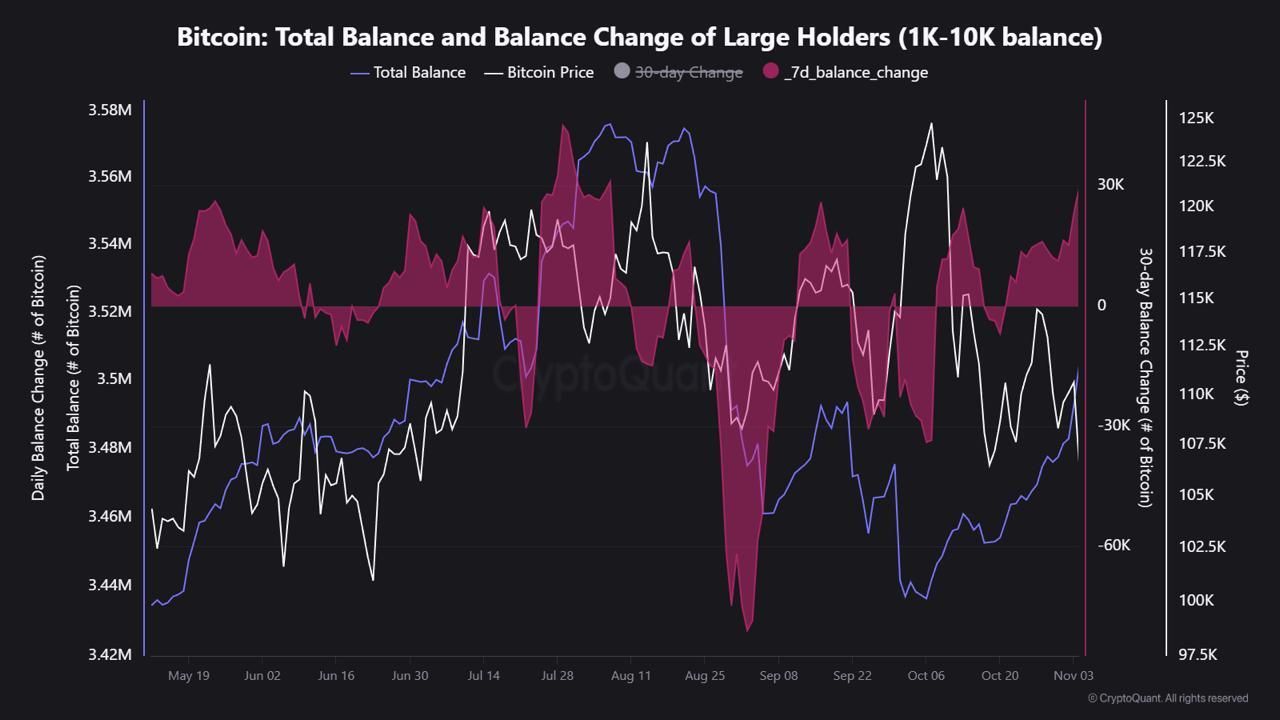 Bitcoin Whale Balance. Source: CryptoQuant
The data suggests that large entities—typically institutions and early whales—are buying weakness, not fleeing it. Their actions contrast sharply with retail sentiment, which has turned fearful after heavy liquidations and ETF outflows.
Over $1 billion in leveraged positions were wiped out last week. US spot Bitcoin ETFs saw more than $2 billion in redemptions, according to recent market data.
Such divergence between “smart money” accumulation and retail caution has historically marked late-stage corrections rather than new downtrends.
By absorbing roughly four times the weekly mining supply, whales are tightening liquid supply on exchanges and reinforcing the $100,000 support zone.
The accumulation also comes amid macro headwinds. The Federal Reserve’s cautious tone on rate cuts has weakened demand for risk assets, contributing to Bitcoin’s recent decline.
Yet, these conditions have also created a liquidity vacuum—an opportunity whales appear to be exploiting.
JPMorgan predicting bitcoin at $170k in next 6-12mo, says perp deleveraging is behind us and that's it undervalued vs gold historically, which implies "significant upside next 6-12mo" pic.twitter.com/CaVVWH6L42
— Eric Balchunas (@EricBalchunas) November 6, 2025
How Will Bitcoin End November?
Technical indicators show Bitcoin consolidating between $100,000 and $107,000, while the Fear & Greed Index sits deep in the “Extreme Fear” zone.
Historically, when large holders increase exposure during high fear periods, price recovery often follows within weeks.
Still, near-term volatility remains likely. Institutional outflows and lingering derivatives unwinds could keep the market choppy before any sustained rebound.
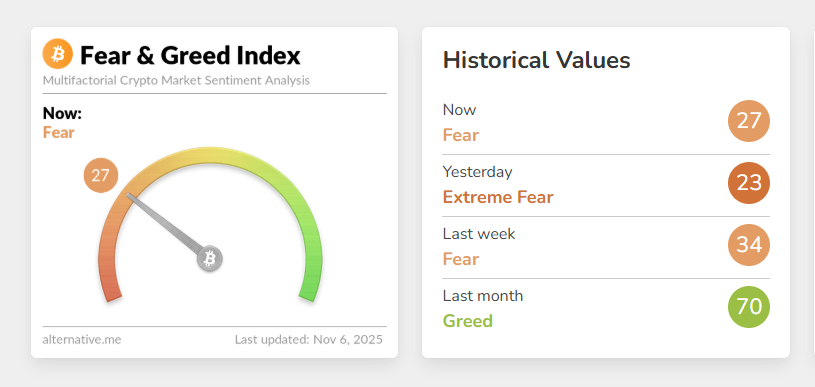 Crypto Fear and Greed Index. Source:
If whale accumulation continues, however, it may form the base for a medium-term recovery toward $115,000–$120,000.
The takeaway from this week’s Whale Watch is clear. While short-term traders panic, long-term holders are repositioning for the next leg.
Their steady accumulation suggests conviction that the market’s structural trend remains intact—even if sentiment hasn’t caught up yet.
Disclaimer: The content of this article solely reflects the author's opinion and does not represent the platform in any capacity. This article is not intended to serve as a reference for making investment decisions.
You may also like
Indian Rupee outperforms amid strong foreign inflows, shrugging off surging US Dollar
USD/JPY Price Forecast: Enters fresh upside leg on consolidation breakout

CoreWeave's quarterly report hits record highs, but Bernstein and HSBC still maintain "sell" ratings
The main concerns focus on three major issues: management claims an annual price of $20-25 million per megawatt, while actual financial data shows only $9.2 million; independent calculations by two institutions both indicate a financing gap of about $33 billion; by 2028, the market will see an influx of 55 gigawatts of new computing power, 20 times CoreWeave’s own capacity. With current debt at $46.9 billion and equity only $4 billion, and no free cash flow within this decade—the question of whether its scarce performance can last until the loans are repaid is something even strong quarterly reports cannot answer.

The AI boom may follow the path of the 19th-century railway bubble, and builders may not be the ultimate winners
Goldman Sachs analyst Bobby Molavi compared the current situation to the 19th-century British railway mania: 500 companies spent more than the nation's annual income building 8,000 miles of railway, with most early investors losing out, while the real beneficiaries were the later "passengers." He pointed out that the current AI craze is driven by both debt and momentum, and that the S&P 500’s forward P/E ratio of 18x is only "a bit cheaper." Whether the builders can retain value is uncertain, and history does not offer an optimistic answer.

Crypto prices
More


