
Bitcoin Avoids Breakdown, For Now — But Still Not Safe Until Price Gains 12%

Bitcoin price has rebounded above $103,700 after narrowly avoiding a breakdown near $98,900. But weak money flow, continued hodler selling, and a looming bearish crossover suggest the recovery remains fragile. Unless the price gains 12% to reclaim key resistance, Bitcoin’s relief rally could still turn into another correction.
The Bitcoin price narrowly escaped a deeper breakdown this week, bouncing 2.1% in the past 24 hours to trade near $103,700 after briefly falling to around $98,900. The move stabilized sentiment, but the market isn’t in the clear yet.
To confirm a true recovery, Bitcoin would need to climb another 12% from current levels — a move that would finally shift the structure from caution to confidence and invalidate the ongoing bearish setup.
Bearish Crossover Builds as Money Flow Remains Weak
On the daily chart, Bitcoin faces pressure from a potential bearish crossover forming between the 20-day and 200-day Exponential Moving Averages (EMAs). EMAs smooth out price data to highlight trend direction, and when a shorter EMA drops below a longer one, it often signals that buyers are losing strength.
A similar 50-day/100-day crossover on November 4 triggered a sharp 10% price dip, underlining the risk of another leg down if this crossover completes.
At the same time, the Chaikin Money Flow (CMF) — which tracks whether capital is entering or leaving the market — continues to hover below zero. CMF has been negative since late October and remains trapped under a downtrend line drawn from October 4.
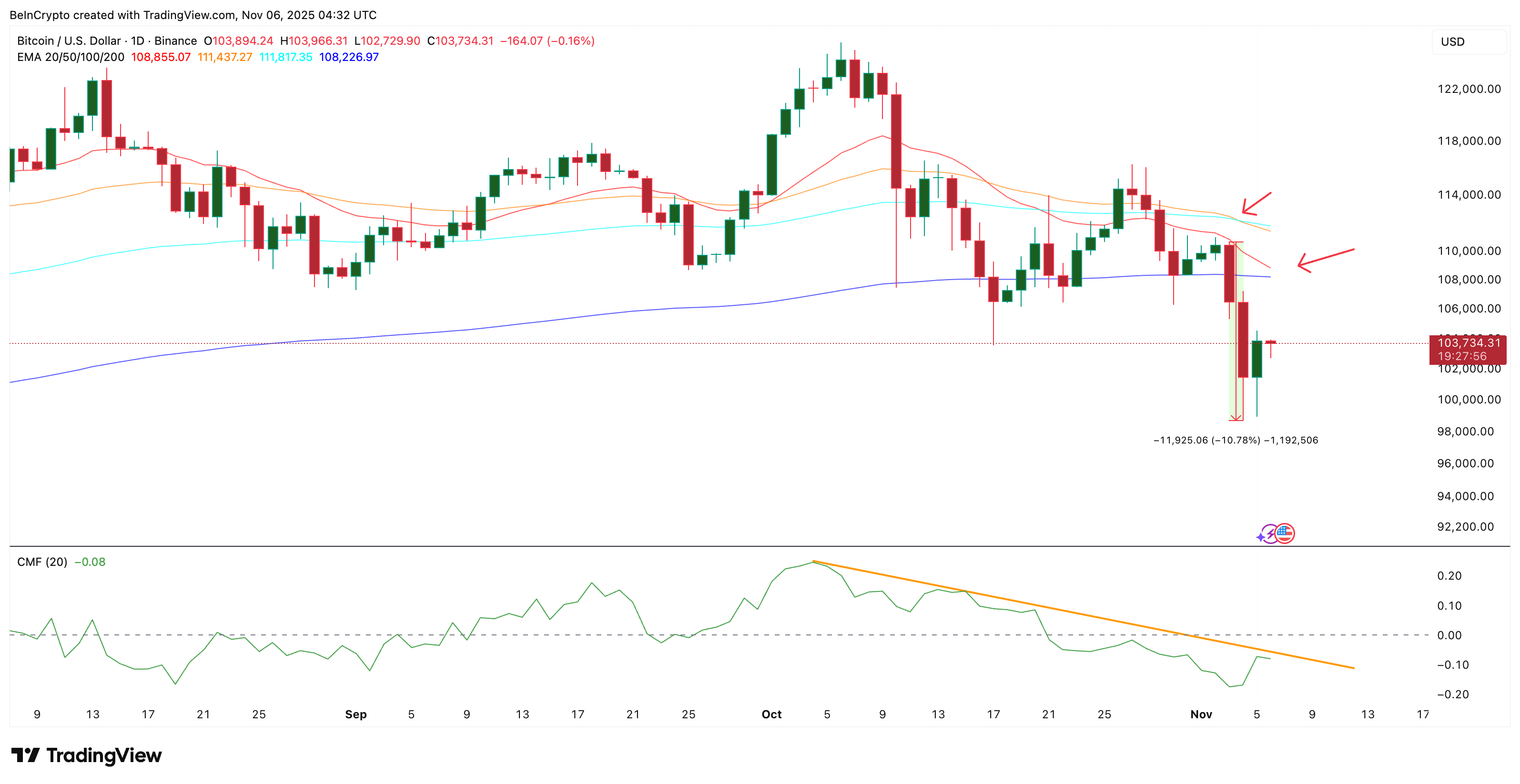 Bitcoin’s Bearish Triggers:
TradingView
Want more token insights like this? Sign up for Editor Harsh Notariya’s Daily Crypto Newsletter.
Until CMF breaks above that line and sustains a positive reading, it signals that large wallets are still holding back and that real inflows haven’t yet returned. Together, the weakening EMAs and negative money flow explain why the rebound feels fragile despite short-term strength.
Hodlers Still Unconvinced After the Post-Crash BTC Bounce
Even after Bitcoin’s rebound, long-term holders haven’t started accumulating again. The Hodler Net Position Change, which measures whether older wallets are buying or selling, remains deep in the red.
Between November 2 and November 5, the metric dropped from –43,810 BTC to –52,250 BTC, a decline of 19.2%. That means long-term investors sold an additional 8,400 BTC during the recovery — showing that conviction is still missing.
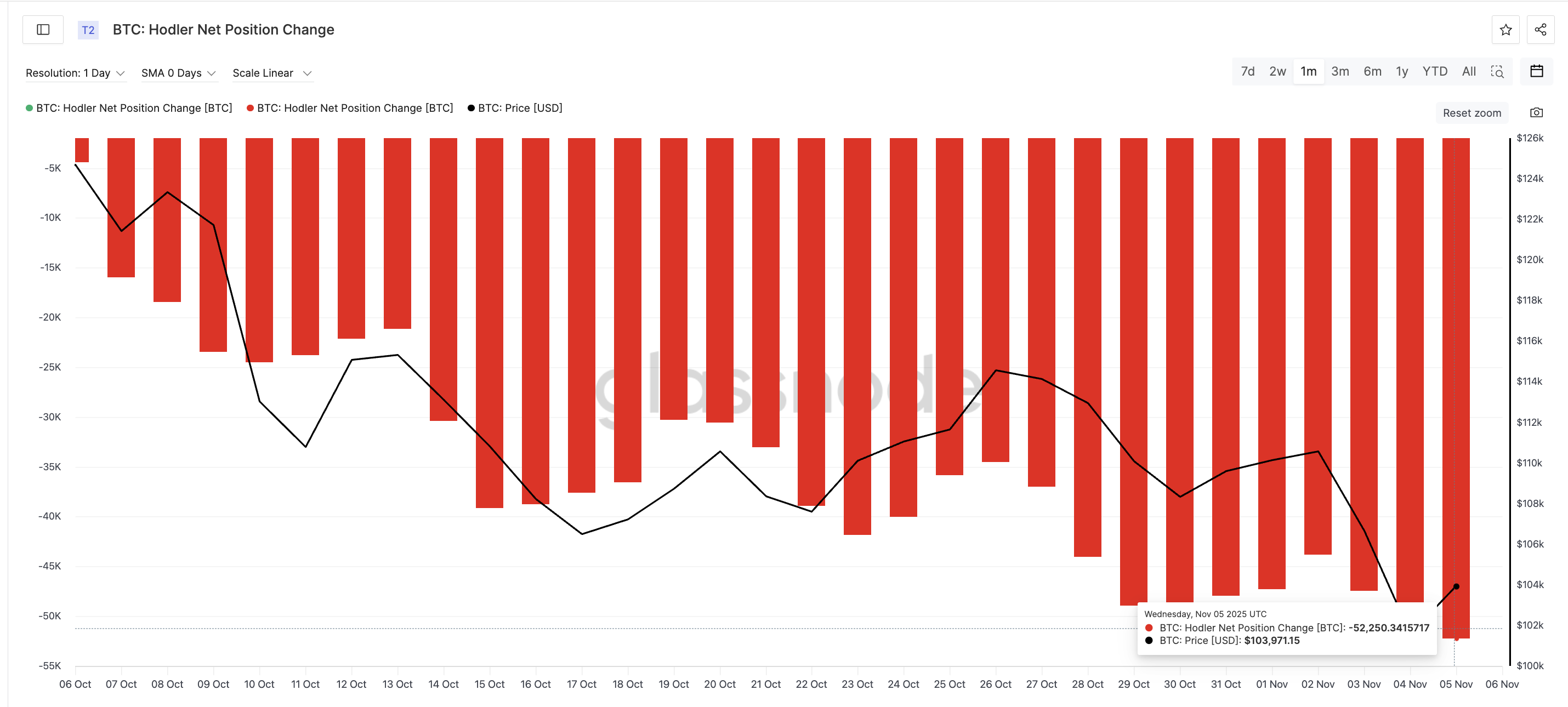 Long-Term Investors Haven’t Started Buying Yet:
Glassnode
Historically, meaningful recoveries have only taken hold once hodlers start adding to their stacks. Their ongoing selling indicates that faith in this rebound remains weak and that traders are driving most of the move.
Bitcoin Price Faces a Critical Test Ahead
For the Bitcoin price to shift bullish again, it must hold above $103,000 and reclaim $105,600 in the short term. The key confirmation level lies at $116,500, roughly 12% above current prices. A break above it would invalidate the head and shoulders pattern and confirm a stronger recovery phase.
However, if $103,000 fails, Bitcoin risks revisiting $98,900. A daily close under that would trigger a neckline breakdown. And that could push the BTC price toward $83,100, the pattern’s projected downside target.
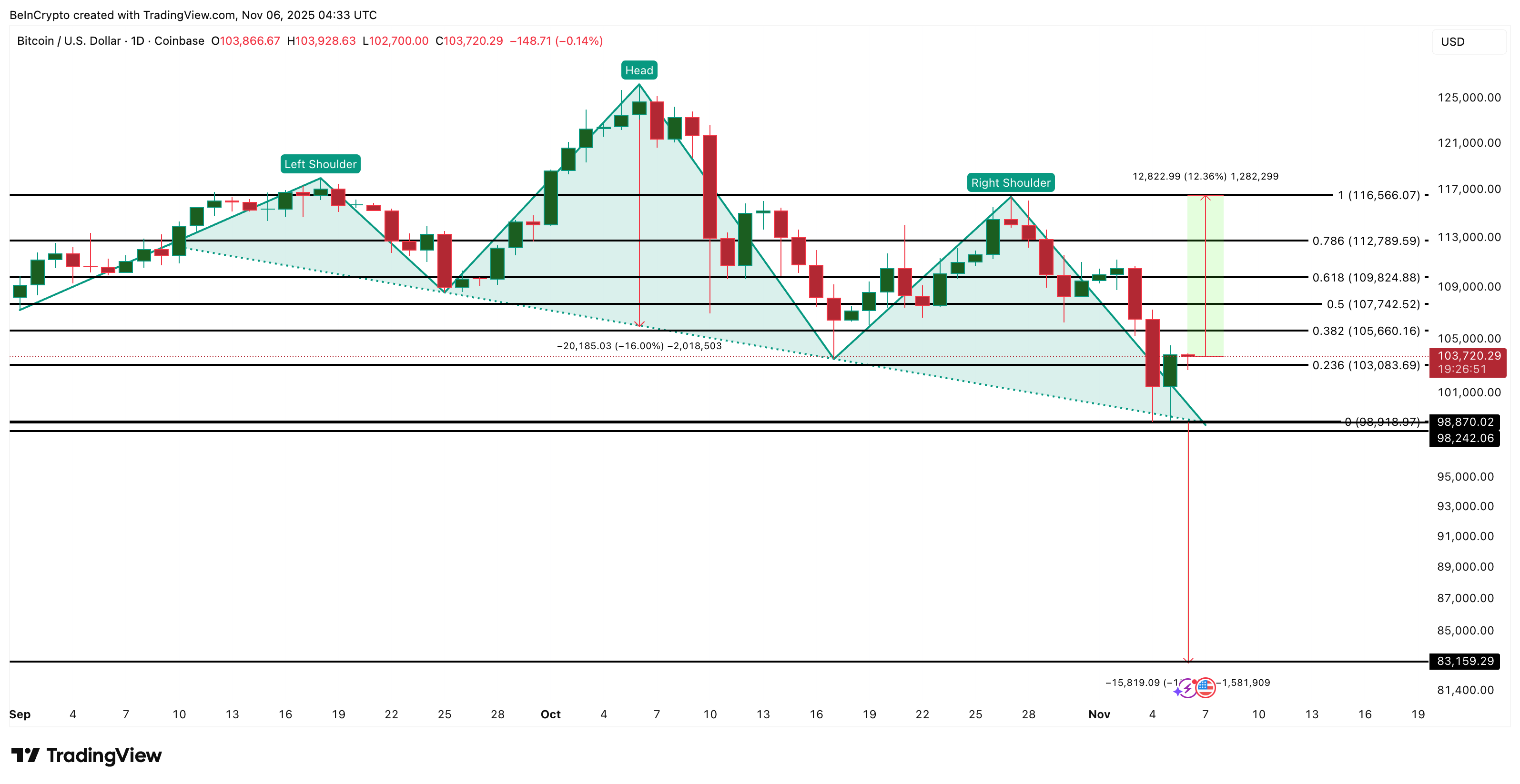 Bitcoin Price Analysis:
TradingView
For now, Bitcoin has avoided disaster. But the lack of strong inflows, weak hodler activity, and looming bearish crossover suggest that this rebound remains fragile. Until the price gains 12% and reclaims higher ground, Bitcoin may have escaped the fall, but it’s far from safe.
Read the article at BeInCryptoDisclaimer: The content of this article solely reflects the author's opinion and does not represent the platform in any capacity. This article is not intended to serve as a reference for making investment decisions.
You may also like
The AI boom may follow the path of the 19th-century railway bubble, and builders may not be the ultimate winners
Goldman Sachs analyst Bobby Molavi compared the current situation to the 19th-century British railway mania: 500 companies spent more than the nation's annual income building 8,000 miles of railway, with most early investors losing out, while the real beneficiaries were the later "passengers." He pointed out that the current AI craze is driven by both debt and momentum, and that the S&P 500’s forward P/E ratio of 18x is only "a bit cheaper." Whether the builders can retain value is uncertain, and history does not offer an optimistic answer.

If Anthropic's IPO goes smoothly and the stock price rises next week, then everything remains the same for AI. Otherwise, some companies will go bankrupt.
The shrinking valuations of two major giants have triggered a chain reaction—investors are adopting more conservative revenue multiples for AI startups and are directly halting high-valuation financing for companies with zero revenue. Multiple venture capital firms have advised their portfolio companies to lower valuation expectations and to quickly build up cash reserves. Market participants warn that the outcome of Anthropic’s IPO will be a barometer for the industry: if successful, the boom will continue; if it fails, some companies may face elimination.
After the Brazilian election, political discount deepens; Morgan Stanley remains bullish on Petrobras (PBR.US), focusing on fuel pricing and dividends
Morgan Stanley still maintains its most optimistic "Overweight" rating, but has lowered its year-end 2027 target price from $31 to $25.

Corning (GLW.US) receives initial "Buy" rating from Jefferies! AI factories driving a fiber optic rush, with a potential global supply gap of up to 30%
For Corning, the recent profit growth mainly comes from the expansion of AI clusters. As the number of optical links crossing cabinets and campuses increases, customers need to deploy more optical fibers within limited conduit and cabinet space, thus driving demand for high-density optical cables and connection systems.

Crypto prices
More


