
Circle Bows to Second Amendment Pressure in Latest USDC Policy Update

Circle has reversed its USDC policy to permit lawful firearm transactions, aligning with the GENIUS Act and President Trump’s “Fair Banking” executive order. The update follows pressure from gun rights advocates and lawmakers, marking a major shift in how stablecoin issuers navigate political and regulatory scrutiny.
Circle Internet Group recently reversed its USDC policy to allow legal firearm purchases that comply with applicable laws. The decision follows industry advocacy and aligns with federal regulatory frameworks targeting financial discrimination.
This policy update comes during increasing scrutiny of payment platforms accused of restricting access for lawful gun merchants. The change reflects the passage of the GENIUS Act, which created a federal framework for dollar-backed stablecoins in the US.
USDC Terms Support Legal Firearm Transactions
Previously, Circle’s USDC terms prohibited all purchases of weapons, including firearms. This approach led to criticism from the National Shooting Sports Foundation (NSSF), which referred to the rule as “financial discrimination.”
The NSSF argued that such bans unfairly penalized lawful gun businesses and owners operating within constitutional rights.
Responding to this advocacy and public attention, Circle revised its terms to prohibit weapon sales only “in contravention of applicable laws.”
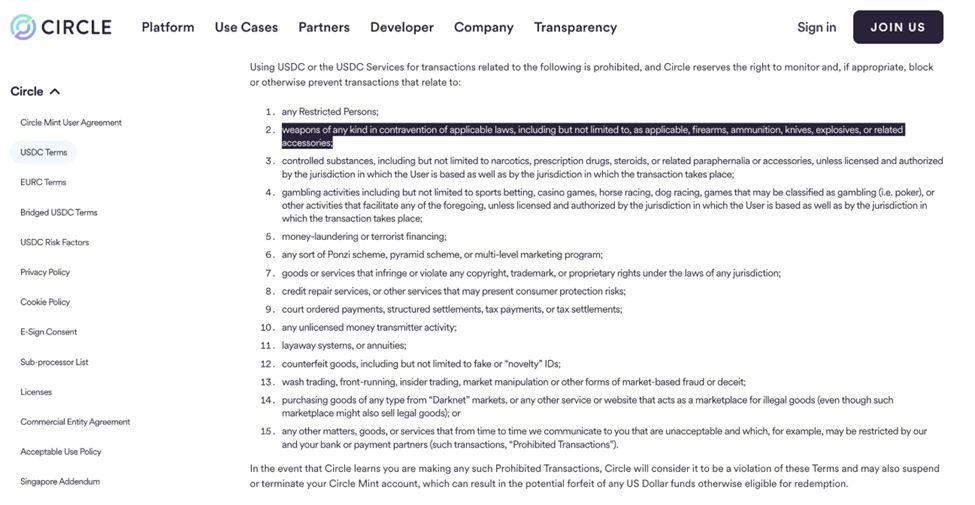 Circle Updates USDC Policy on Firearms. Source:
Circle T&Cs
The NSSF praised the policy shift as a victory against ideological restrictions. The organization, however, stated it would “trust, but verify” Circle’s commitment, emphasizing ongoing vigilance against financial discrimination.
Senator Cynthia Lummis supported Circle’s decision, saying the move defends constitutional rights and prevents financial system weaponization against law-abiding gun owners.
After discussions w/ Circle, I'm glad they now allow legal firearm purchases using its stablecoin. By aligning its terms of service w/ existing legal requirements, Circle defends constitutional rights & ensures financial systems can't be weaponized against law-abiding gun owners.
— Senator Cynthia Lummis (@SenLummis) November 5, 2025
This comment illustrates growing bipartisan momentum to protect lawful commerce from payment platform gate-keeping.
Circle’s reversal is linked to President Trump’s executive order “Guaranteeing Fair Banking for All Americans” issued on August 7, 2025. The order targets “debanking,” where financial firms deny services to individuals or businesses based on their political views or involvement in lawful but controversial activities. It specifically mentions the firearms sector.
The order requires regulators to replace “reputation risk” with objective, risk-based standards and to review historical cases of debanking. Institutions must notify and reinstate clients who have been denied services due to political or lawful business reasons. A 180-day deadline was set for compliance.
Additionally, the GENIUS Act, signed on July 18, 2025, established clear federal rules for stablecoin issuers. It set standards for authorization and exempted issuers from certain bank capital requirements.
This act is viewed as a turning point for US stablecoin policy and has encouraged more adoption by creating regulatory clarity.
These regulatory developments place new political and legal pressures on payment firms to avoid imposing ideological bans. Circle’s decision reflects this paradigm shift.
Broader Impacts for Stablecoins and Payment Systems
The firearms policy revision may influence how other stablecoin issuers define what’s allowed. Concern is that USDC’s involvement in politically sensitive issues could complicate compliance outside the US, where attitudes differ sharply.
NSSF framed this move as part of a larger trend where payment and financial firms are moving away from ideological restrictions.
The organization warned that digital-first economies make payment firm policies crucial to industry access, highlighting what’s at stake for financial freedom.
Advocacy groups, such as the NSSF, are intensifying efforts to reverse financial discrimination labeled as risk management.
Disclaimer: The content of this article solely reflects the author's opinion and does not represent the platform in any capacity. This article is not intended to serve as a reference for making investment decisions.
You may also like
The AI boom may follow the path of the 19th-century railway bubble, and builders may not be the ultimate winners
Goldman Sachs analyst Bobby Molavi compared the current situation to the 19th-century British railway mania: 500 companies spent more than the nation's annual income building 8,000 miles of railway, with most early investors losing out, while the real beneficiaries were the later "passengers." He pointed out that the current AI craze is driven by both debt and momentum, and that the S&P 500’s forward P/E ratio of 18x is only "a bit cheaper." Whether the builders can retain value is uncertain, and history does not offer an optimistic answer.

If Anthropic's IPO goes smoothly and the stock price rises next week, then everything remains the same for AI. Otherwise, some companies will go bankrupt.
The shrinking valuations of two major giants have triggered a chain reaction—investors are adopting more conservative revenue multiples for AI startups and are directly halting high-valuation financing for companies with zero revenue. Multiple venture capital firms have advised their portfolio companies to lower valuation expectations and to quickly build up cash reserves. Market participants warn that the outcome of Anthropic’s IPO will be a barometer for the industry: if successful, the boom will continue; if it fails, some companies may face elimination.
After the Brazilian election, political discount deepens; Morgan Stanley remains bullish on Petrobras (PBR.US), focusing on fuel pricing and dividends
Morgan Stanley still maintains its most optimistic "Overweight" rating, but has lowered its year-end 2027 target price from $31 to $25.

Corning (GLW.US) receives initial "Buy" rating from Jefferies! AI factories driving a fiber optic rush, with a potential global supply gap of up to 30%
For Corning, the recent profit growth mainly comes from the expansion of AI clusters. As the number of optical links crossing cabinets and campuses increases, customers need to deploy more optical fibers within limited conduit and cabinet space, thus driving demand for high-density optical cables and connection systems.

Crypto prices
More


