
A Massive Scam Organized by Pyongyang Hits GitHub, Upwork, and Freelancer

North Korean hackers have already siphoned millions in bitcoin and ether, ranking among the worst nightmares of the crypto community. Feared, hunted, cursed, they nevertheless evade every net. For recently, they no longer just steal: they recruit, organize, infiltrate, and structure. GitHub, Upwork, Freelancer… all platforms have become hunting grounds. And what they now aim at is no longer just a jackpot but the very framework of the decentralized economy.
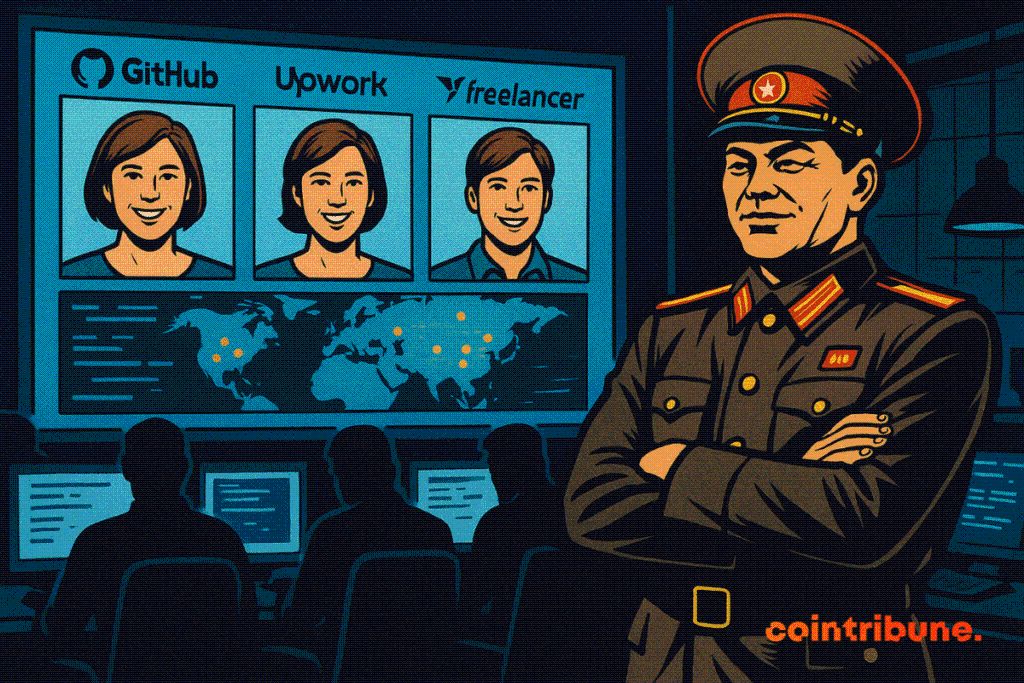
In brief
- North Korean hackers impersonate recruiters and target freelancers on GitHub or Upwork.
- They use malware, forged documents, and AI to impersonate identities and deceive platforms.
- Victims are often vulnerable: women, Ukrainians, or precarious people lured by fake jobs.
- Payments pass through proxies and then go as crypto to the North Korean regime’s networks.
When AI Recruiters and Fake Profiles Infest Tech Platforms
In 2024, Pyongyang, which has more than 60 developers on crypto platforms , has taken a new step in its digital war. The regime’s hackers no longer simply apply for offers: they create them. On Upwork, Freelancer, or GitHub, they publish ads designed to lure developers specialized in crypto. Behind these seemingly ordinary offers lies a well-oiled plan : the candidate is invited to download a project hosted on GitHub, supposed to serve as a technical test. The code contains malware, often of the BeaverTail type.
To make these traps undetectable, North Korean agents use AI to generate faces, falsify voices, and produce ultra-credible official documents. They use sophisticated tools to enhance identity files, alter photos, and modify voices to deceive verification systems.
Nothing is left to chance: the appearance, the sound, the administrative details are optimized to pass checks without raising the slightest suspicion.
Require a live and interactive video interview during the selection process, to ensure the candidate’s appearance matches the profile photo and submitted documents (often stolen or AI-generated).
Heiner García Pérez, member of SEAL Intel
These fake profiles become real Trojan horses. The KYC system of platforms is no longer a barrier, but a camouflage tool. It’s a war of appearance where the North Korean regime leads the dance.
Social Engineering and Human Exploitation: Recruiters with a Digital Smile
North Korean cunning doesn’t stop at tools. It relies on human weaknesses. Pyongyang agents target vulnerable people: isolated freelancers, Ukrainians in crisis, women seeking economic independence. On forums like InterPals or AbleHere, approaches always start gently: a friendly exchange, a promise of income, a quick test.
Then comes the spiral: identity documents, software like AnyDesk, takeover of the freelance account. The “recruited” become fronts. And the share is clear: 20% for them, 80% for the operator.
An internal document found in a hacker’s files indicates a quasi-military organization: contact scripts, onboarding procedures, explanatory PowerPoint. Fraud becomes a digital subcontracting business.
The crypto community, which relies on decentralization, is the perfect prey. Digital wallets are accessible, crypto freelancers are numerous, identities circulate.
Behind this system, a chilling truth: Pyongyang exploits individuals to deceive others. And all this under a friendly, benevolent, almost engaging mask.
Opaque Networks, Crypto, and AI: Pyongyang’s Business Plan
What North Korea has set up amounts to an industrial plan. Payments pass through freelance platforms to bank accounts or crypto wallets held by “proxies.” Then, funds are repatriated in the form of crypto-assets to Pyongyang or its accomplices.
AI still plays a role here: generated profiles, simulated activity histories, fake Zoom calls to validate identities. Recruiters sometimes ask their collaborators to enroll their circle, forming a pyramid network hard to trace.
The crypto sphere becomes the ideal channel for these invisible flows: no bank, no regulator, no customs.
Visual Summary of Key Facts:
- More than 300 developers targeted since 2024;
- Payment redistributed according to a rule: 80% operator / 20% proxy;
- Infiltrated platforms: Upwork, Freelancer, GitHub…;
- Massive use of AI for identity theft;
- Widespread malware: BeaverTail, InvisibleFerret.
This model works because it mixes technology and psychological manipulation, with formidable effectiveness. Platforms, often overwhelmed, struggle to block these accounts, which reappear under other names, other faces.
North Korean hackers bled the crypto universe dry in 2024. With $1.3 billion siphoned, they signed a record year. Their strategy evolves. Their power too. How far will they go?
Disclaimer: The content of this article solely reflects the author's opinion and does not represent the platform in any capacity. This article is not intended to serve as a reference for making investment decisions.
You may also like
The AI boom may follow the path of the 19th-century railway bubble, and builders may not be the ultimate winners
Goldman Sachs analyst Bobby Molavi compared the current situation to the 19th-century British railway mania: 500 companies spent more than the nation's annual income building 8,000 miles of railway, with most early investors losing out, while the real beneficiaries were the later "passengers." He pointed out that the current AI craze is driven by both debt and momentum, and that the S&P 500’s forward P/E ratio of 18x is only "a bit cheaper." Whether the builders can retain value is uncertain, and history does not offer an optimistic answer.

If Anthropic's IPO goes smoothly and the stock price rises next week, then everything remains the same for AI. Otherwise, some companies will go bankrupt.
The shrinking valuations of two major giants have triggered a chain reaction—investors are adopting more conservative revenue multiples for AI startups and are directly halting high-valuation financing for companies with zero revenue. Multiple venture capital firms have advised their portfolio companies to lower valuation expectations and to quickly build up cash reserves. Market participants warn that the outcome of Anthropic’s IPO will be a barometer for the industry: if successful, the boom will continue; if it fails, some companies may face elimination.
After the Brazilian election, political discount deepens; Morgan Stanley remains bullish on Petrobras (PBR.US), focusing on fuel pricing and dividends
Morgan Stanley still maintains its most optimistic "Overweight" rating, but has lowered its year-end 2027 target price from $31 to $25.

Corning (GLW.US) receives initial "Buy" rating from Jefferies! AI factories driving a fiber optic rush, with a potential global supply gap of up to 30%
For Corning, the recent profit growth mainly comes from the expansion of AI clusters. As the number of optical links crossing cabinets and campuses increases, customers need to deploy more optical fibers within limited conduit and cabinet space, thus driving demand for high-density optical cables and connection systems.

Crypto prices
More


