
Bitcoin Price Dips Below $100,000, Losses Climb To 9-Month High

Bitcoin’s losses reach nine-month highs after slipping under $100,000, though on-chain metrics hint that selling pressure may be peaking, offering a potential setup for recovery.
Bitcoin (BTC) has continued its downward trajectory this week, with the crypto king losing more than 8% in value over the past 48 hours. The decline has confirmed a bearish pattern that could lead to further losses if selling pressure persists.
The final outcome, however, hinges on how investors respond as Bitcoin hovers around key psychological levels.
Bitcoin Holders Have A Shot
The current market sentiment around Bitcoin is turning increasingly negative. On-chain data shows that the total transaction volume in losses has surged to a nine-month high. More than 235,850 BTC, valued at approximately $24 billion, have been moved at a loss in the last 24 hours, reflecting widespread panic selling among investors.
This large-scale movement of Bitcoin at a loss signals diminishing investor confidence and rising fear in the market. If this behavior continues, it could accelerate Bitcoin’s decline, eroding capital and triggering deeper losses across the broader crypto market.
Want more token insights like this? Sign up for Editor Harsh Notariya’s Daily Crypto Newsletter.
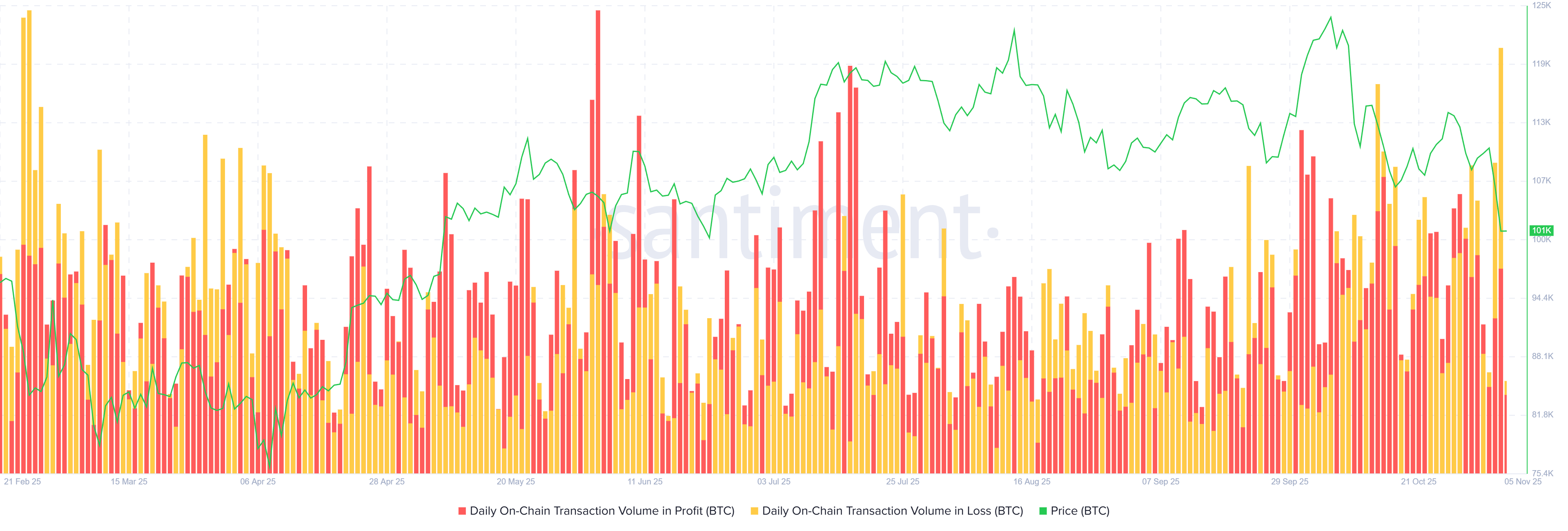 Bitcoin Transaction Volume In Loss. Source:
From a macro perspective, Bitcoin’s MVRV Ratio—a key profitability metric—has fallen into the “opportunity zone” for the first time since March. The ratio, currently between 6% and 17%, typically indicates a market bottom, suggesting selling activity has reached saturation levels.
This development could signal a turning point if market participants begin viewing Bitcoin’s current price as a value-buying opportunity. However, the broader macroeconomic sentiment and investor behavior over the next few days will be critical in determining whether BTC stabilizes or continues its descent.
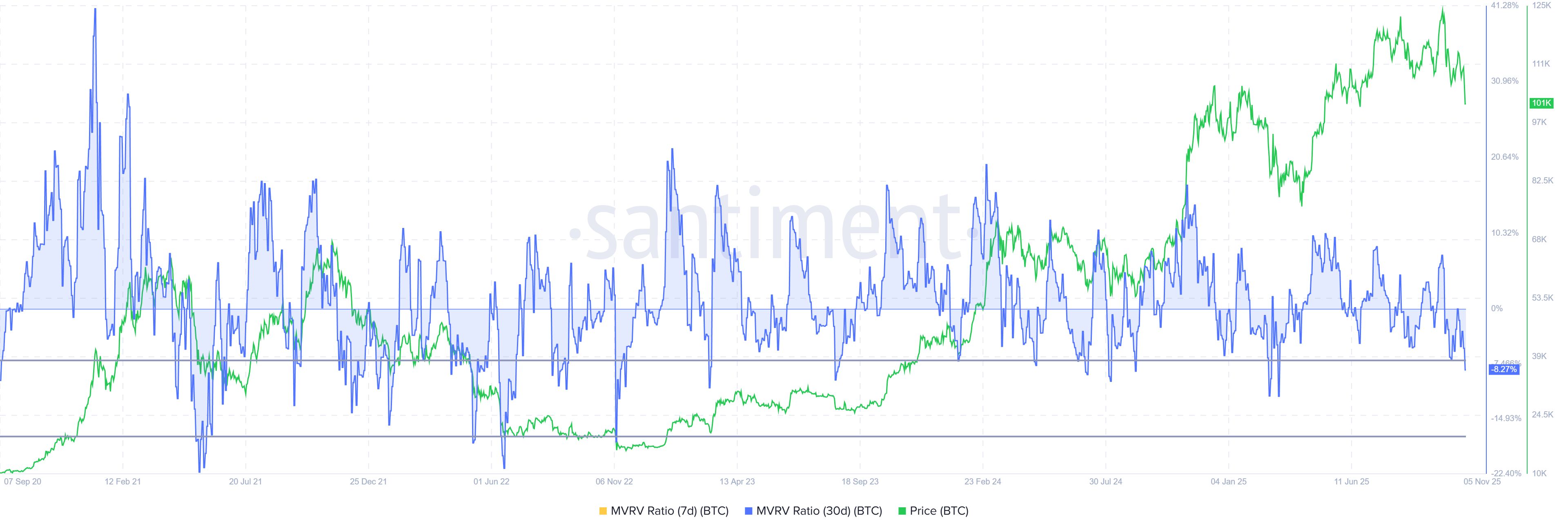 Bitcoin MVRV Ratio. Source:
BTC Price Is Holding On
Bitcoin is trading at $101,729 at the time of writing, sitting just above the critical $100,000 support. Earlier, BTC slipped below this level, forming an intraday low of $98,966 before rebounding slightly.
The recent 8% drop has validated a head-and-shoulders pattern, which projects a potential 13.6% decline targeting $89,948. However, if investors begin buying at lower levels, Bitcoin could bounce from $100,000 and retest $105,000 or higher.
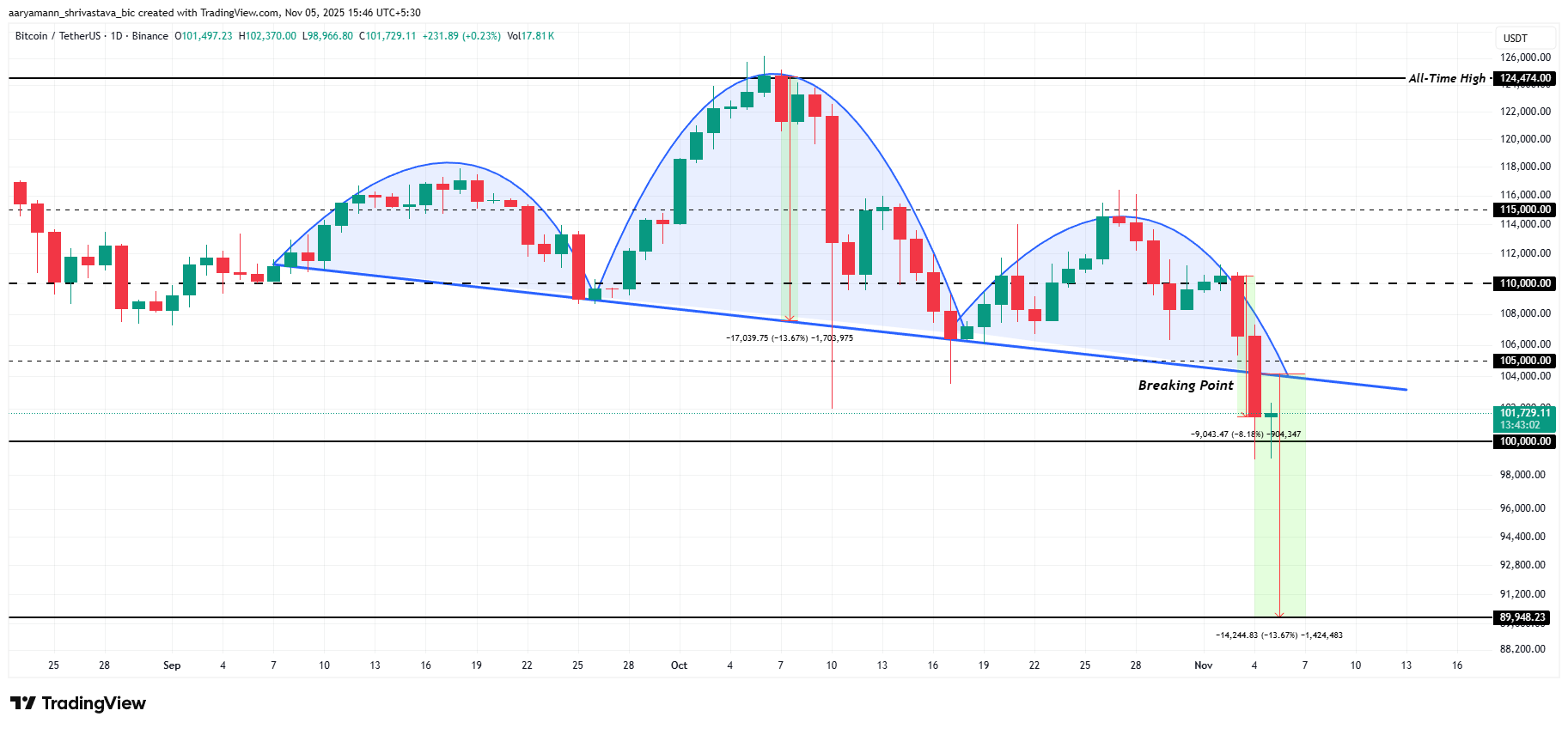 Bitcoin Price Analysis. Source:
Conversely, continued selling pressure and weak market conditions could send BTC below $100,000 again. A breach under $98,000 may lead to further losses toward $95,000 or lower, undermining any short-term recovery hopes.
Disclaimer: The content of this article solely reflects the author's opinion and does not represent the platform in any capacity. This article is not intended to serve as a reference for making investment decisions.
You may also like
The AI boom may follow the path of the 19th-century railway bubble, and builders may not be the ultimate winners
Goldman Sachs analyst Bobby Molavi compared the current situation to the 19th-century British railway mania: 500 companies spent more than the nation's annual income building 8,000 miles of railway, with most early investors losing out, while the real beneficiaries were the later "passengers." He pointed out that the current AI craze is driven by both debt and momentum, and that the S&P 500’s forward P/E ratio of 18x is only "a bit cheaper." Whether the builders can retain value is uncertain, and history does not offer an optimistic answer.

If Anthropic's IPO goes smoothly and the stock price rises next week, then everything remains the same for AI. Otherwise, some companies will go bankrupt.
The shrinking valuations of two major giants have triggered a chain reaction—investors are adopting more conservative revenue multiples for AI startups and are directly halting high-valuation financing for companies with zero revenue. Multiple venture capital firms have advised their portfolio companies to lower valuation expectations and to quickly build up cash reserves. Market participants warn that the outcome of Anthropic’s IPO will be a barometer for the industry: if successful, the boom will continue; if it fails, some companies may face elimination.
After the Brazilian election, political discount deepens; Morgan Stanley remains bullish on Petrobras (PBR.US), focusing on fuel pricing and dividends
Morgan Stanley still maintains its most optimistic "Overweight" rating, but has lowered its year-end 2027 target price from $31 to $25.

Corning (GLW.US) receives initial "Buy" rating from Jefferies! AI factories driving a fiber optic rush, with a potential global supply gap of up to 30%
For Corning, the recent profit growth mainly comes from the expansion of AI clusters. As the number of optical links crossing cabinets and campuses increases, customers need to deploy more optical fibers within limited conduit and cabinet space, thus driving demand for high-density optical cables and connection systems.

Crypto prices
More


