
3 Diverging Signals Show XRP Investors Holding Firm Despite Market Fear

Despite price declines, XRP investors continue accumulating and withdrawing tokens from exchanges, signaling confidence backed by ETF interest and global legal recognition.
XRP investors may be facing a difficult period as their portfolios show little improvement in November. However, several data points reveal positive signals that contradict the token’s bearish price action.
These divergences suggest that XRP remains one of the top choices among retail investors seeking to protect their portfolios amid the unpredictable volatility of late 2025.
XRP Dominance Rises While Price Falls
A divergence occurs when two related indicators move in opposite directions. It often reveals underlying dynamics that are not immediately visible.
The first notable divergence appears between XRP’s price and its market dominance (XRP.D), which represents XRP’s share of the total crypto market capitalization.
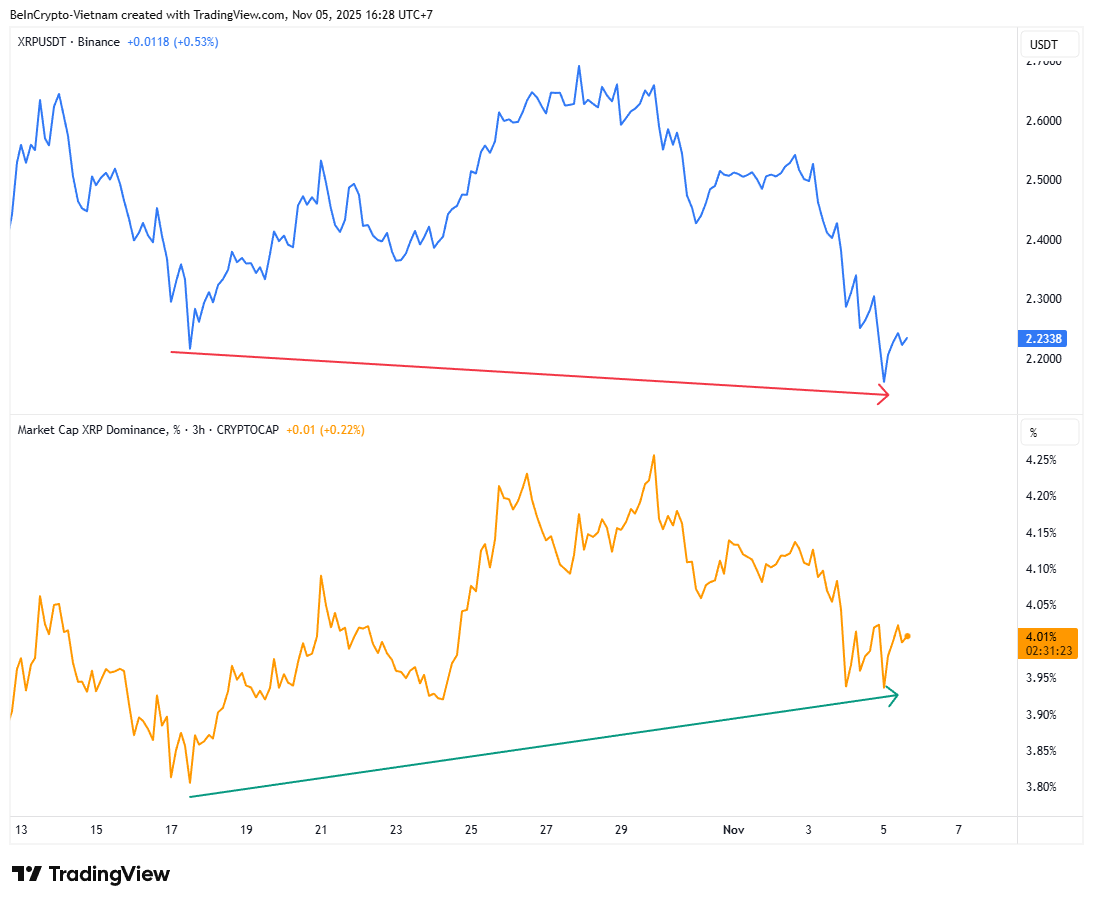 XRP Prive vs XRP Dominance. Source:
TradingView
TradingView data shows XRP’s price has been forming lower lows over the past month. Meanwhile, XRP.D has been trending upward during the same period.
Currently, XRP.D stands at 4%, up from 3.8% last month. This rise suggests that investors may be shifting their focus to XRP as many altcoins lose momentum.
A Q3 2025 report from Kaito Research ranked XRP alongside Ethereum (ETH), trailing only Bitcoin across six key metrics: Volume, Liquidity, Market Capitalization, Market Availability, Maturity, and Custody Availability.
“Bitcoin achieves a perfect 100/100 score, and ranks as the only AAA-rated asset. ETH and XRP tied for second place with scores of 95,” investor Crypto Eri ~ Carpe Diem said.
Exchange Withdrawing Addresses Surge
The second divergence appears in on-chain data: XRP’s price continues to fall, but the number of withdrawing addresses has surged.
According to CryptoQuant, since July, the price of XRP has dropped from above $3.50 to $2.20. Yet, the 30-day average number of withdrawing addresses has increased from under 1,000 to over 2,500.
Instead of panicking and sending XRP to exchanges for selling, many investors are withdrawing their tokens from exchanges. This move signals long-term commitment and makes the circulating supply on exchanges more scarce.
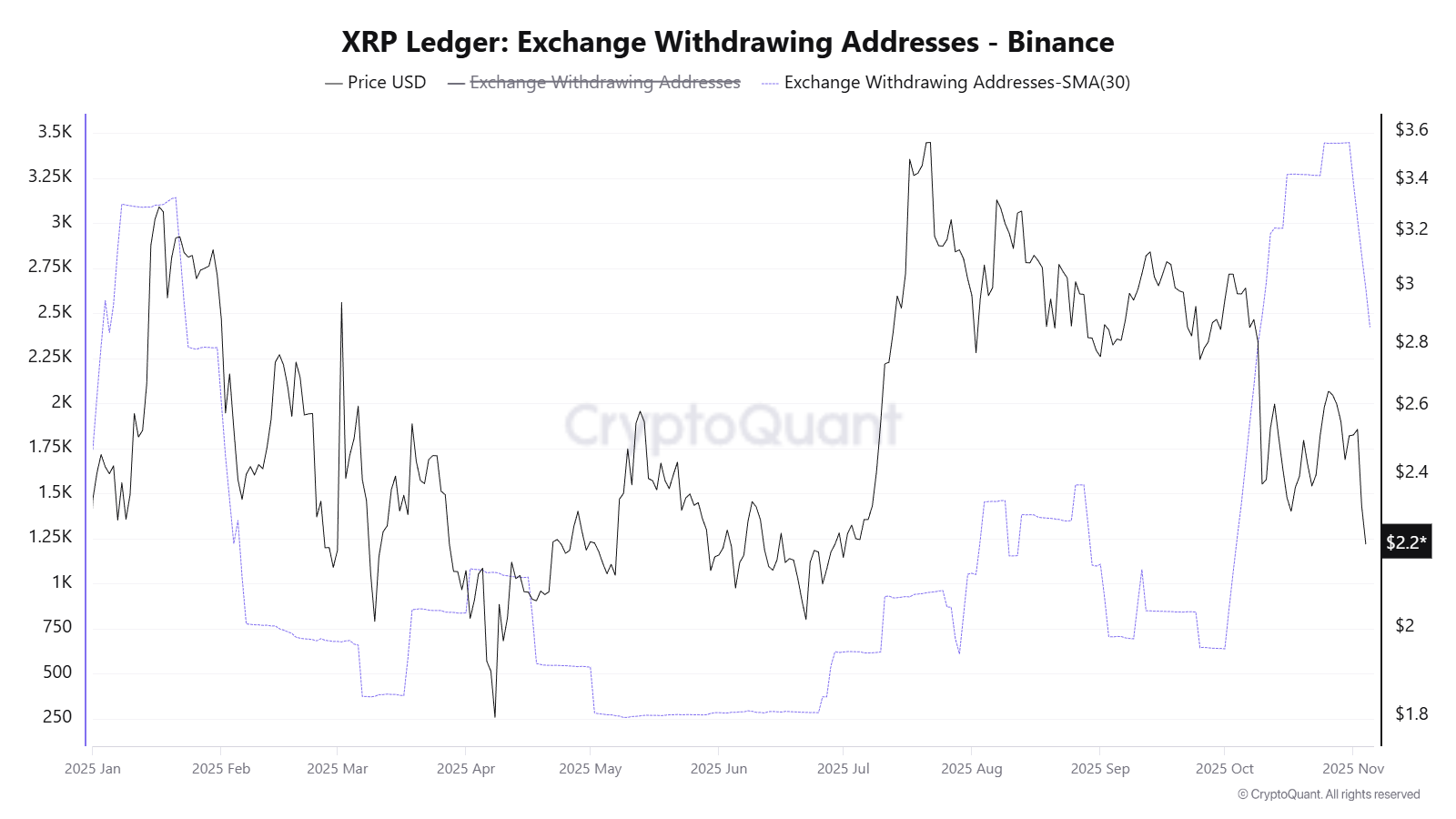 XRP Exchange Withdrawing Addresses (Binance). Source:
CryptoQuant.
A recent report from BeInCrypto revealed that 300 million XRP were withdrawn from Binance in the past month. In November, XRP reserves on Binance continued to hit new lows.
Earlier in 2025, a similar rise in withdrawing addresses coincided with XRP’s upward price movement. This pattern suggests that the current fear-driven sentiment might be masking the token’s underlying strength.
XRP Holders Increase
The third divergence suggests that XRP’s price is decreasing while the number of holders is increasing.
Data from CoinMarketCap reveals that over the past month, XRP’s price has dropped from above $3 to $ 2.20, but the number of holders has increased by over 8,000.
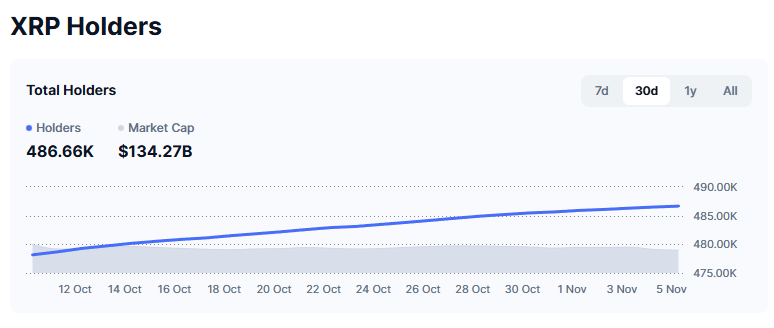 XRP Holders. Source:
CoinMarketCap.
This trend suggests that many investors view the price decline as an opportunity to accumulate XRP at better valuations.
Recent positive developments may have encouraged this sentiment. Both Franklin Templeton and Grayscale Investments submitted amended filings to the US Securities and Exchange Commission (SEC) for proposed XRP exchange-traded funds (ETFs). Additionally, the Madras High Court in India recognized XRP as a legal asset, granting it protection under criminal law.
These diverging signals indicate that many XRP investors remain confident despite the broader market’s fearful mood. Confidence alone does not guarantee success, but what matters more is having a clear capital protection strategy when the market moves against expectations.
Read the article at BeInCryptoDisclaimer: The content of this article solely reflects the author's opinion and does not represent the platform in any capacity. This article is not intended to serve as a reference for making investment decisions.
You may also like
The AI boom may follow the path of the 19th-century railway bubble, and builders may not be the ultimate winners
Goldman Sachs analyst Bobby Molavi compared the current situation to the 19th-century British railway mania: 500 companies spent more than the nation's annual income building 8,000 miles of railway, with most early investors losing out, while the real beneficiaries were the later "passengers." He pointed out that the current AI craze is driven by both debt and momentum, and that the S&P 500’s forward P/E ratio of 18x is only "a bit cheaper." Whether the builders can retain value is uncertain, and history does not offer an optimistic answer.

If Anthropic's IPO goes smoothly and the stock price rises next week, then everything remains the same for AI. Otherwise, some companies will go bankrupt.
The shrinking valuations of two major giants have triggered a chain reaction—investors are adopting more conservative revenue multiples for AI startups and are directly halting high-valuation financing for companies with zero revenue. Multiple venture capital firms have advised their portfolio companies to lower valuation expectations and to quickly build up cash reserves. Market participants warn that the outcome of Anthropic’s IPO will be a barometer for the industry: if successful, the boom will continue; if it fails, some companies may face elimination.
After the Brazilian election, political discount deepens; Morgan Stanley remains bullish on Petrobras (PBR.US), focusing on fuel pricing and dividends
Morgan Stanley still maintains its most optimistic "Overweight" rating, but has lowered its year-end 2027 target price from $31 to $25.

Corning (GLW.US) receives initial "Buy" rating from Jefferies! AI factories driving a fiber optic rush, with a potential global supply gap of up to 30%
For Corning, the recent profit growth mainly comes from the expansion of AI clusters. As the number of optical links crossing cabinets and campuses increases, customers need to deploy more optical fibers within limited conduit and cabinet space, thus driving demand for high-density optical cables and connection systems.

Crypto prices
More


