

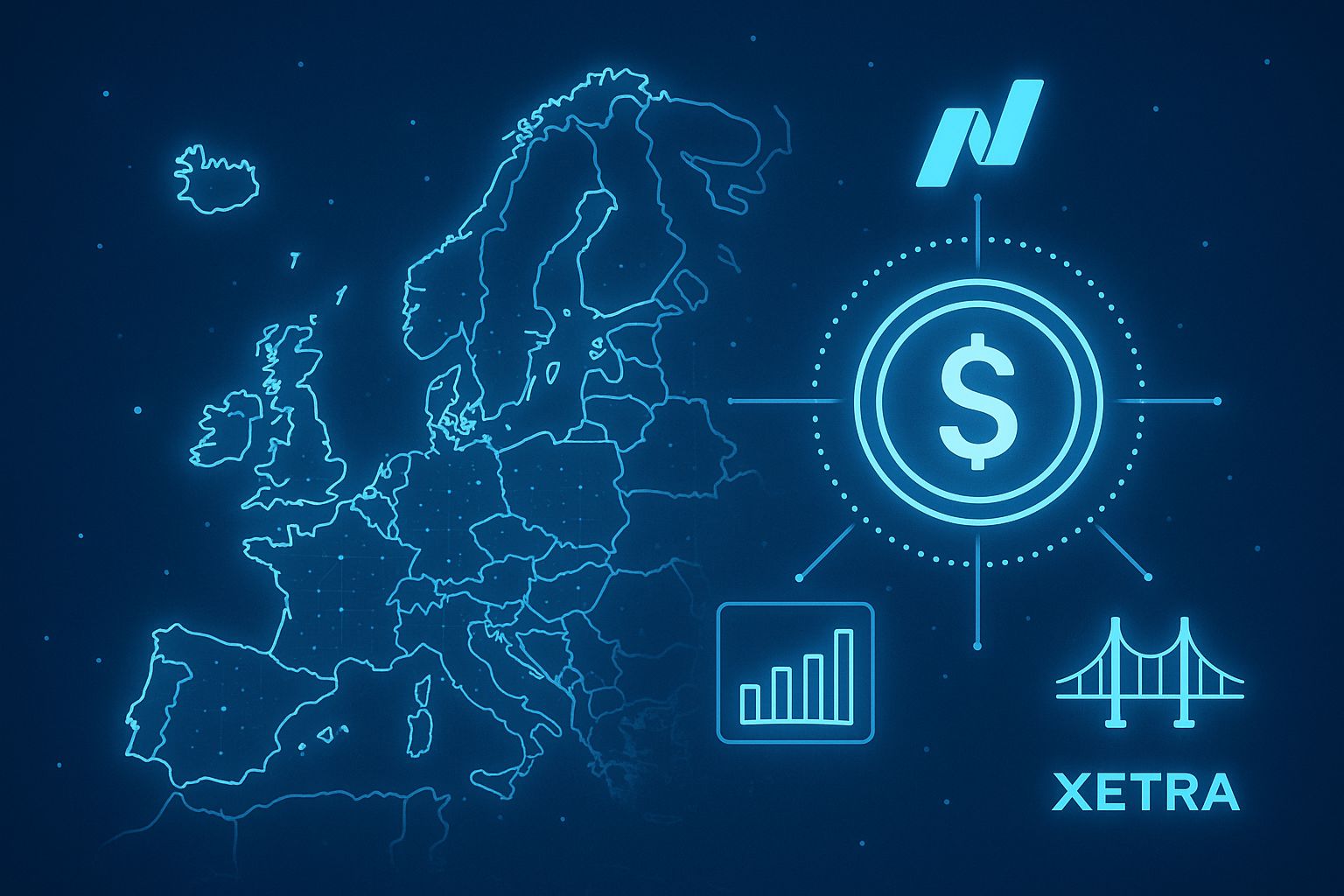
- The STABLE ETP is physically backed and rebalanced quarterly via Coinbase Custody.
- Investors gain exposure to Ethereum, XRP, Solana, Chainlink, Stellar, and Aave.
- Launch aligns with Europe’s MiCA regulation and Nasdaq’s digital asset strategy.
A Swedish crypto asset manager has launched Europe’s first exchange-traded product (ETP) dedicated to the infrastructure supporting stablecoins, marking a turning point for regulated digital asset investing in the region.
The first stablecoin infrastructure ETP in Europe
Trading under the Bloomberg ticker STABLE, the product is designed to capture value from the blockchains and crypto assets that underpin the growing stablecoin ecosystem.
On Nasdaq Stockholm and Helsinki, it trades as STABLE and STABLEE, respectively, while the Xetra listing uses the symbol VRTN.
The ETP is available to both institutional and retail investors through major brokers and banks, including Avanza, Nordnet, SAVR, Scalable Capital, Smartbroker, and Finanzen Zero.
Virtune describes the product as “the first of its kind” in Europe.
Unlike conventional crypto funds that hold stablecoins such as USDC or Tether, the STABLE ETP provides exposure to the blockchains where stablecoins operate.
It is 100% physically backed by digital assets stored securely with Coinbase Custody and is rebalanced quarterly to reflect market shifts.
The ETP carries a 1.95% annual management fee and supports trading in SEK and EUR.
Capturing the growth of the $314.5 billion stablecoin market
The stablecoin sector has grown rapidly over the past year, with financial institutions adopting tokenised money to facilitate round-the-clock settlements and faster cross-border transfers.
According to CoinMarketCap data , the total stablecoin market value stands at about $314.5 billion.
Euro-backed stablecoins, while still small in comparison, have reached a market capitalisation of $609.37 million, as per CoinGecko , led by Circle’s EURC, Stasis Euro, and Societe Generale’s EUR CoinVertible.
This expansion has encouraged European banks to experiment with their own digital currencies.
In September, nine banks, including UniCredit, Banca Sella, DekaBank, and ING, announced plans to launch a MiCA-compliant euro-backed stablecoin.
Virtune’s STABLE ETP arrives amid this momentum, offering investors a regulated avenue to participate in the wider stablecoin ecosystem.
A bridge between traditional finance and digital assets
By focusing on blockchain infrastructure rather than the stablecoins themselves, Virtune’s ETP aims to diversify risk while capturing growth potential from multiple networks.
The index is weighted using the square root of market capitalisation, a method designed to prevent dominance by larger assets and to maintain balanced exposure across the ecosystem.
For investors, the STABLE ETP represents a gateway into crypto infrastructure via a regulated vehicle.
It eliminates the need to manage private keys or digital wallets while still providing participation in the networks driving stablecoin use in payments, banking, and commerce.
The ETP also aligns with Nasdaq’s broader strategy to expand its range of digital asset products within a transparent regulatory framework.
Helena Wedin, Head of ETF and ETP Services for European Markets at Nasdaq, said the exchange’s goal is to encourage innovation in a secure marketplace.
The listing of Virtune’s product, she noted, highlights the growing maturity of the ETP sector and its importance in linking traditional investors to blockchain-based opportunities.
What Virtune’s launch signals for Europe
The introduction of STABLE marks a significant milestone for European digital asset markets, which are now operating under the new MiCA regulation.
It underscores a shift from speculative crypto products toward infrastructure-focused investments that mirror the real-world utility of blockchain technology.
By packaging stablecoin infrastructure into a regulated exchange-traded product, Virtune has provided a blueprint for how digital assets can coexist with mainstream financial systems.
As more financial institutions explore tokenised money and on-chain settlements, products such as the Virtune Stablecoin Index ETP could serve as benchmarks for future innovation.
In a market driven by efficiency, transparency, and accessibility, Virtune’s launch demonstrates how Europe’s financial ecosystem is evolving to embrace the technology powering the next generation of digital finance.





