
Is dropping below $100,000 just the beginning? Bitcoin "whales" have dumped $4.5 billions in one month, and the sell-off may continue until next spring

This wave of sell-offs may continue until next spring, and bitcoin could further drop to 85,000 dollars.
This wave of selling may continue until next spring, and Bitcoin could further drop to $85,000.
Written by: Dong Jing
Bitcoin falling below $100,000 may signal the arrival of a new and more intense wave of selling, as there are signs that this time the market downturn is not driven by leveraged liquidations, but by the continued selling of long-term holders.
On November 5, Bitcoin once fell by 7.4%, dropping below $100,000 for the first time since June, and has accumulated a decline of more than 20% from the all-time high set a month ago.
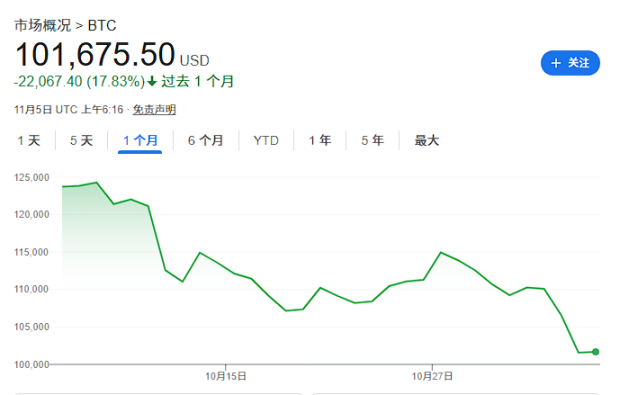
Market data shows that about $2 billion in crypto positions were liquidated in the past 24 hours, far lower than the $19 billion during last month's crash. Bitcoin futures open interest remains low, indicating that leverage is no longer the dominant force.
According to Markus Thielen, head of 10x Research, long-term Bitcoin holders have sold about 400,000 bitcoins worth around $45 billion in the past month, causing an imbalance between supply and demand in the market.
Analysts warn that this wave of selling may continue until next spring, and Bitcoin could further drop to $85,000.
Spot Selling Dominates, Market Dynamics Shift
The core feature of this round of decline is the sustained selling pressure in the spot market, rather than the chain reaction of futures liquidations that crypto traders have recently become accustomed to. In the past 24 hours, about $2 billion in crypto positions were liquidated, a figure that pales in comparison to the $19 billion during last month's crash.
Vetle Lunde, head of research at K33, stated that over 319,000 bitcoins have been reactivated in the past month, mainly from coins held for 6 to 12 months. "This indicates a large-scale profit-taking since mid-July. Although some reactivations are due to internal transfers, many reflect real selling behavior."
Bitcoin futures open interest remains low, while options traders are betting on the $80,000 level with put options. Against the backdrop of relatively calm leverage, the market focus has shifted to long-term holders choosing to sell.
"Whales" Stop Buying, Selling Wave May Continue Until Next Spring
Markus Thielen pointed out that the increasingly severe imbalance between long-term holders selling Bitcoin and new buyers entering the market is beginning to shape market direction, not just sentiment.
If the crash in October was forced selling, the current pullback may reflect a more alarming phenomenon: conviction is collapsing.
Earlier this year, Thielen observed that "super whales" (entities holding 1,000 to 10,000 bitcoins) began to sell heavily, while institutional investors tried to absorb the supply. But since the crash on October 10, broader demand has faded.
Thielen said: "We have broken through some on-chain indicators—people are in a loss position, and they need to close out." Overall, the accumulation of the group holding 100 to 1,000 bitcoins has dropped sharply. "The whales are simply not buying," he said.
Looking ahead, Thielen warns that this selling may continue until next spring. During the 2021-2022 bear market, large holders sold more than 1 million bitcoins over nearly a year, and Thielen believes this scale could repeat.
"If it's at a similar pace, we could see this continue for another six months."
He did not predict a catastrophic crash but believes there is room for further decline. "I don't believe in cycle theory," Thielen said, "but I think we will consolidate and may drift slightly lower from here. $85,000 is my maximum downside target."
Disclaimer: The content of this article solely reflects the author's opinion and does not represent the platform in any capacity. This article is not intended to serve as a reference for making investment decisions.
You may also like
The AI boom may follow the path of the 19th-century railway bubble, and builders may not be the ultimate winners
Goldman Sachs analyst Bobby Molavi compared the current situation to the 19th-century British railway mania: 500 companies spent more than the nation's annual income building 8,000 miles of railway, with most early investors losing out, while the real beneficiaries were the later "passengers." He pointed out that the current AI craze is driven by both debt and momentum, and that the S&P 500’s forward P/E ratio of 18x is only "a bit cheaper." Whether the builders can retain value is uncertain, and history does not offer an optimistic answer.

If Anthropic's IPO goes smoothly and the stock price rises next week, then everything remains the same for AI. Otherwise, some companies will go bankrupt.
The shrinking valuations of two major giants have triggered a chain reaction—investors are adopting more conservative revenue multiples for AI startups and are directly halting high-valuation financing for companies with zero revenue. Multiple venture capital firms have advised their portfolio companies to lower valuation expectations and to quickly build up cash reserves. Market participants warn that the outcome of Anthropic’s IPO will be a barometer for the industry: if successful, the boom will continue; if it fails, some companies may face elimination.
After the Brazilian election, political discount deepens; Morgan Stanley remains bullish on Petrobras (PBR.US), focusing on fuel pricing and dividends
Morgan Stanley still maintains its most optimistic "Overweight" rating, but has lowered its year-end 2027 target price from $31 to $25.

Corning (GLW.US) receives initial "Buy" rating from Jefferies! AI factories driving a fiber optic rush, with a potential global supply gap of up to 30%
For Corning, the recent profit growth mainly comes from the expansion of AI clusters. As the number of optical links crossing cabinets and campuses increases, customers need to deploy more optical fibers within limited conduit and cabinet space, thus driving demand for high-density optical cables and connection systems.

Crypto prices
More


