
Ethereum Turns Negative for 2025 as Crypto Liquidations Exceed $1.1 Billion

Ethereum’s drop below $3,400 has erased its 2025 gains as crypto markets suffer over $1.1 billion in liquidations. With Bitcoin hovering near $100,000 and whales selling into weakness, traders fear the worst may not be over yet.
Ethereum and Bitcoin extended their sharp declines on November 4, triggering over $1.1 billion in crypto liquidations within 24 hours as traders rushed to the exits amid mounting market stress.
The drawdown has plunged the Ethereum price to a milestone last seen a year ago.
Ethereum Turns Negative for 2025 as Crypto Liquidations Exceed $1.1 Billion
Ethereum broke below the critical $3,400 mark, officially turning negative year-to-date (YTD) after starting 2025 near $3,353. The move marked a 7% daily plunge, its steepest drop in months.
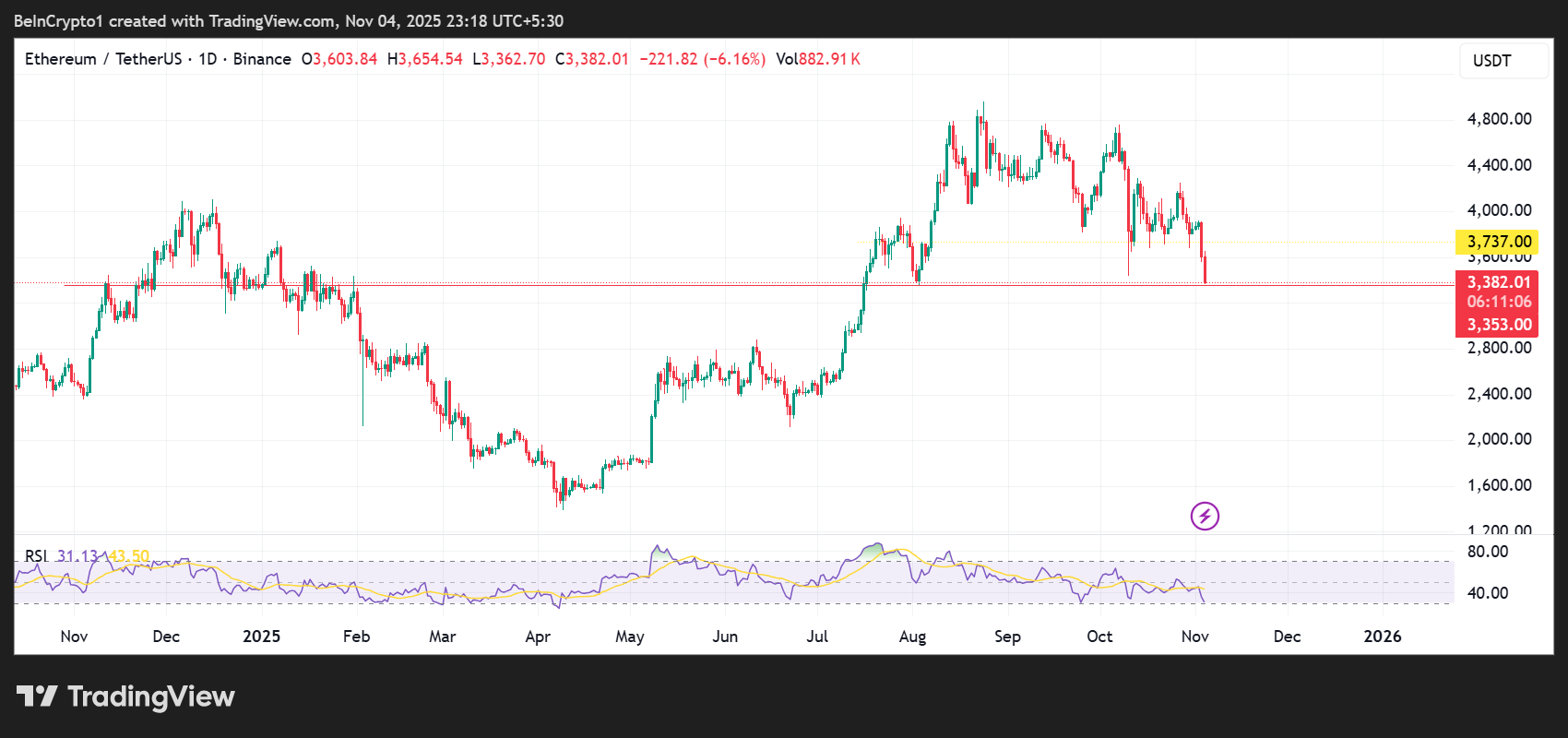 Ethereum (ETH) Price Performance. Source:
TradingView
The decline has effectively erased all of ETH’s year-to-date gains, signaling a shift in sentiment after months of relative stability in the altcoin market.
Bitcoin, meanwhile, slid to an intraday low of $100,721, putting the leading cryptocurrency within striking distance of the psychologically crucial $100,000 support zone, a level not seen since June 23.
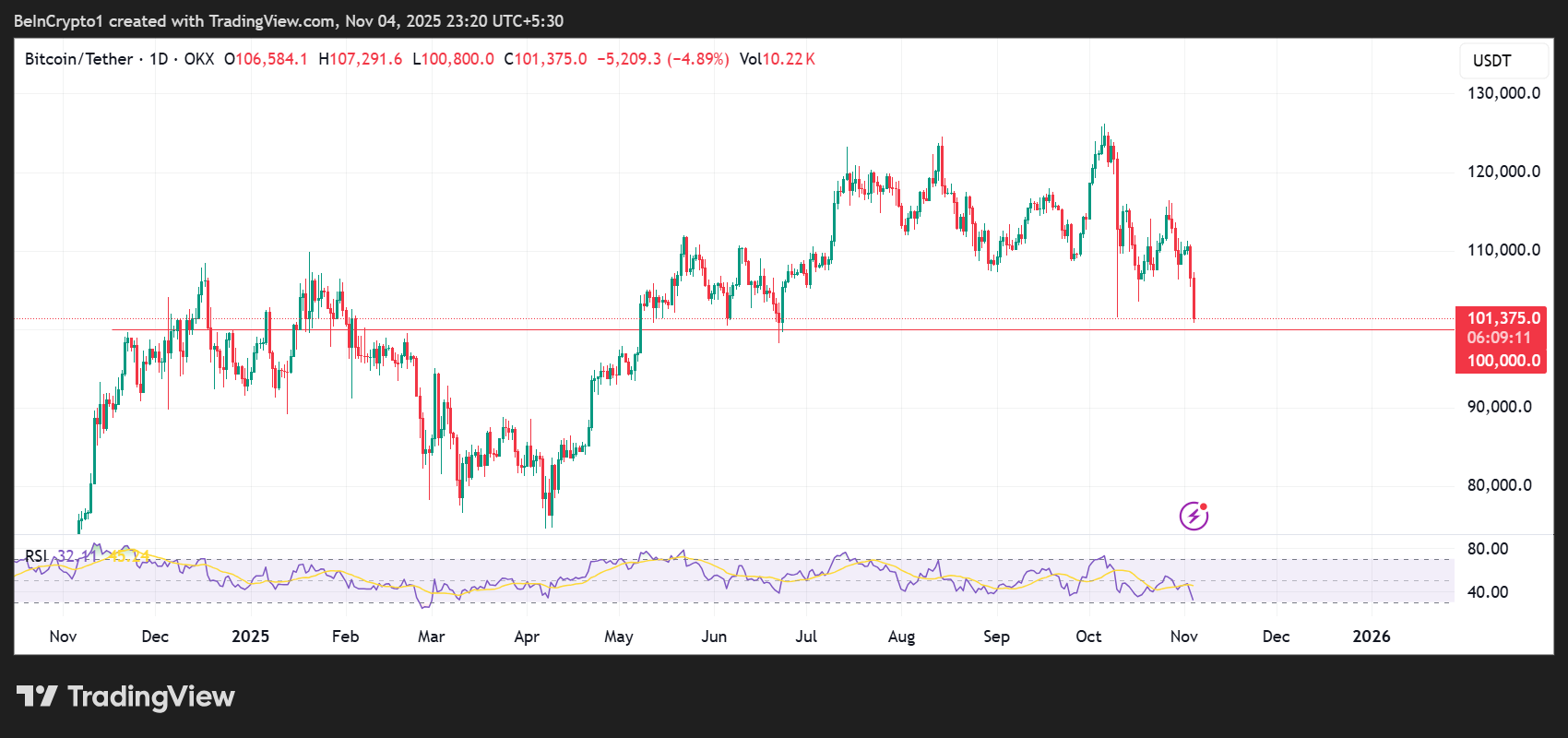 Bitcoin (BTC) Price Performance. Source:
TradingView
For both assets, the RSI (Relative Strength Index) trended at near-oversold territories, indicating the magnitude of investor sentiment.
The synchronized selloff sent shockwaves across the market, with major altcoins following suit amid widespread deleveraging.
$1.1 Billion in Liquidations as Leverage Unwinds
Data from Coinglass shows that over 303,000 traders were liquidated in the past 24 hours, resulting in a total of $1.10 billion in forced liquidations across major exchanges.
Within a single hour, over $300 million in positions were wiped out, with approximately $287 million representing long positions. This highlights how overleveraged bullish bets were punished as prices broke key support levels.
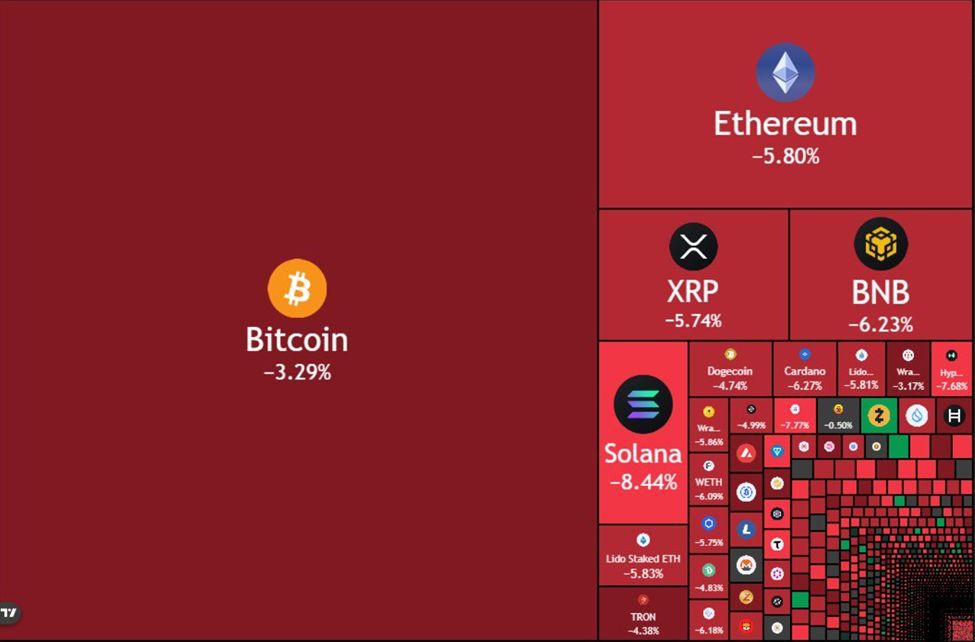 Total Crypto Liquidations. Source: TradingView
Bitcoin and Ethereum accounted for the bulk of these liquidations, but high-beta assets like Solana, BNB, and XRP also experienced aggressive unwinding as traders rushed to reduce their exposure.
Amidst the chaos, however, one controversial trader, James Wynn, has been vindicated. According to Lookonchain, Wynn is finally in the green, sitting on an unrealized profit of $66,465.
James Wynn has finally won! In the past two months, he's been liquidated 45 times, whether going long or short.But now, he's finally in the green — sitting on an unrealized profit of $66,465.
Whale Dumping Deepens Bearish Pressure
On-chain analytics firm Santiment reported a notable behavioral split between large and small Bitcoin holders.
Wallets holding between 10 and 10,000 BTC, often referred to as whales and sharks (respectively), have offloaded over 38,366 BTC since October 12. This represents a 0.28% decline in their overall holdings.
These addresses currently control 68.5% of Bitcoin’s total supply, meaning their selling has an outsized market impact.
Conversely, retail traders holding less than 0.01 BTC (“shrimps”) have been accumulating, adding 415 BTC (+0.85%) during the same period.
Santiment noted that this accumulation pattern is typically seen during market drawdowns but warned that a sustained rebound would only begin when whales flip from distribution to accumulation.
“Markets rise when key stakeholders accumulate the coins that small wallets shed. Micro traders need to show capitulation and fear, losing patience and selling off their coins at a loss as whales scoop them up. When this happens — and it will — it will signal a market bottom and an ideal time to buy,” Santiment wrote.
With both Bitcoin and Ethereum now flirting with critical psychological and technical thresholds, traders are closely watching for signs of stabilization or further breakdown.
A decisive breach below $100,000 for Bitcoin could accelerate outflows and compound negative sentiment across the digital asset space.
Disclaimer: The content of this article solely reflects the author's opinion and does not represent the platform in any capacity. This article is not intended to serve as a reference for making investment decisions.
You may also like
The AI boom may follow the path of the 19th-century railway bubble, and builders may not be the ultimate winners
Goldman Sachs analyst Bobby Molavi compared the current situation to the 19th-century British railway mania: 500 companies spent more than the nation's annual income building 8,000 miles of railway, with most early investors losing out, while the real beneficiaries were the later "passengers." He pointed out that the current AI craze is driven by both debt and momentum, and that the S&P 500’s forward P/E ratio of 18x is only "a bit cheaper." Whether the builders can retain value is uncertain, and history does not offer an optimistic answer.

If Anthropic's IPO goes smoothly and the stock price rises next week, then everything remains the same for AI. Otherwise, some companies will go bankrupt.
The shrinking valuations of two major giants have triggered a chain reaction—investors are adopting more conservative revenue multiples for AI startups and are directly halting high-valuation financing for companies with zero revenue. Multiple venture capital firms have advised their portfolio companies to lower valuation expectations and to quickly build up cash reserves. Market participants warn that the outcome of Anthropic’s IPO will be a barometer for the industry: if successful, the boom will continue; if it fails, some companies may face elimination.
After the Brazilian election, political discount deepens; Morgan Stanley remains bullish on Petrobras (PBR.US), focusing on fuel pricing and dividends
Morgan Stanley still maintains its most optimistic "Overweight" rating, but has lowered its year-end 2027 target price from $31 to $25.

Corning (GLW.US) receives initial "Buy" rating from Jefferies! AI factories driving a fiber optic rush, with a potential global supply gap of up to 30%
For Corning, the recent profit growth mainly comes from the expansion of AI clusters. As the number of optical links crossing cabinets and campuses increases, customers need to deploy more optical fibers within limited conduit and cabinet space, thus driving demand for high-density optical cables and connection systems.

Crypto prices
More


