
Changpeng Zhao’s $2M Aster Investment Boosts DeFi Market Confidence

Aster, a decentralized perpetuals exchange, surged over the weekend after Binance founder Changpeng “CZ” Zhao revealed a personal investment of more than $2 million in its native token. His entry into the project reignited market excitement, drawing investors back to the fast-growing DeFi platform and reaffirming his lasting influence over digital-asset markets.
In brief
- CZ invests over $2M of personal funds in Aster, sending its price soaring from $0.91 to above $1.20 within an hour.
- Aster surpasses Hyperliquid with $70B in weekly trading, cementing its place as a top decentralized perpetuals exchange.
- CZ’s post-pardon comeback boosts sentiment across DeFi, signaling a revival of institutional and retail crypto confidence.
- Aster’s transparency tools and Layer-2 integrations enhance credibility, driving renewed trust and trading activity.
Changpeng Zhao’s Personal Investment Triggers Aster Price Rally
Zhao announced the purchase in a post on X, saying he had bought Aster with his own funds on Binance and that he viewed himself as a long-term holder rather than a trader.
Following his post, Aster’s price jumped from around $0.91 to over $1.20 within an hour, according to market data. A surge in trading volume accompanied the sharp rise as market participants quickly followed CZ’s lead.
Aster’s close ties to YZi Labs—Zhao’s family office—drew additional attention to the project. The connection strengthened investor confidence in Aster’s foundations and its expanding role in decentralized perpetual trading.
Aster Emerges as a Leader in the Expanding Perpetuals Market
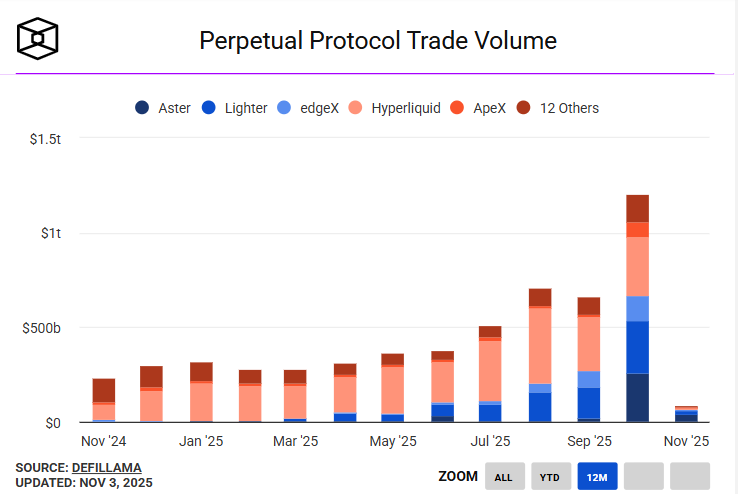
Perpetual exchanges have emerged as one of 2025’s standout growth sectors, and Aster is now positioned among the leaders . It recently surpassed Hyperliquid in reported trading volumes, logging more than $70 billion in transactions over a seven-day span, according to The Block data.
Earlier this year, questions over data accuracy surfaced when DefiLlama founder 0xngmi temporarily removed Aster’s metrics, citing verification challenges . The data was later reinstated after new monitoring systems were deployed to improve the tracking of decentralized-exchange volumes.
As scrutiny eased, traders began to reassess Aster’s strength and market position. Zhao’s investment amplified that focus, highlighting several key factors behind the protocol’s rise:
- High trading throughput: Processes billions in daily volume through on-chain settlement.
- Deepening liquidity: Growing participation from major market makers supports stronger price stability.
- Community governance: Token holders have direct input on protocol fees and incentive structures.
- Cross-chain compatibility: Integrations with leading Layer-2 networks improve access and efficiency.
- Transparency upgrades: New verification tools help validate reported trading data.
These features have strengthened Aster’s credibility and helped it capture a larger share of the perpetual-trading market.
Market Sentiment Shifts as CZ Reclaims Spotlight Following Pardon
Zhao’s return to the public stage represents a significant turning point for crypto. After resigning as Binance CEO and serving a four-month U.S. prison sentence for banking-law violations, he received a presidential pardon from Donald Trump on October 23—a move that swiftly reshaped sentiment toward both him and his affiliated projects.
White House Press Secretary Karoline Leavitt described the pardon as the end of what she called the previous administration’s “war on cryptocurrency.” Market analysts viewed it as a signal of easing regulatory pressure and a potential revival of institutional interest.
Both Aster and Binance’s BNB token responded immediately. Aster climbed to $1.07, while BNB gained more than 5%, reaching $1,123. Despite Aster’s Fear & Greed Index reading of 42, investor enthusiasm appears to be returning.
Sunday’s surge reinforced Zhao’s continuing ability to move markets. With his re-emergence in the public eye and Aster’s growing momentum, the decentralized-perpetuals sector may be entering a new phase of renewed confidence and attention.
Disclaimer: The content of this article solely reflects the author's opinion and does not represent the platform in any capacity. This article is not intended to serve as a reference for making investment decisions.
You may also like
The AI boom may follow the path of the 19th-century railway bubble, and builders may not be the ultimate winners
Goldman Sachs analyst Bobby Molavi compared the current situation to the 19th-century British railway mania: 500 companies spent more than the nation's annual income building 8,000 miles of railway, with most early investors losing out, while the real beneficiaries were the later "passengers." He pointed out that the current AI craze is driven by both debt and momentum, and that the S&P 500’s forward P/E ratio of 18x is only "a bit cheaper." Whether the builders can retain value is uncertain, and history does not offer an optimistic answer.

If Anthropic's IPO goes smoothly and the stock price rises next week, then everything remains the same for AI. Otherwise, some companies will go bankrupt.
The shrinking valuations of two major giants have triggered a chain reaction—investors are adopting more conservative revenue multiples for AI startups and are directly halting high-valuation financing for companies with zero revenue. Multiple venture capital firms have advised their portfolio companies to lower valuation expectations and to quickly build up cash reserves. Market participants warn that the outcome of Anthropic’s IPO will be a barometer for the industry: if successful, the boom will continue; if it fails, some companies may face elimination.
After the Brazilian election, political discount deepens; Morgan Stanley remains bullish on Petrobras (PBR.US), focusing on fuel pricing and dividends
Morgan Stanley still maintains its most optimistic "Overweight" rating, but has lowered its year-end 2027 target price from $31 to $25.

Corning (GLW.US) receives initial "Buy" rating from Jefferies! AI factories driving a fiber optic rush, with a potential global supply gap of up to 30%
For Corning, the recent profit growth mainly comes from the expansion of AI clusters. As the number of optical links crossing cabinets and campuses increases, customers need to deploy more optical fibers within limited conduit and cabinet space, thus driving demand for high-density optical cables and connection systems.

Crypto prices
More


