
3 Altcoins Facing Major Liquidations in the First Week of November

Ethereum, Aster, and Dash are leading the week’s high-risk liquidation zones as shorts dominate derivatives markets. With leverage skewed heavily to the downside, sharp rebounds could trigger billions in forced liquidations and amplify volatility.
The crypto market began the first week of November in the red, turning short-term sentiment among derivatives traders negative. Capital and leverage are now heavily positioned on short bets, increasing the likelihood of large short liquidations in the weeks ahead.
In this unbalanced liquidation landscape, certain altcoins could trigger significant losses for traders. Which ones are at risk?
1. Ethereum (ETH)
ETH’s seven-day liquidation map reveals a clear imbalance between potential liquidations on the long and short sides. The short positions dominate.
If ETH rebounds to $4,000 this week, more than $4.2 billion worth of shorts could be liquidated. A stronger recovery toward $4,300 could push total short liquidations close to $8 billion.
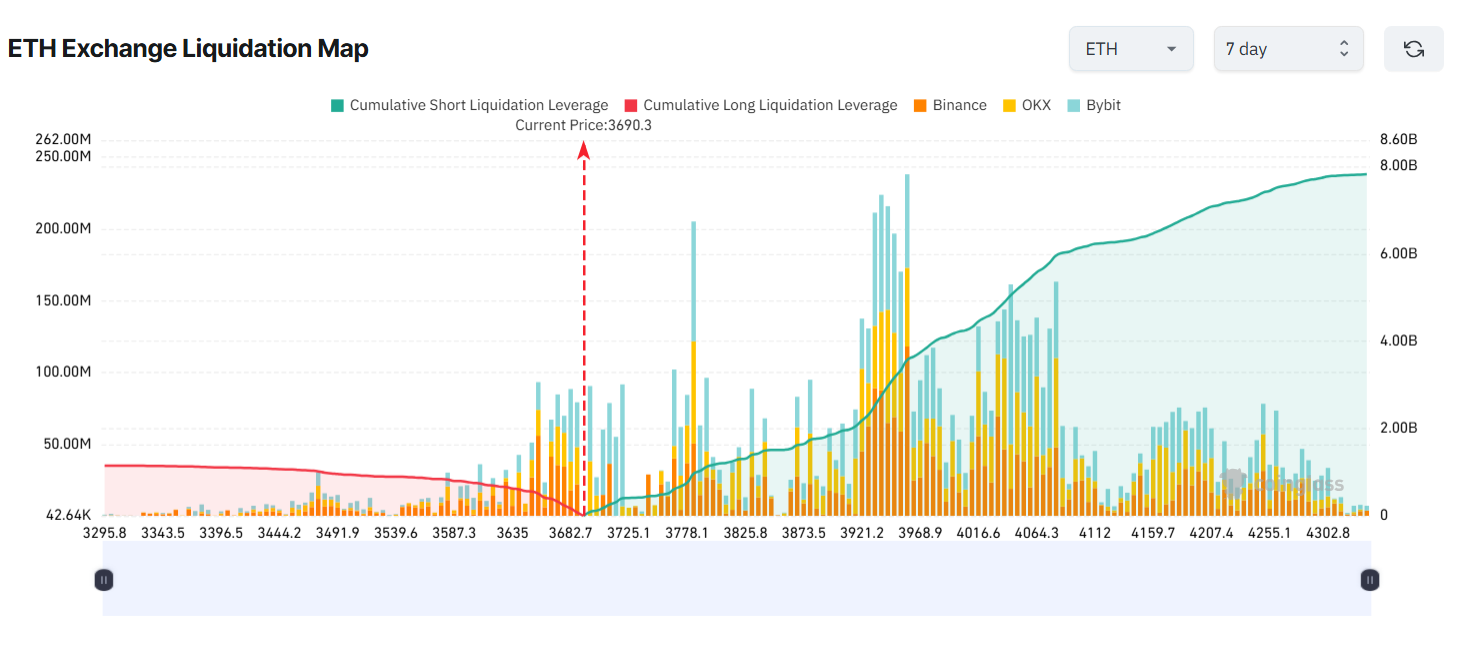 ETH Exchange Liquidation Map. Source:
Coinglass.
Recent analysis from BeInCrypto highlights a bullish divergence, signaling possible recovery momentum for ETH this week.
Analysts also noted that, despite short-term volatility, Ethereum’s network continues to set new records. These metrics reinforce strong fundamentals, encouraging investors to accumulate ETH on deep pullbacks.
For example, ETH’s application revenue has reached an all-time high, while the supply of stablecoins on the network keeps climbing.
ethereum app revenue hit an ATHin october, and stablecoin supply still marching higher pic.twitter.com/sXiz3RsoBL
— rip.eth (@ripeth) November 2, 2025
Given these factors, short sellers without proper risk management could face massive liquidations if ETH prices rebound sharply.
2. Aster (ASTER)
On the first Monday of November’s opening week, Aster’s liquidation map also shows a stark imbalance, with short-side liquidations outweighing long-side risks.
If ASTER rises to $1.4, roughly $44 million in short positions could be wiped out. Conversely, if it drops to $0.9, long liquidations could exceed $15 million.
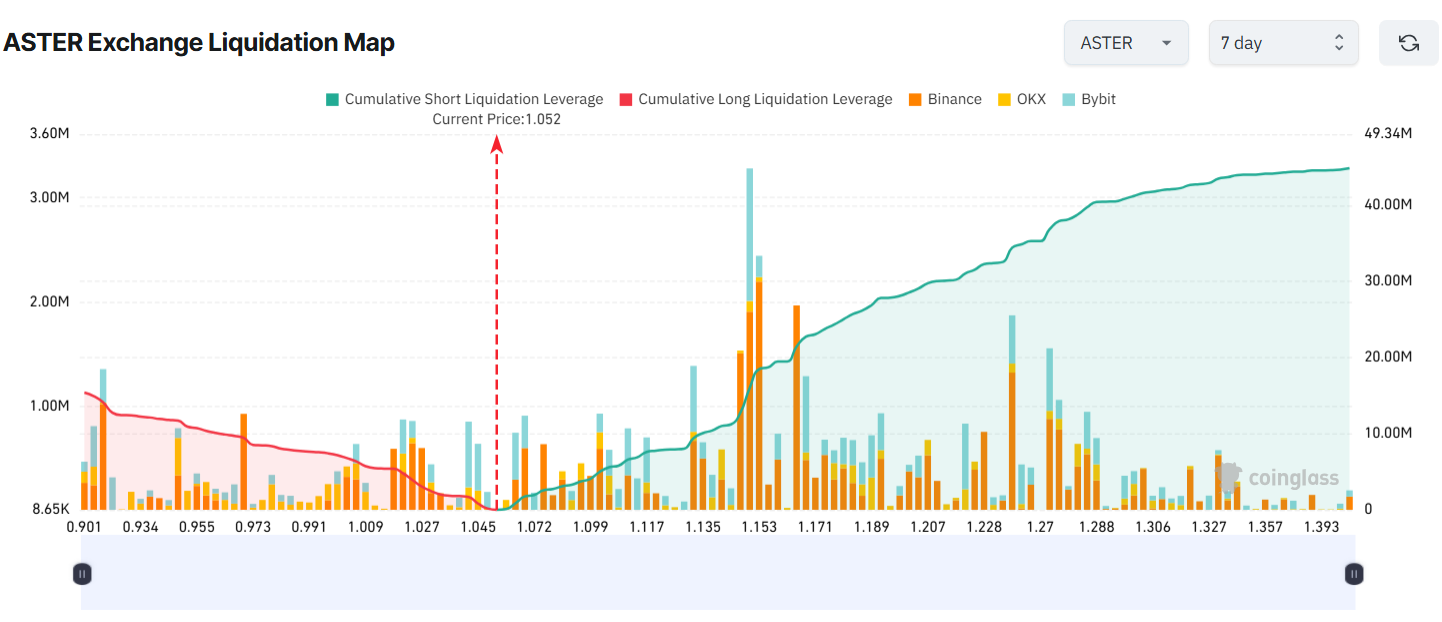 ASTER Exchange Liquidation Map. Source:
Coinglass
What could trigger short liquidations for ASTER? The biggest risk likely stems from social media influence, particularly from CZ’s recent posts on X.
Aster surged 30% after Binance founder Changpeng Zhao revealed he had personally purchased $2 million worth of ASTER tokens for long-term holding. This announcement prompted several other KOLs to disclose their own ASTER purchases publicly.
Although the price has since corrected, uncertainty remains. If CZ releases new updates about ASTER, it could cause another short-term price pump, leading to potential short liquidations. Short traders must stay cautious in such conditions.
3. Dash (DASH)
The privacy coin narrative continues into November. This time, Dash (DASH) has taken the spotlight, surpassing Zcash (ZEC) and reaching its highest price in three years.
Derivative traders are leaning bearish, increasing their short exposure. If DASH climbs to $105, over $13 million in short positions could be liquidated.
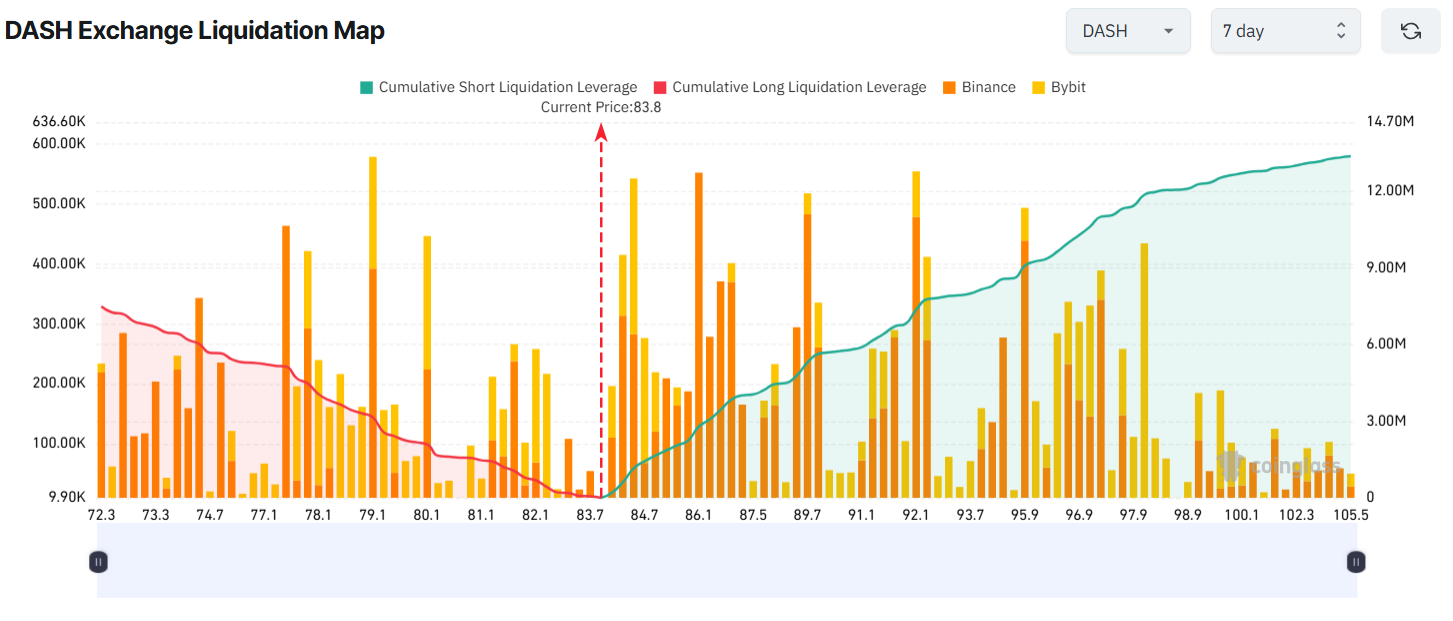 DASH Exchange Liquidation Map. Source:
Coinglass.
On X, some analysts are even more optimistic, projecting higher targets.
“Next stop: $100–140. If privacy meta continues… don’t be surprised to see this at $250,” Tactical Investing predicted.
In a FOMO-driven rally, it’s difficult to determine when the momentum will stop. As long as community discussions remain bullish, shorting DASH may carry a substantial risk of liquidation.
The altcoins gaining community attention — such as ETH, ASTER, and DASH — reflect themes recycled from previous months, including Ethereum’s ecosystem, DEX, and privacy narratives. This pattern suggests the market is running out of new catalysts.
Therefore, even if prices recover, such rallies might lack sustainability. As volatility increases, both long and short traders may end up facing similar levels of risk and loss.
Disclaimer: The content of this article solely reflects the author's opinion and does not represent the platform in any capacity. This article is not intended to serve as a reference for making investment decisions.
You may also like
The AI boom may follow the path of the 19th-century railway bubble, and builders may not be the ultimate winners
Goldman Sachs analyst Bobby Molavi compared the current situation to the 19th-century British railway mania: 500 companies spent more than the nation's annual income building 8,000 miles of railway, with most early investors losing out, while the real beneficiaries were the later "passengers." He pointed out that the current AI craze is driven by both debt and momentum, and that the S&P 500’s forward P/E ratio of 18x is only "a bit cheaper." Whether the builders can retain value is uncertain, and history does not offer an optimistic answer.

If Anthropic's IPO goes smoothly and the stock price rises next week, then everything remains the same for AI. Otherwise, some companies will go bankrupt.
The shrinking valuations of two major giants have triggered a chain reaction—investors are adopting more conservative revenue multiples for AI startups and are directly halting high-valuation financing for companies with zero revenue. Multiple venture capital firms have advised their portfolio companies to lower valuation expectations and to quickly build up cash reserves. Market participants warn that the outcome of Anthropic’s IPO will be a barometer for the industry: if successful, the boom will continue; if it fails, some companies may face elimination.
After the Brazilian election, political discount deepens; Morgan Stanley remains bullish on Petrobras (PBR.US), focusing on fuel pricing and dividends
Morgan Stanley still maintains its most optimistic "Overweight" rating, but has lowered its year-end 2027 target price from $31 to $25.

Corning (GLW.US) receives initial "Buy" rating from Jefferies! AI factories driving a fiber optic rush, with a potential global supply gap of up to 30%
For Corning, the recent profit growth mainly comes from the expansion of AI clusters. As the number of optical links crossing cabinets and campuses increases, customers need to deploy more optical fibers within limited conduit and cabinet space, thus driving demand for high-density optical cables and connection systems.

Crypto prices
More


