
Crypto Funds Bleed $360 Million After Powell Speech — Except Solana

Digital asset investment products faced $360 million in weekly outflows after Fed Chair Jerome Powell signaled a cautious stance on rate cuts, warning that premature easing could threaten inflation control.
Digital asset investment products saw $360 million in outflows last week after Federal Reserve Chair Jerome Powell signaled hesitation on future interest rate cuts.
Bitcoin ETFs took the hardest hit, losing $946 million, while Solana attracted a record $421 million in inflows.
Powell’s Hawkish Stance Rattles Markets
Outflows followed comments from Powell indicating another rate cut in December was not assured. He warned that loosening policy too quickly could threaten progress on inflation, while slow action might weigh on economic growth.
Investors viewed his remarks as hawkish, dampening hopes for swift monetary easing. These signals triggered withdrawals from digital asset products, especially in the US. US investors led outflows, pulling $439 million from crypto products.
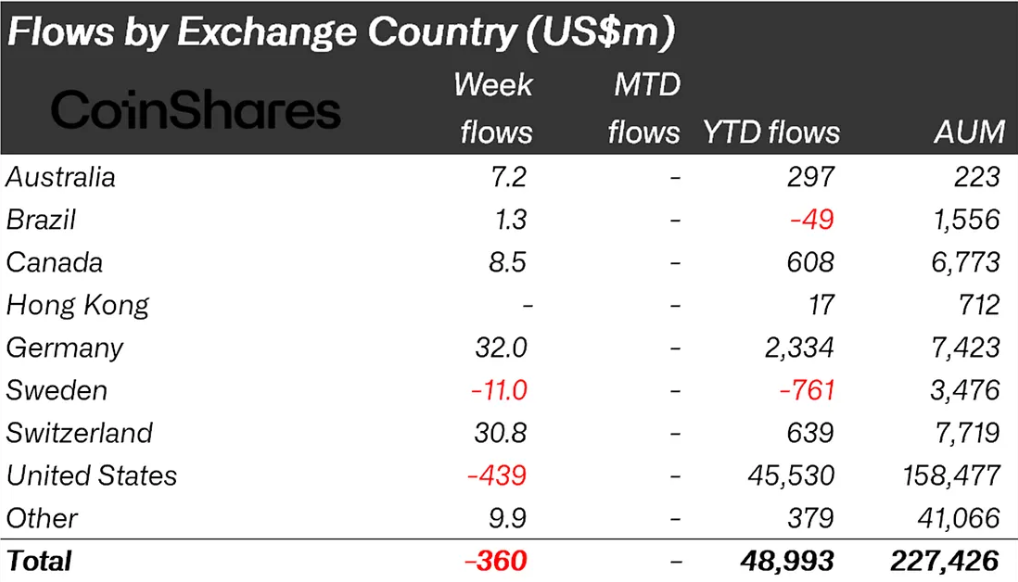 Crypto Outflows By Country. Source:
CoinShares Report
While US investors exited, Germany and Switzerland recorded modest inflows of $32 million and $30.8 million, showing ongoing regional confidence. Additionally, the lack of major US economic data releases contributed to market uncertainty through the week.
Bitcoin products posted the largest declines, losing $946 million over the week. This made Bitcoin the most exposed asset to monetary policy shifts.
The timing coincided with a broader risk-off period, as market participants reconsidered their hopes for aggressive rate cuts.
Solana Bucks the Trend with Record Institutional Demand
Amid retreat elsewhere, Solana stood out. The blockchain platform received $421 million in inflows, the second-highest weekly total for the asset.
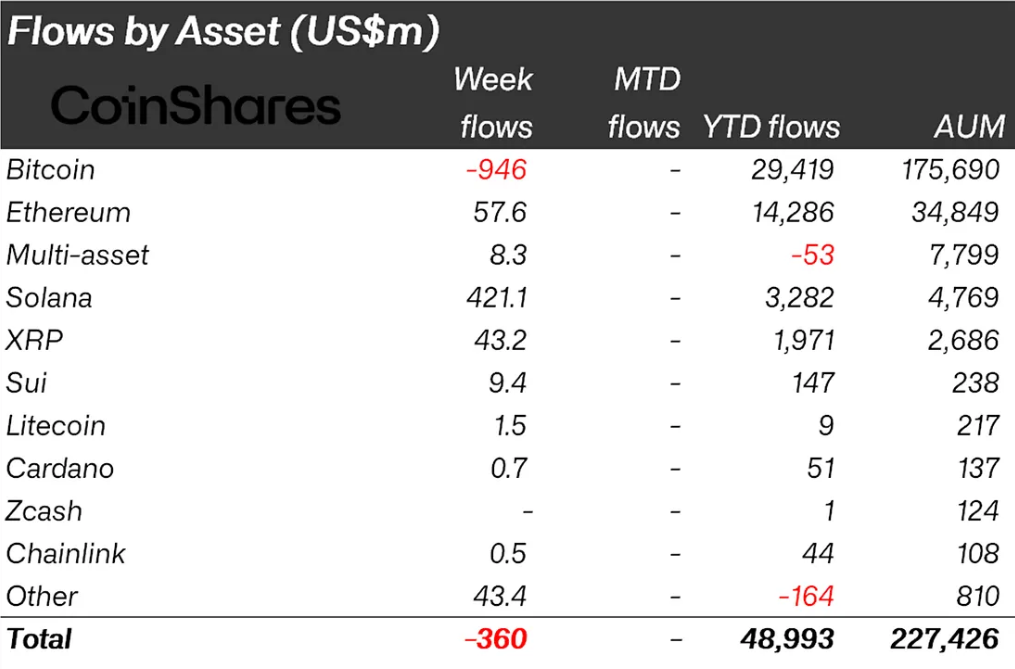 Crypto Outflows By Asset. Source: CoinShares
This increase was primarily driven by the launch of newly launched US Solana ETFs, including Bitwise’s BSOL, which drew record inflows during its first trading week.
SoSoValue reported that Solana ETFs recorded four consecutive days of net inflows totalling $200 million after their launch.
According to SoSoValue ETFs Dashboard, since the launch of the Bitwise Solana Staking ETF ($BSOL) and Grayscale Solana ETF ($GSOL) on Oct 28 & 29:$SOL ETFs have seen 4 consecutive days of net inflows, totaling $200 million.$BTC & $ETH Spot ETFs have simultaneously recorded net… pic.twitter.com/CrKgogePA5
— SoSoValue (@SoSoValueCrypto) November 3, 2025
At the same time, Bitcoin and Ethereum Spot ETFs saw outflows, reinforcing Solana’s contrarian momentum. This suggests institutional investors now view Solana as an attractive, differentiated asset.
The launch of Solana ETFs marks a key moment for institutional access to the network, praised for transaction speed and low fees.
Grayscale’s GSOL, which launched on NYSE Arca on October 29, offers direct SOL exposure alongside possible staking rewards, aligning with Solana’s proof-of-stake approach. These features set Solana ETFs apart from traditional Bitcoin products and appeal to yield-seeking investors.
Year-to-date, Solana inflows have reached $3.3 billion, confirming its status as one of the fastest-growing digital assets among institutions.
Sustained demand shows confidence in the platform’s technical strengths and ecosystem expansion, even as broad market headwinds persist.
Disclaimer: The content of this article solely reflects the author's opinion and does not represent the platform in any capacity. This article is not intended to serve as a reference for making investment decisions.
You may also like
The AI boom may follow the path of the 19th-century railway bubble, and builders may not be the ultimate winners
Goldman Sachs analyst Bobby Molavi compared the current situation to the 19th-century British railway mania: 500 companies spent more than the nation's annual income building 8,000 miles of railway, with most early investors losing out, while the real beneficiaries were the later "passengers." He pointed out that the current AI craze is driven by both debt and momentum, and that the S&P 500’s forward P/E ratio of 18x is only "a bit cheaper." Whether the builders can retain value is uncertain, and history does not offer an optimistic answer.

If Anthropic's IPO goes smoothly and the stock price rises next week, then everything remains the same for AI. Otherwise, some companies will go bankrupt.
The shrinking valuations of two major giants have triggered a chain reaction—investors are adopting more conservative revenue multiples for AI startups and are directly halting high-valuation financing for companies with zero revenue. Multiple venture capital firms have advised their portfolio companies to lower valuation expectations and to quickly build up cash reserves. Market participants warn that the outcome of Anthropic’s IPO will be a barometer for the industry: if successful, the boom will continue; if it fails, some companies may face elimination.
After the Brazilian election, political discount deepens; Morgan Stanley remains bullish on Petrobras (PBR.US), focusing on fuel pricing and dividends
Morgan Stanley still maintains its most optimistic "Overweight" rating, but has lowered its year-end 2027 target price from $31 to $25.

Corning (GLW.US) receives initial "Buy" rating from Jefferies! AI factories driving a fiber optic rush, with a potential global supply gap of up to 30%
For Corning, the recent profit growth mainly comes from the expansion of AI clusters. As the number of optical links crossing cabinets and campuses increases, customers need to deploy more optical fibers within limited conduit and cabinet space, thus driving demand for high-density optical cables and connection systems.

Crypto prices
More


