
Balancer Hack Drains Over $110M from DeFi Pools, Here's What Happened

Balancer ( $BAL ) suffered a massive exploit draining over $110 million from its liquidity pools. The attack, initially estimated at $70–88 million, was later confirmed to be far more severe.
Balancer’s official account acknowledged the exploit hours after reports surfaced, confirming that their v2 pools were affected and that internal teams were investigating with “high priority.” The announcement came only after widespread panic and a sharp selloff in both DeFi tokens and Bitcoin, which fell below $108,000.
Balancer Hack: What Happened
According to early data from CoinDesk , the exploit targeted multiple liquidity pools — including WETH, osETH, and wstETH — draining an estimated $70M to $88M within hours.
Shortly after, on-chain analysts such as Lookonchain reported that the stolen amount had surged past $116 million, suggesting the attacker continued siphoning funds even as Balancer began mitigation efforts.
The project has not disclosed the precise vulnerability yet but stated:
“We’re aware of a potential exploit impacting Balancer v2 pools. Our engineering and security teams are investigating with high priority.”
Market Reaction: DeFi Fear and Bitcoin Selloff
The exploit’s impact was immediate. The Balancer ($BAL) token dropped over 10% intraday, trading near $0.90 — a steep fall from its previous close around $0.98.
The broader crypto market also felt the shockwave. Reports indicate that traders rushed to de-risk their DeFi exposure, leading to additional sell pressure on $Ethereum, $Solana, and $BNB.
At the same time, Bitcoin ($BTC) defended the $107K support level amid heavy volatility. Analysts noted that Bitcoin’s resilience might be linked to traders exiting altcoins and rotating into BTC as a temporary safe haven.
BAL Token Price Analysis
According to the attached chart, BAL/USD shows a sharp downward candle pattern consistent with panic selling.
- Current BAL Price: $0.90
- 24h Change: -10.6%
- Previous Close: $0.9838
- Support Zone: $0.88 – $0.90
- Resistance Zone: $0.95 – $1.00
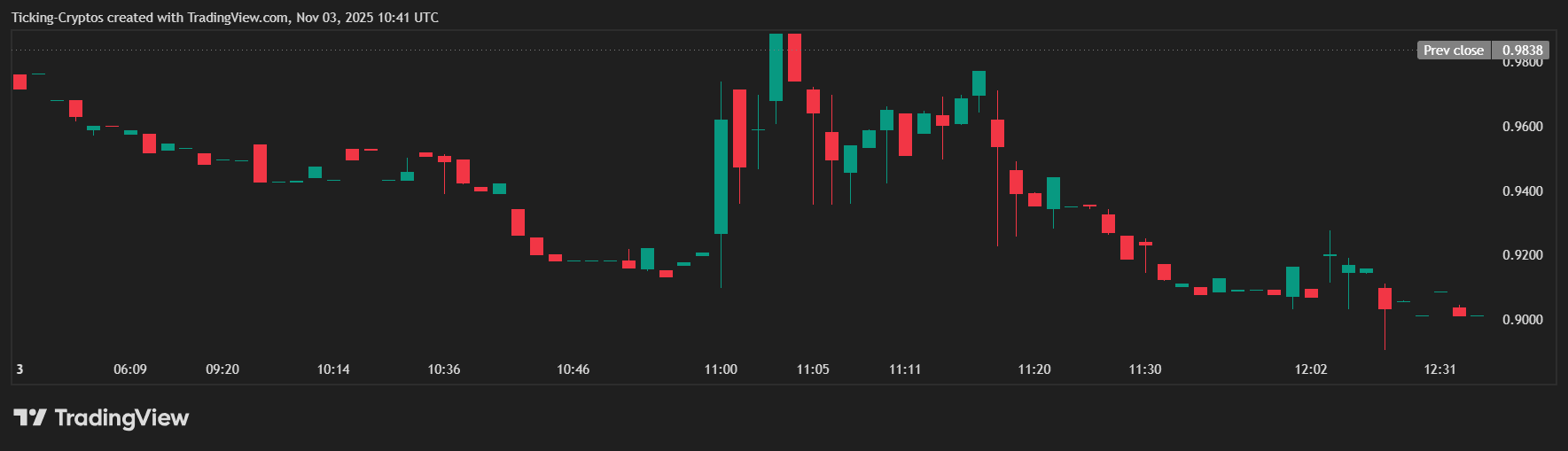
If panic continues, BAL could test the $0.80 level, though a stabilization near $0.90 might signal a short-term bottom, especially if Balancer issues a detailed recovery plan.
Disclaimer: The content of this article solely reflects the author's opinion and does not represent the platform in any capacity. This article is not intended to serve as a reference for making investment decisions.
You may also like
The AI boom may follow the path of the 19th-century railway bubble, and builders may not be the ultimate winners
Goldman Sachs analyst Bobby Molavi compared the current situation to the 19th-century British railway mania: 500 companies spent more than the nation's annual income building 8,000 miles of railway, with most early investors losing out, while the real beneficiaries were the later "passengers." He pointed out that the current AI craze is driven by both debt and momentum, and that the S&P 500’s forward P/E ratio of 18x is only "a bit cheaper." Whether the builders can retain value is uncertain, and history does not offer an optimistic answer.

If Anthropic's IPO goes smoothly and the stock price rises next week, then everything remains the same for AI. Otherwise, some companies will go bankrupt.
The shrinking valuations of two major giants have triggered a chain reaction—investors are adopting more conservative revenue multiples for AI startups and are directly halting high-valuation financing for companies with zero revenue. Multiple venture capital firms have advised their portfolio companies to lower valuation expectations and to quickly build up cash reserves. Market participants warn that the outcome of Anthropic’s IPO will be a barometer for the industry: if successful, the boom will continue; if it fails, some companies may face elimination.
After the Brazilian election, political discount deepens; Morgan Stanley remains bullish on Petrobras (PBR.US), focusing on fuel pricing and dividends
Morgan Stanley still maintains its most optimistic "Overweight" rating, but has lowered its year-end 2027 target price from $31 to $25.

Corning (GLW.US) receives initial "Buy" rating from Jefferies! AI factories driving a fiber optic rush, with a potential global supply gap of up to 30%
For Corning, the recent profit growth mainly comes from the expansion of AI clusters. As the number of optical links crossing cabinets and campuses increases, customers need to deploy more optical fibers within limited conduit and cabinet space, thus driving demand for high-density optical cables and connection systems.

Crypto prices
More


