
Institutional Bitcoin Buying Drops Below Mining Supply

Institutional net Bitcoin buying fell below the daily mining supply, reversing a key bullish metric. The decline comes as corporate demand wanes and whales move large amounts of BTC to exchanges.
Net Bitcoin purchases by institutional investors have fallen below the daily issuance rate (mining supply) for the first time in seven months. According to a crypto investment analyst, this signals a concerning shift in market dynamics.
On Monday, Charles Edwards, head of Capriole Investments, shared the stark data on his X account. Expressing immediate concern, Edwards stated, “Won’t lie, this was the main metric keeping me bullish the last months while every other asset outperformed Bitcoin. Not good.”
The Bullish Metric Flips to Bearish
Edwards presented a chart illustrating Bitcoin’s price alongside key institutional buying/selling pressure metrics. These metrics track three types of institutional activity: miners (red), spot ETF and similar institutional buying (light green), and BTC Digital Asset Treasury (DAT) corporate activity (orange).
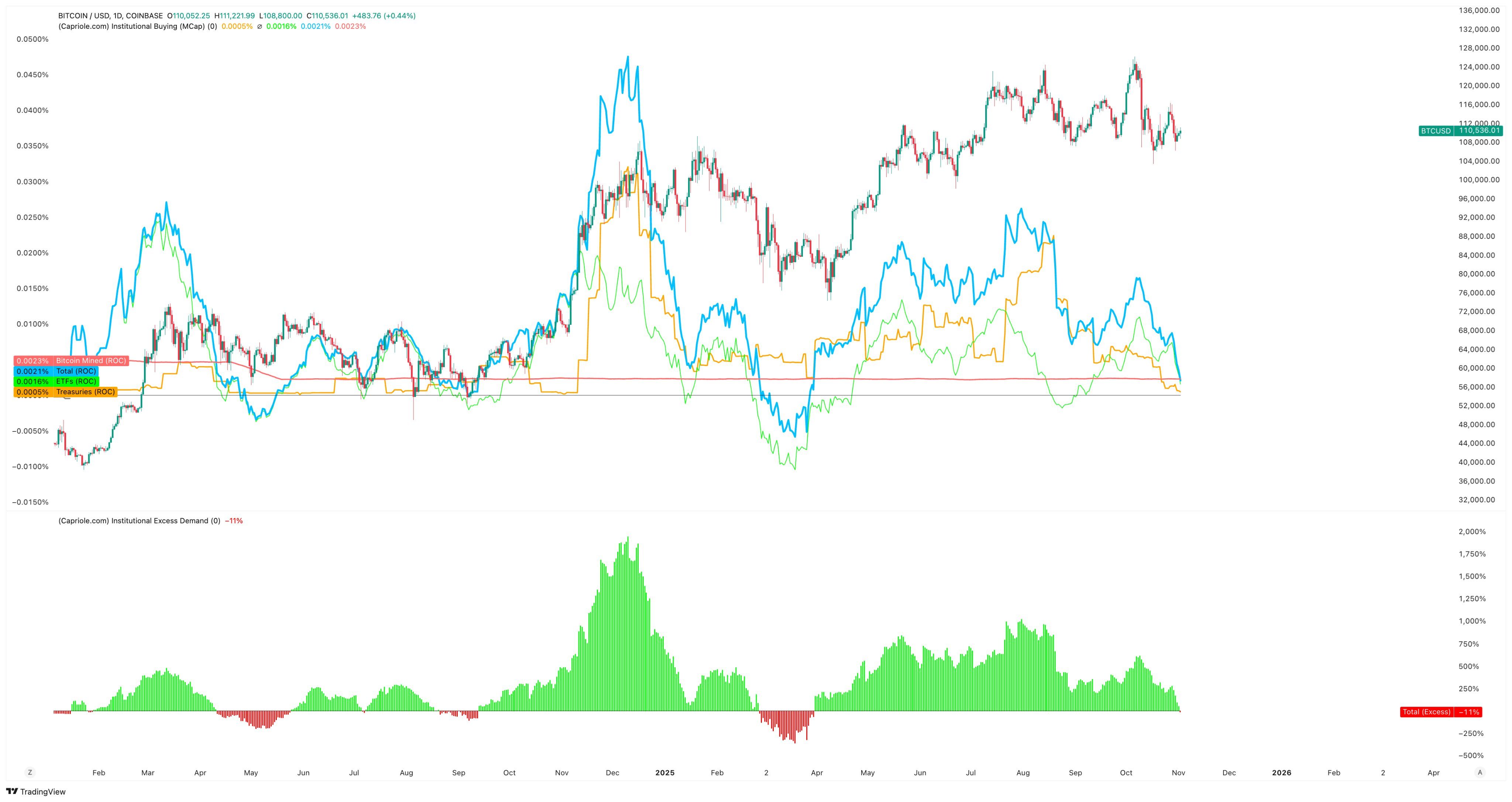 Institutional Buying/Selling Pressure Metrics. Source:
@caprioleio
The analysis shows a staggered decline in demand. BTC DAT corporate buying was the first to diminish significantly, starting around August 14. Initially, the subsequent inflow from spot ETFs compensated for this reduced corporate pressure, keeping the overall institutional demand afloat.
However, spot ETF buying also began to contract sharply following the market crash on October 10. The current scenario shows that comprehensive net institutional purchasing—combining all major institutional streams—has now dropped below the daily supply of newly mined Bitcoin.
The histogram at the bottom of Edwards’ chart, which tracks institutional pressure (green for buying, red for selling), is transitioning from green to red.
Heavy Bags and Waning Interest
While cautioning that this short-term trend does not dictate long-term direction, Edwards highlighted the immediate structural weakness. “The trend could flip tomorrow, next week, or in 2 years. But right now we have 188 treasury companies carrying heavy bags with no business model and a lot less interested institutional buyers than before,” he stated.
Separately, on-chain data platform Lookonchain reported increased selling movement among individual whale investors, outside of institutional streams. In a Monday post, the firm noted that a major whale, “BitcoinOG (1011short),” deposited approximately 13,000 BTC ($1.48 billion) to exchanges including Kraken, Binance, Coinbase, and Hyperliquid since October 1.
Furthermore, prominent Bitcoin whale ‘Owen Gunden’ was confirmed to have transferred 3,265 BTC ($364.5 million) to the Kraken exchange after October 21. Large transfers to centralized exchanges typically precede major liquidation events, though final confirmation of cash-out is pending.
Disclaimer: The content of this article solely reflects the author's opinion and does not represent the platform in any capacity. This article is not intended to serve as a reference for making investment decisions.
You may also like
The AI boom may follow the path of the 19th-century railway bubble, and builders may not be the ultimate winners
Goldman Sachs analyst Bobby Molavi compared the current situation to the 19th-century British railway mania: 500 companies spent more than the nation's annual income building 8,000 miles of railway, with most early investors losing out, while the real beneficiaries were the later "passengers." He pointed out that the current AI craze is driven by both debt and momentum, and that the S&P 500’s forward P/E ratio of 18x is only "a bit cheaper." Whether the builders can retain value is uncertain, and history does not offer an optimistic answer.

If Anthropic's IPO goes smoothly and the stock price rises next week, then everything remains the same for AI. Otherwise, some companies will go bankrupt.
The shrinking valuations of two major giants have triggered a chain reaction—investors are adopting more conservative revenue multiples for AI startups and are directly halting high-valuation financing for companies with zero revenue. Multiple venture capital firms have advised their portfolio companies to lower valuation expectations and to quickly build up cash reserves. Market participants warn that the outcome of Anthropic’s IPO will be a barometer for the industry: if successful, the boom will continue; if it fails, some companies may face elimination.
After the Brazilian election, political discount deepens; Morgan Stanley remains bullish on Petrobras (PBR.US), focusing on fuel pricing and dividends
Morgan Stanley still maintains its most optimistic "Overweight" rating, but has lowered its year-end 2027 target price from $31 to $25.

Corning (GLW.US) receives initial "Buy" rating from Jefferies! AI factories driving a fiber optic rush, with a potential global supply gap of up to 30%
For Corning, the recent profit growth mainly comes from the expansion of AI clusters. As the number of optical links crossing cabinets and campuses increases, customers need to deploy more optical fibers within limited conduit and cabinet space, thus driving demand for high-density optical cables and connection systems.

Crypto prices
More


