
Crypto: Why fear persists despite the USA-China tariff truce

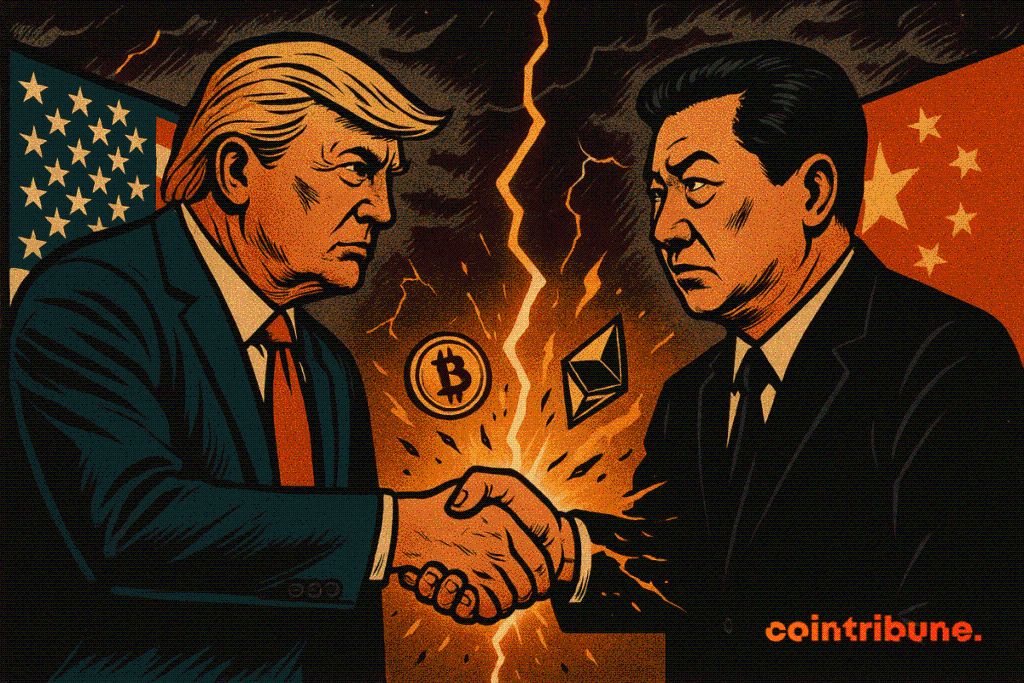
In the crypto universe, memories are stubborn. October 11 left marks: 19 billion dollars vanished in a few hours. Since then, even positive signals struggle to wake the markets. Donald Trump and Xi Jinping try to play firefighters with a major tariff truce. But in this field, their potential for explosion is too well known. Traders remain cautious, still breathless.
In brief
- 19 billion dollars evaporated after Donald Trump’s tariff threats.
- The Fear & Greed index stagnates, the crypto market has not regained its breath.
- The USA-China truce suspends key sanctions without triggering crypto rebound.
- Altcoins like Solana struggle to take off despite encouraging technical fundamentals.
Red October: When the memory of crashes paralyzes the market
Certain dates imprint on minds like burns. On October 11, 2025, Donald Trump threatened to overtax China at 100%. The crypto market took the hit: 19 billion liquidated in 24 hours .
Since then, the Crypto Fear & Greed index remains frozen . It quietly climbs from 33 to 37, but fear still dominates. Bitcoin hovers around $110,000, Ether around $3,900. Nothing reassuring.
For some, like Michael van de Poppe, this kind of crash represents a floor. Yet investors remain defensive. Confidence is eroded, altcoins lag behind. Resilience moves backward. Even with a calmer atmosphere, no one jumps on the bull run train. Too early, too risky.
Trump-Xi truce: promises abound, doubts fill heads
The agreement signed between Donald Trump and Xi Jinping looks like a turning point: lifting measures against rare metals, massive purchases of American soy, suspension of controls on key sectors. On paper, this should boost the global economy and the crypto industry.
But crypto operators are not fooled. They know these agreements can sometimes be illusions. Their trust is measured by facts. Every tweet, every political U-turn can destroy what has been built.
On X, Ash Crypto speaks of a “bullish” outlook for markets. Conversely, other observers note that major announcements are not enough. Experience has shown stability is fragile. In reality, the crypto market remains cautious. For the slightest misstep, the agreement could become a double-edged sword again.
Crypto still cautious: why the recovery hasn’t started (yet)
Volatility is a way of life for the crypto market, but since the FTX–Covid–October black series, investors act with restraint. The USA-China tariff truce could have brought new impetus. Yet few players see it as a lasting impulse.
Solana, Chainlink, and a few others rise timidly. Volumes improve. But overall, mistrust dominates. Technical signals say “why not”, traders’ instincts answer “not yet”.
Proof? Reactions on X oscillate between feigned euphoria and acknowledged skepticism. Everyone keeps in mind that the protagonists of this agreement are the same who, just yesterday, shook markets with sanctions.
Five facts to remember about the Trump-Xi truce and its effect on cryptos
- On October 11, 2025, $19 billion was liquidated in 24 hours in crypto;
- The Fear & Greed index remains stuck between 33 and 37 despite announcements;
- China will buy 25 million tons of US soy/year until 2028;
- Exports of rare metals to the USA are reauthorized;
- The bitcoin price and Ether’s price have not exploded despite the Seoul agreement.
October certainly did not give Bitcoin a break. The expected “Uptober” turned into a black month. It remains to be seen if November will take over , with a less sharp memory and dynamics finally launched.
Disclaimer: The content of this article solely reflects the author's opinion and does not represent the platform in any capacity. This article is not intended to serve as a reference for making investment decisions.
You may also like
The AI boom may follow the path of the 19th-century railway bubble, and builders may not be the ultimate winners
Goldman Sachs analyst Bobby Molavi compared the current situation to the 19th-century British railway mania: 500 companies spent more than the nation's annual income building 8,000 miles of railway, with most early investors losing out, while the real beneficiaries were the later "passengers." He pointed out that the current AI craze is driven by both debt and momentum, and that the S&P 500’s forward P/E ratio of 18x is only "a bit cheaper." Whether the builders can retain value is uncertain, and history does not offer an optimistic answer.

If Anthropic's IPO goes smoothly and the stock price rises next week, then everything remains the same for AI. Otherwise, some companies will go bankrupt.
The shrinking valuations of two major giants have triggered a chain reaction—investors are adopting more conservative revenue multiples for AI startups and are directly halting high-valuation financing for companies with zero revenue. Multiple venture capital firms have advised their portfolio companies to lower valuation expectations and to quickly build up cash reserves. Market participants warn that the outcome of Anthropic’s IPO will be a barometer for the industry: if successful, the boom will continue; if it fails, some companies may face elimination.
After the Brazilian election, political discount deepens; Morgan Stanley remains bullish on Petrobras (PBR.US), focusing on fuel pricing and dividends
Morgan Stanley still maintains its most optimistic "Overweight" rating, but has lowered its year-end 2027 target price from $31 to $25.

Corning (GLW.US) receives initial "Buy" rating from Jefferies! AI factories driving a fiber optic rush, with a potential global supply gap of up to 30%
For Corning, the recent profit growth mainly comes from the expansion of AI clusters. As the number of optical links crossing cabinets and campuses increases, customers need to deploy more optical fibers within limited conduit and cabinet space, thus driving demand for high-density optical cables and connection systems.

Crypto prices
More


