
America.Fun Wants To Fix the Pump.Fun Problem — But Will It Succeed?

America.Fun promises a safer alternative to Pump.Fun’s chaos. Ogle says its curated model fixes major flaws — but token data tells a cautious story.
America.Fun is a new Solana-based launchpad advised by World Liberty Financial’s Ogle. It claims to offer a safer alternative to the meme-coin chaos typified by Pump.Fun.
The platform’s stated goal is to reduce spam tokens and improve user protection. However, questions remain about its sustainability, token performance, and transparency.
A Response to a Market Gone Wild
Ogle said the project’s design responds directly to issues seen across permissionless meme coin platforms.
“Whenever you have catastrophic drops or scams, it’s usually a combination of many factors,” he said. “We wanted to build a safer, more legitimate place for people who are not as gambling.”
The platform requires creators to pay a small fee — about $20 worth of AOL tokens — to launch a token. According to Ogle, that friction discourages mass bot deployments and copycat scams.
“Right now it’s free to deploy in every other launchpad. I don’t think that’s a good thing,” he said. “When it costs a little, you think before you spam.”
America.Fun also restricts duplicate tickers. Each token name can only exist once, addressing a core issue of Pump.Fun, where dozens of imitations often appear within minutes of a trending launch.
“You don’t know which one’s real on other platforms,” Ogle explained. “Here, there can only be one.”
Building a “Walled Garden”
Last month, BeInCrypto published an exclusive report on how racist and offensive tokens were surging like wildfire on Pump.Fun.
According to Ogle, America.Fun is working to directly address this issue that plagues most launchpads.The platform’s frontend is curated. Offensive or scam tokens may still exist on-chain, but they won’t appear on the platform’s interface or trending lists.
Ogle compared it to early America Online moderation:
“There were safeguards in place to stop racism and abuse. That’s why it worked. We’re doing the same — a walled garden where people feel safe.”
This semi-permissioned model positions the launchpad between hyper-open ecosystems like Pump.Fun and fully regulated venues like ICM.
According to Ogle, the team wants to strike a “middle ground” between creativity and compliance.
But is it enough to gain traction in an extremely crowded space?
A Crowded and Competitive Space
America.Fun enters a saturated launchpad market dominated by Pump.Fun and LetsBonk.Fun, both of which have massive user bases and trading volumes.
Ogle acknowledged the challenge but said the platform’s strategy is “reputation and curation.”
He also disclosed that America.Fun operates as a strategic arm of the USD1 partnership, connecting World Liberty Financial’s USD1 stablecoin with Radium and Bonk.
However, he declined to comment on any formal stake or revenue-sharing structure.
The decision to pair all new tokens initially against USD1 — instead of the more widely used USDC — could limit accessibility.
Ogle argued that this is intentional. He said trading through DEX routers automatically converts USDC to USD1, keeping user experience seamless while supporting USD1’s liquidity.
Token and Performance Data
The platform’s native token, AOL (America’s Official Launchpad), launched in early September.
As of November 2, it trades at $0.0046, down 54% from its peak, with a $4.6 million market cap and $625,000 daily volume.
This decline mirrors the wider post-October 10 crash downturn, but also suggests that community enthusiasm has yet to translate into sustainable demand.
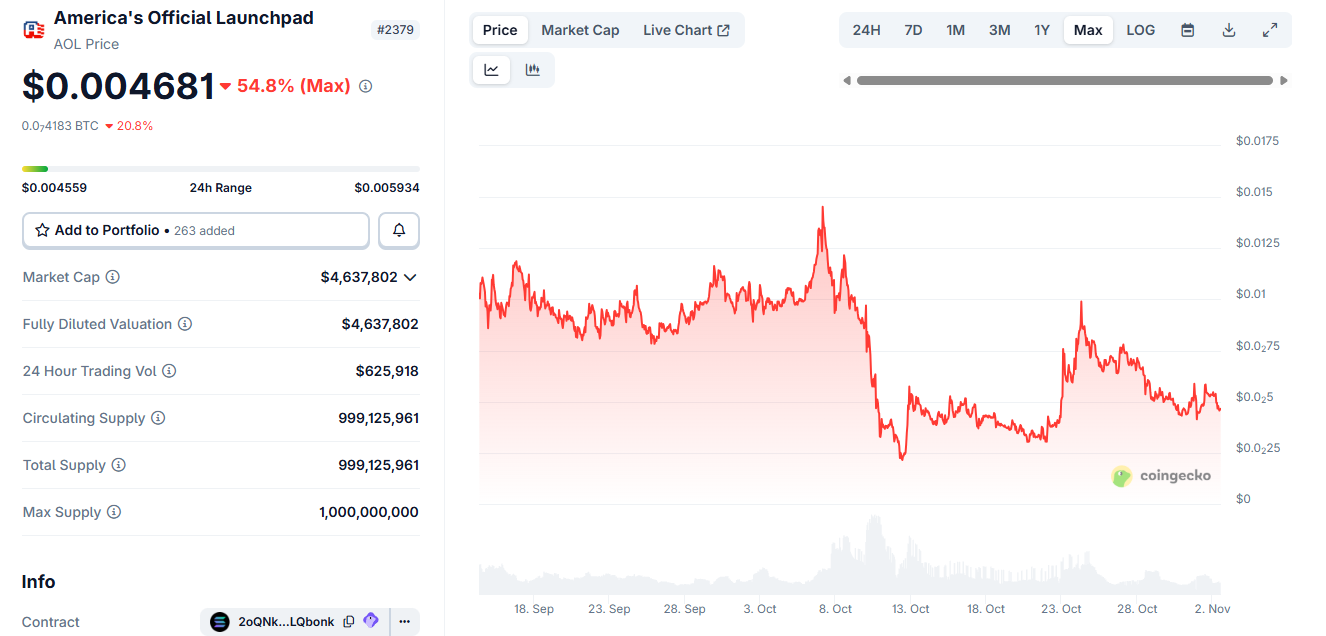 AOL Token Price Chart Since Launch. Source:
CoinGecko
Ogle recently claimed the project gained 39,000 active users in the past 30 days and 222,000 page views, with Singapore, China, and Ukraine leading in traffic.
These metrics are unverified, but they indicate early traction in Asia rather than the US market.
America.Fun’s selective moderation and launch fees address real problems in the meme coin ecosystem — spam, scams, and offensive content.
Yet, the model introduces its own risks. Curated access can slow growth, and limiting pairs to USD1 could restrict liquidity in a market that favors flexibility.
The AOL token’s steep price drop also raises concerns about sustainability. Without clear revenue flows, audit transparency, or external verification of user data, investors have limited ways to gauge the platform’s real health.
For now, America.Fun represents an ambitious experiment. A launchpad that wants to clean up a chaotic market without killing its energy.
Whether that balance holds will depend on adoption beyond early speculative users.
Disclaimer: The content of this article solely reflects the author's opinion and does not represent the platform in any capacity. This article is not intended to serve as a reference for making investment decisions.
You may also like
The AI boom may follow the path of the 19th-century railway bubble, and builders may not be the ultimate winners
Goldman Sachs analyst Bobby Molavi compared the current situation to the 19th-century British railway mania: 500 companies spent more than the nation's annual income building 8,000 miles of railway, with most early investors losing out, while the real beneficiaries were the later "passengers." He pointed out that the current AI craze is driven by both debt and momentum, and that the S&P 500’s forward P/E ratio of 18x is only "a bit cheaper." Whether the builders can retain value is uncertain, and history does not offer an optimistic answer.

If Anthropic's IPO goes smoothly and the stock price rises next week, then everything remains the same for AI. Otherwise, some companies will go bankrupt.
The shrinking valuations of two major giants have triggered a chain reaction—investors are adopting more conservative revenue multiples for AI startups and are directly halting high-valuation financing for companies with zero revenue. Multiple venture capital firms have advised their portfolio companies to lower valuation expectations and to quickly build up cash reserves. Market participants warn that the outcome of Anthropic’s IPO will be a barometer for the industry: if successful, the boom will continue; if it fails, some companies may face elimination.
After the Brazilian election, political discount deepens; Morgan Stanley remains bullish on Petrobras (PBR.US), focusing on fuel pricing and dividends
Morgan Stanley still maintains its most optimistic "Overweight" rating, but has lowered its year-end 2027 target price from $31 to $25.
Corning (GLW.US) receives initial "Buy" rating from Jefferies! AI factories driving a fiber optic rush, with a potential global supply gap of up to 30%
For Corning, the recent profit growth mainly comes from the expansion of AI clusters. As the number of optical links crossing cabinets and campuses increases, customers need to deploy more optical fibers within limited conduit and cabinet space, thus driving demand for high-density optical cables and connection systems.
Crypto prices
More


