
Digital Euro: The ECB's Promise for a Stronger European Economy

The digital euro, an ambitious project of the European Central Bank (ECB), promises to transform payments in Europe. Led by Christine Lagarde, it generates as much enthusiasm as mistrust. Between financial innovation and concerns for individual freedoms, this project fits into a context where crypto redefines the rules of money. What will its real impact be on the economy and European citizens?

In brief
- Christine Lagarde presents the digital euro as a symbol of unity and trust, meant to strengthen Europe’s financial sovereignty.
- Voices denounce a risk of surveillance and centralization of the digital euro, preferring bitcoin as an alternative.
- The EU blocks the Russian stablecoin A7A5, fueling debates over a possible strategy to impose its CBDC against the rise of independent cryptos.
Christine Lagarde and the promise of an inclusive and secure digital euro
Christine Lagarde presents the digital euro as:
- A symbol of unity and trust ;
- A major advancement for Europe;
- A tool designed to strengthen financial sovereignty and facilitate daily transactions.
According to her, this digital currency will enable instant, free, and accessible payments to all, even without an internet connection. All this while guaranteeing confidentiality comparable to current systems.
The project, budgeted at 1.3 billion euros, aims for a gradual launch by 2027. Lagarde emphasizes its complementary nature to cash. Indeed, it offers a public alternative to private solutions such as bank cards or electronic wallets. For the ECB, the goal is to meet the needs of an increasingly digitalized economy while preserving the stability of the European financial system.
Criticism of the digital euro: between surveillance and centralization
The digital euro is not unanimous, especially in the crypto ecosystem. Critics point to risks of increased surveillance and state control over financial transactions. For them, a digital currency issued by a central bank opposes the decentralization principles that underpin the spirit of cryptocurrencies. In France, political voices rise to denounce this project. Éric Ciotti even proposed a law aiming to ban the digital euro, advocating instead for adopting bitcoin as an alternative currency.
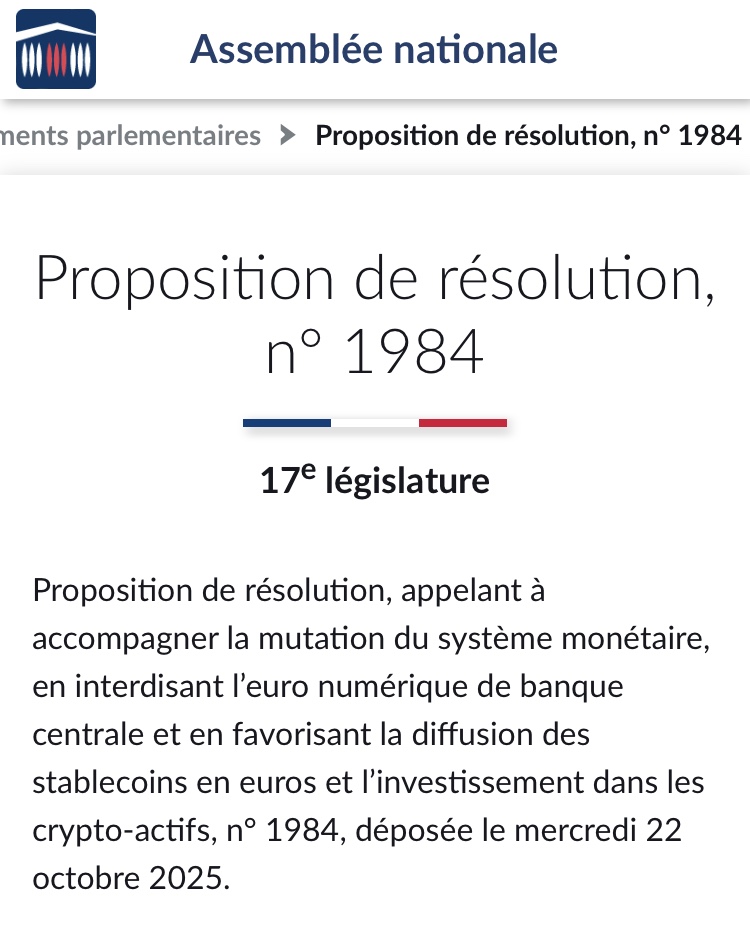 In France, Éric Ciotti proposes a law aiming to ban the digital euro.
In Germany, parties such as the AfD call to recognize bitcoin as a national priority , arguing that the digital euro could lead to an overly intrusive financial system. These criticisms reflect growing mistrust towards central institutions and their ability to guarantee privacy.
The EU blocks the Russian stablecoin A7A5: a strategy to impose its CBDC?
At the end of October 2025, the European Union banned the Russian stablecoin A7A5 , accused of circumventing sanctions and financing the war in Ukraine. This stablecoin, backed by the ruble, allowed Russia to maintain financial exchanges despite embargoes. By banning it, the EU displays its intention to control monetary flows on its territory and limit the influence of foreign digital currencies.
This decision raises questions: is the EU looking to eliminate competition to facilitate the adoption of its own CBDC? In this context, bitcoin emerges as a neutral and censorship-resistant solution. While states develop their sovereign digital currencies, BTC remains the only fully decentralized asset, favored by those who reject a financial system controlled by central banks. A symbolic but also practical resistance in a landscape where crypto redraws the frontiers of finance.
The digital euro crystallizes hopes for a modern financial Europe according to Christine Lagarde, but also fears of an overly controlled system. Between innovation and preservation of freedoms, the debate remains intense. As states and central banks move their pieces, crypto, and particularly bitcoin , continues to represent a decentralized alternative. Will the balance between regulation and financial freedom be possible?
Disclaimer: The content of this article solely reflects the author's opinion and does not represent the platform in any capacity. This article is not intended to serve as a reference for making investment decisions.
You may also like
The AI boom may follow the path of the 19th-century railway bubble, and builders may not be the ultimate winners
Goldman Sachs analyst Bobby Molavi compared the current situation to the 19th-century British railway mania: 500 companies spent more than the nation's annual income building 8,000 miles of railway, with most early investors losing out, while the real beneficiaries were the later "passengers." He pointed out that the current AI craze is driven by both debt and momentum, and that the S&P 500’s forward P/E ratio of 18x is only "a bit cheaper." Whether the builders can retain value is uncertain, and history does not offer an optimistic answer.

If Anthropic's IPO goes smoothly and the stock price rises next week, then everything remains the same for AI. Otherwise, some companies will go bankrupt.
The shrinking valuations of two major giants have triggered a chain reaction—investors are adopting more conservative revenue multiples for AI startups and are directly halting high-valuation financing for companies with zero revenue. Multiple venture capital firms have advised their portfolio companies to lower valuation expectations and to quickly build up cash reserves. Market participants warn that the outcome of Anthropic’s IPO will be a barometer for the industry: if successful, the boom will continue; if it fails, some companies may face elimination.
After the Brazilian election, political discount deepens; Morgan Stanley remains bullish on Petrobras (PBR.US), focusing on fuel pricing and dividends
Morgan Stanley still maintains its most optimistic "Overweight" rating, but has lowered its year-end 2027 target price from $31 to $25.

Corning (GLW.US) receives initial "Buy" rating from Jefferies! AI factories driving a fiber optic rush, with a potential global supply gap of up to 30%
For Corning, the recent profit growth mainly comes from the expansion of AI clusters. As the number of optical links crossing cabinets and campuses increases, customers need to deploy more optical fibers within limited conduit and cabinet space, thus driving demand for high-density optical cables and connection systems.

Crypto prices
More


