
Bitcoin showing signs of being in the midst of initial coin offering, analyst says

Bitcoin could be in the middle of an unofficial phase as OG coin holders rotate out and fresh blood scoops up the tokens, distributing the supply across a broader number of people, macro analyst and Wall Street old hand Jordi Visser says.
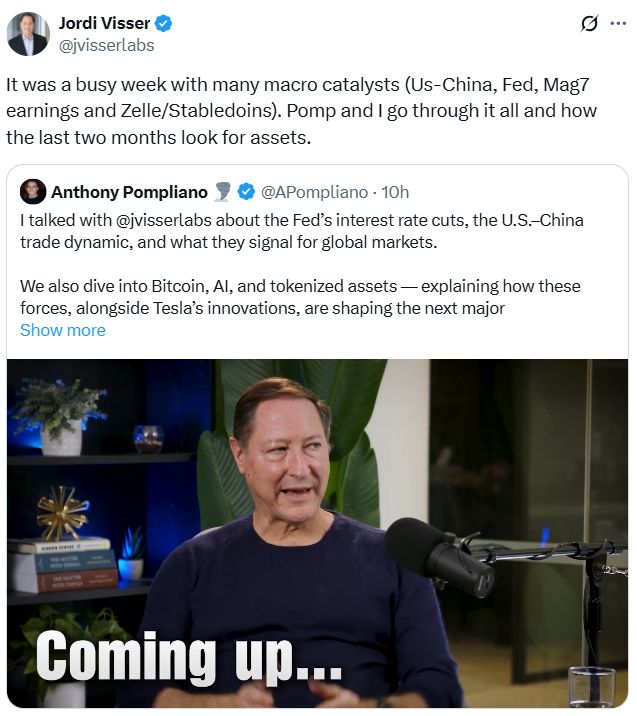
In a Saturday episode of entrepreneur Anthony Pompliano’s podcast and a post on Substack, Visser said old coins that have been dormant for years are on the move, “Not all at once. Not in panic. But steadily,” and new investors are stepping in, “accumulating on dips.”
“In the traditional world, this moment is similar to when early believers cash out, when founders become wealthy, when venture capitalists return money to their limited partners,” he said.
“The excitement of concentration is being replaced by the durability of distribution. The early believers are passing the torch to long-term holders who bought at higher prices and have different motivations. This is what success looks like. This is Bitcoin evolving through a new phase.”
Bitcoin going sideways in consolidation move
Bitcoin (BTC) has been fluctuating between $106,786 and $115,957 over the last seven days. Visser said when a company goes public and early investors begin to sell their positions, the stock often consolidates, even during broader market rallies.
New hands are stacking Bitcoin but they are moving cautiously, waiting for the distribution among a broader market to be complete before getting more aggressive.
“The result? A sideways grind that drives everyone crazy. The fundamentals are fine. The broader market is rallying. But the stock just… sits there,” Visser said. “The consolidation is frustrating. The sentiment is terrible.”
“This is the exact pattern you see after a major distribution event when lock-up periods expire. The stock doesn’t crash. It consolidates. Early investors sell. New long-term holders accumulate. Ownership transfers from the visionaries to the institutions,” he added.
Faith still going strong, despite price pressure
The Crypto Fear & Greed Index, an indicator that tracks market sentiment toward Bitcoin and cryptocurrencies, has been returning “fear” ratings since Wednesday and also had an average fear rating for the previous week.
However, Visser thinks there is still faith in the underlying asset, as shown through ongoing exchange-traded fund approvals, Bitcoin network hashrate hitting new highs, and growing stablecoin adoption.

“In a bear market, there are no buyers. Price collapses because everyone wants out and nobody wants in. But look at what’s actually happening: Bitcoin is consolidating, not collapsing. Every dip gets bought. The price isn’t making new lows, it’s holding a range,” Visse said.
Related: Bitcoin ends October in red, but now enters its biggest month for gains
“The divergence from risk assets is confusing. But the fundamentals are stronger than ever. And the structure, the distribution of holdings from concentrated to fragmented, is exactly what Bitcoin needs to graduate from a revolutionary experiment to a durable monetary asset.”
Current process will keep playing out
This phase will likely continue for a while longer, according to Visser, because typically they last for six to 18 months, and while Bitcoin moves faster than standard assets, the process is still around the six-month mark on the timeline.
When it finishes, one of the results will likely be reduced volatility, as ownership is distributed among many more people, as opposed to just the early holders and founders.
“For now, expect continued consolidation. Expect Bitcoin to keep frustrating people by not rallying with risk assets. Expect the sentiment to remain poor for a little while longer but be wary because there will be no signal. It will just start because the good news is already present.”
Magazine: Mysterious Mr Nakamoto author: Finding Satoshi would hurt Bitcoin
Disclaimer: The content of this article solely reflects the author's opinion and does not represent the platform in any capacity. This article is not intended to serve as a reference for making investment decisions.
You may also like
The AI boom may follow the path of the 19th-century railway bubble, and builders may not be the ultimate winners
Goldman Sachs analyst Bobby Molavi compared the current situation to the 19th-century British railway mania: 500 companies spent more than the nation's annual income building 8,000 miles of railway, with most early investors losing out, while the real beneficiaries were the later "passengers." He pointed out that the current AI craze is driven by both debt and momentum, and that the S&P 500’s forward P/E ratio of 18x is only "a bit cheaper." Whether the builders can retain value is uncertain, and history does not offer an optimistic answer.

If Anthropic's IPO goes smoothly and the stock price rises next week, then everything remains the same for AI. Otherwise, some companies will go bankrupt.
The shrinking valuations of two major giants have triggered a chain reaction—investors are adopting more conservative revenue multiples for AI startups and are directly halting high-valuation financing for companies with zero revenue. Multiple venture capital firms have advised their portfolio companies to lower valuation expectations and to quickly build up cash reserves. Market participants warn that the outcome of Anthropic’s IPO will be a barometer for the industry: if successful, the boom will continue; if it fails, some companies may face elimination.
After the Brazilian election, political discount deepens; Morgan Stanley remains bullish on Petrobras (PBR.US), focusing on fuel pricing and dividends
Morgan Stanley still maintains its most optimistic "Overweight" rating, but has lowered its year-end 2027 target price from $31 to $25.

Corning (GLW.US) receives initial "Buy" rating from Jefferies! AI factories driving a fiber optic rush, with a potential global supply gap of up to 30%
For Corning, the recent profit growth mainly comes from the expansion of AI clusters. As the number of optical links crossing cabinets and campuses increases, customers need to deploy more optical fibers within limited conduit and cabinet space, thus driving demand for high-density optical cables and connection systems.

Crypto prices
More


