
Bitget App
Trade smarter
Buy cryptoMarketsTradeFuturesStocksEarnInstitutionAI & More
Crypto Coins Face Turbulence: A Look at Stellar, Dogecoin, Chainlink, and Aave

Crypto Coins Face Turbulence: A Look at Stellar, Dogecoin, Chainlink, and Aave

CointurkCointurk2025/11/01 23:15
By:Ömer Ergin

In Brief XLM, DOGE, LINK, and AAVE followed different trends, diverging from the broader market. Dogecoin faced a significant 5.5% drop, losing a critical support level. Chainlink and AAVE experienced institutional selling pressure, impacting their market performance.


Summarize the content using AI

Crypto Coins Face Turbulence: A Look at Stellar, Dogecoin, Chainlink, and Aave image 1
ChatGPT


Crypto Coins Face Turbulence: A Look at Stellar, Dogecoin, Chainlink, and Aave image 2
Grok

As the week draws to a close, the leading altcoins Stellar , Dogecoin $0.187225 , Chainlink $17 , and Aave have shown divergent paths, separating them from the broader market trends. While Stellar’s XLM maintained a steady course, Dogecoin and Chainlink experienced significant drops. Despite its strong foundation in the DeFi sector, Aave was not spared from the selling pressure. Low trading volume, declining institutional interest, and technical breakdowns have been crucial in shaping the market’s direction.

XLM and DOGE Show Different Patterns

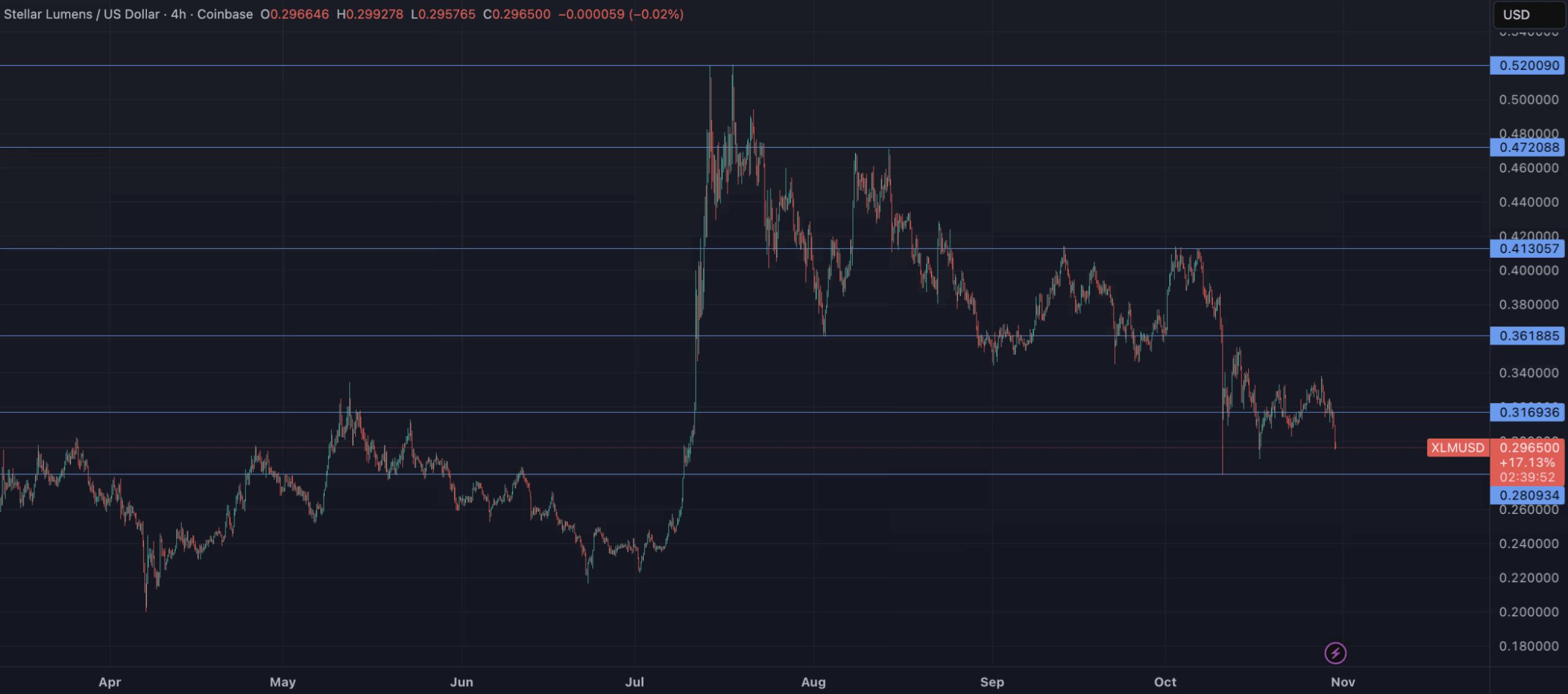
Stellar’s XLM coin maintained a stable position at $0.2975. This stability comes even as the overall crypto market rises, which points to a lack of investor interest as XLM lags by 3.5%. The trading volume remains 21% below the 30-day average, indicating missing institutional support. While the support at $0.2950 remains firm, the resistance zone between $0.3000 and $0.3050 stands strong. Technical indicators suggest that an upward breakout would require a supportive increase in volume.
Crypto Coins Face Turbulence: A Look at Stellar, Dogecoin, Chainlink, and Aave image 3

Conversely, Dogecoin lost its $0.1940 support, dropping by 5.5% to settle at $0.1843. Intraday volume surged by 180% to 1.17 billion coins, reflecting the strong impact of large-scale sales. The reduction of positions by institutional investors poses a risk of the price further declining to $0.1765. With the RSI indicator approaching the oversold territory, reclaiming the $0.1950 level is deemed critical in the short term.

Institutional Selling Pressure on LINK and AAVE

Chainlink’s LINK saw an 8% decline in the past 24 hours, dropping to $16.9 and touching a two-week low. The breach of support levels with a trading volume of 3.94 million LINK tokens confirms strong selling pressure. Interestingly, within the blockchain, Chainlink Reserve capitalized on this opportunity to repurchase 64,445 LINK, marking the largest nominal buyback since August.

Meanwhile, AAVE experienced a weekly decline of 16%, settling at $208. The breach of the $211 support level reinforces its technical weakness. However, Aave’s institutional credit platform, Horizon, has shown impressive performance by reaching $450 million in size within two months. Despite this, the substantial activity and ongoing downtrend signal that price pressure may continue in the short term.


0
0

Disclaimer: The content of this article solely reflects the author's opinion and does not represent the platform in any capacity. This article is not intended to serve as a reference for making investment decisions.

Understand the market, then trade.
Bitget offers one-stop trading for cryptocurrencies, stocks, and gold.
Trade now!

You may also like

The AI boom may follow the path of the 19th-century railway bubble, and builders may not be the ultimate winners

Goldman Sachs analyst Bobby Molavi compared the current situation to the 19th-century British railway mania: 500 companies spent more than the nation's annual income building 8,000 miles of railway, with most early investors losing out, while the real beneficiaries were the later "passengers." He pointed out that the current AI craze is driven by both debt and momentum, and that the S&P 500’s forward P/E ratio of 18x is only "a bit cheaper." Whether the builders can retain value is uncertain, and history does not offer an optimistic answer.

华尔街见闻•2026/11/12 03:56
The AI boom may follow the path of the 19th-century railway bubble, and builders may not be the ultimate winners

If Anthropic's IPO goes smoothly and the stock price rises next week, then everything remains the same for AI. Otherwise, some companies will go bankrupt.

The shrinking valuations of two major giants have triggered a chain reaction—investors are adopting more conservative revenue multiples for AI startups and are directly halting high-valuation financing for companies with zero revenue. Multiple venture capital firms have advised their portfolio companies to lower valuation expectations and to quickly build up cash reserves. Market participants warn that the outcome of Anthropic’s IPO will be a barometer for the industry: if successful, the boom will continue; if it fails, some companies may face elimination.

华尔街见闻•2026/11/12 03:46

After the Brazilian election, political discount deepens; Morgan Stanley remains bullish on Petrobras (PBR.US), focusing on fuel pricing and dividends

Morgan Stanley still maintains its most optimistic "Overweight" rating, but has lowered its year-end 2027 target price from $31 to $25.

智通财经•2026/11/12 03:42
After the Brazilian election, political discount deepens; Morgan Stanley remains bullish on Petrobras (PBR.US), focusing on fuel pricing and dividends

Corning (GLW.US) receives initial "Buy" rating from Jefferies! AI factories driving a fiber optic rush, with a potential global supply gap of up to 30%

For Corning, the recent profit growth mainly comes from the expansion of AI clusters. As the number of optical links crossing cabinets and campuses increases, customers need to deploy more optical fibers within limited conduit and cabinet space, thus driving demand for high-density optical cables and connection systems.

智通财经•2026/11/12 02:47
Corning (GLW.US) receives initial "Buy" rating from Jefferies! AI factories driving a fiber optic rush, with a potential global supply gap of up to 30%
