Bitget App
Trade smarter
Buy cryptoMarketsTradeFuturesStocksEarnInstitutionAI & More
Bitcoin At $2 Trillion Still Faces Psychology Risk Newton Learned The Hard Way

Bitcoin At $2 Trillion Still Faces Psychology Risk Newton Learned The Hard Way

CoinEditionCoinEdition2025/10/31 16:00
By:Izabela Anna

Bitcoin’s $2 trillion market value is fueling a “too big to fail” narrative in the market Analysts counter this, citing the 1720 South Sea Bubble, which bankrupted Sir Isaac Newton The historical lesson is that market psychology and euphoria, not size, are the real risk to investors

  • Bitcoin’s $2 trillion market value is fueling a “too big to fail” narrative in the market
  • Analysts counter this, citing the 1720 South Sea Bubble, which bankrupted Sir Isaac Newton
  • The historical lesson is that market psychology and euphoria, not size, are the real risk to investors

Bitcoin’s rise beyond a $2 trillion market value has reignited a critical debate about market psychology. The milestone brought on a narrative belief within the broader crypto market, Henrik Zeberg, Head Macro Economist at Swissblock, quoted: 

“Bitcoin cannot collapse because it has reached above 2 trillion USD”

Zeberg countered this notion by introducing a stark historical precedent: the South Sea Bubble of 1720. This event, which famously bankrupted Sir Isaac Newton, serves as a powerful warning. It proves that market psychology can overwhelm any asset, regardless of its size.

The 1720 Warning: When Sir Isaac Newton Lost a Fortune

In 1720, Britain’s entire nominal GDP was only £60–£70 million. The South Sea Company, however, reached a valuation of £150 million. This was nearly twice the nation’s economic output. 

The South Sea Bubble soon after, famously wiped out investors, including Sir Isaac Newton. Analysts note this event is definitive proof that market psychology, not size, drives bubbles. Applying this 2x GDP scale to today, a similar bubble would imply a market value of $7.5 trillion.

Coin Edition analysts rightly pointed out that yes, valuations of magnitudes can still collapse, and that it happens when a rally is driven more out of sentiment than robust fundamentals. The team also laid out how markets tend to repeat emotional cycles, regardless of the technology.

Why Bulls Say This Time Is Different

Despite these historical warnings, Bitcoin’s expanding institutional adoption has created a “safety cushion.” This cushion was unseen in past bubbles. Analysts argue that widespread corporate and government integration could dampen volatility, even if corrections occur.
Bitcoin At $2 Trillion Still Faces Psychology Risk Newton Learned The Hard Way image 0 Source: X

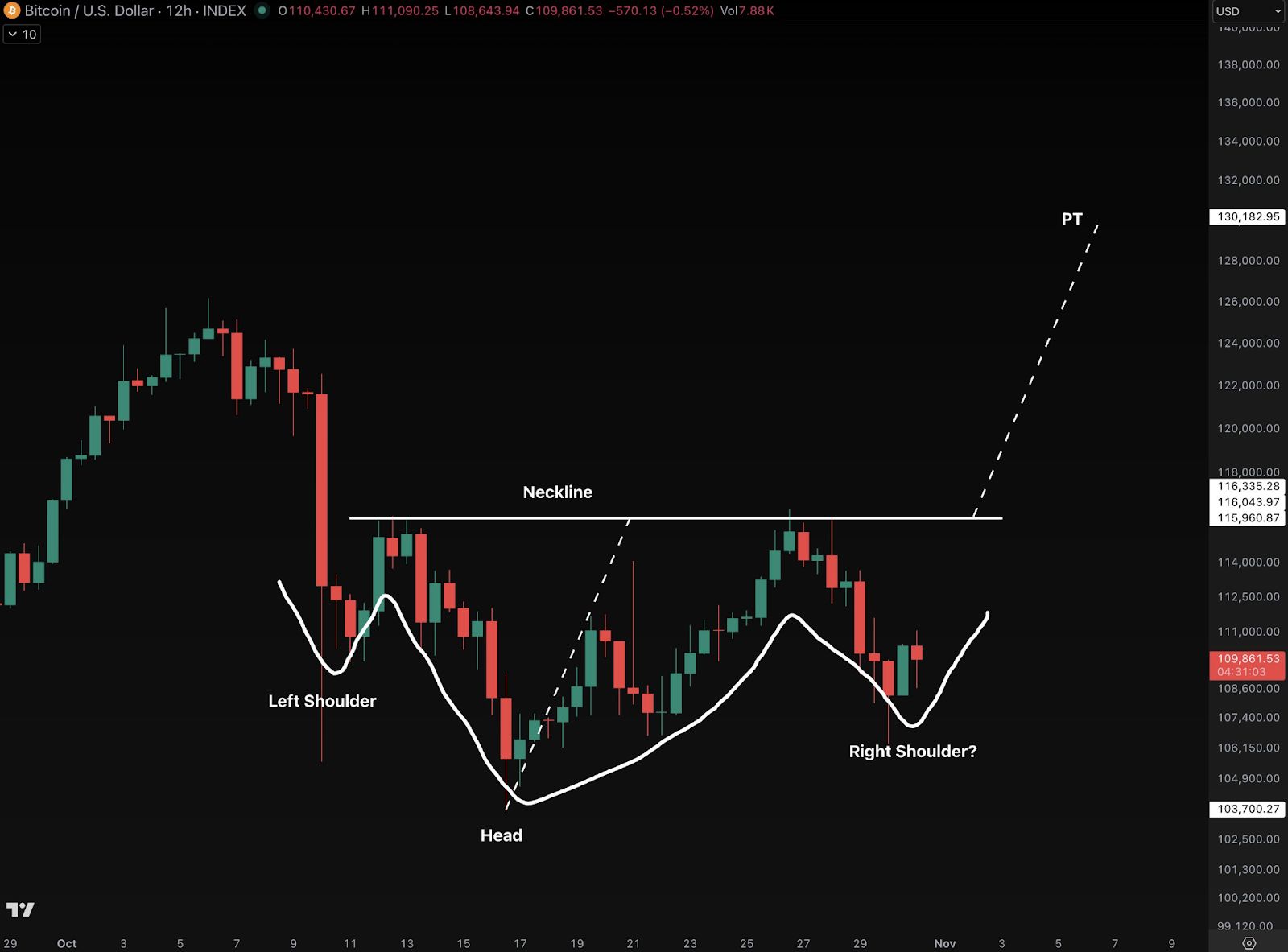
Market observer GandalfCrypto identified an inverse head and shoulders pattern forming on Bitcoin’s chart. This pattern signals a potential bullish reversal. 

Related: Bitcoin Price Prediction: Analysts Eye $115K Breakout As November Seasonality Turns Bullish

The neckline sits around $115,000–$116,000. A breakout above this level could target $130,000. Maintaining support near $108,000 remains essential to confirm the structure.

Kiyosaki: ‘Hard Assets’ Are the Only Refuge

Meanwhile, financial author Robert Kiyosaki warned about an impending global crash and urged investors to seek refuge in hard assets. He stated that gold, silver, Bitcoin, and Ethereum offer protection from inflation and currency devaluation. 

While his statements lacked specific timelines, they resonated with investors uneasy about rising debt. Critics, however, argue that his repeated warnings often amplify fear without substantiated data.

Related: Kiyosaki Warns of ‘Massive Crash,’ Urges Investors to Turn to Bitcoin and Ethereum

0
0

Disclaimer: The content of this article solely reflects the author's opinion and does not represent the platform in any capacity. This article is not intended to serve as a reference for making investment decisions.

Understand the market, then trade.
Bitget offers one-stop trading for cryptocurrencies, stocks, and gold.
Trade now!

You may also like

The AI boom may follow the path of the 19th-century railway bubble, and builders may not be the ultimate winners

Goldman Sachs analyst Bobby Molavi compared the current situation to the 19th-century British railway mania: 500 companies spent more than the nation's annual income building 8,000 miles of railway, with most early investors losing out, while the real beneficiaries were the later "passengers." He pointed out that the current AI craze is driven by both debt and momentum, and that the S&P 500’s forward P/E ratio of 18x is only "a bit cheaper." Whether the builders can retain value is uncertain, and history does not offer an optimistic answer.

华尔街见闻•2026/11/12 03:56
The AI boom may follow the path of the 19th-century railway bubble, and builders may not be the ultimate winners

If Anthropic's IPO goes smoothly and the stock price rises next week, then everything remains the same for AI. Otherwise, some companies will go bankrupt.

The shrinking valuations of two major giants have triggered a chain reaction—investors are adopting more conservative revenue multiples for AI startups and are directly halting high-valuation financing for companies with zero revenue. Multiple venture capital firms have advised their portfolio companies to lower valuation expectations and to quickly build up cash reserves. Market participants warn that the outcome of Anthropic’s IPO will be a barometer for the industry: if successful, the boom will continue; if it fails, some companies may face elimination.

华尔街见闻•2026/11/12 03:46

After the Brazilian election, political discount deepens; Morgan Stanley remains bullish on Petrobras (PBR.US), focusing on fuel pricing and dividends

Morgan Stanley still maintains its most optimistic "Overweight" rating, but has lowered its year-end 2027 target price from $31 to $25.

智通财经•2026/11/12 03:42
After the Brazilian election, political discount deepens; Morgan Stanley remains bullish on Petrobras (PBR.US), focusing on fuel pricing and dividends

Corning (GLW.US) receives initial "Buy" rating from Jefferies! AI factories driving a fiber optic rush, with a potential global supply gap of up to 30%

For Corning, the recent profit growth mainly comes from the expansion of AI clusters. As the number of optical links crossing cabinets and campuses increases, customers need to deploy more optical fibers within limited conduit and cabinet space, thus driving demand for high-density optical cables and connection systems.

智通财经•2026/11/12 02:47
Corning (GLW.US) receives initial "Buy" rating from Jefferies! AI factories driving a fiber optic rush, with a potential global supply gap of up to 30%

