
Flash Crash of $19 Billion, Fed Turns Hawkish Again: Could November Be Bitcoin's Comeback Month?

In October, the cryptocurrency market experienced two major setbacks: a flash crash that caused $19 billion in liquidations and hawkish signals from the Federal Reserve that dampened expectations for rate cuts. Despite these challenges, bulls still believe bitcoin could reach $150,000 by the end of the year, citing seasonal trends and macroeconomic tailwinds. Summary generated by Mars AI. This summary was generated by the Mars AI model, and the accuracy and completeness of its content are still being iteratively improved.
The just-concluded month of October saw the cryptocurrency market experience two major black storms, leaving investors still shaken. The first was the large-scale flash crash on October 11, during which contract liquidations across the entire network reached as high as $19 billion within 24 hours, setting a new single-day liquidation record in recent years and instantly triggering market panic. The second storm came at the end of the month: although the Federal Reserve cut rates by 25 basis points as expected and announced it would end quantitative tightening (QT) starting December 1, Chairman Powell sent a hawkish signal at the press conference, emphasizing that "rate cuts are not inevitable," which severely dampened market expectations for a December rate cut.
Is bitcoin still expected to hit $150,000 this year?
However, despite the heavy blows in October severely denting investor confidence, market bulls believe that before the end of this year, bitcoin still has a chance to reach the year-end targets predicted by various institutions and analysts, surging to the $150,000 level.
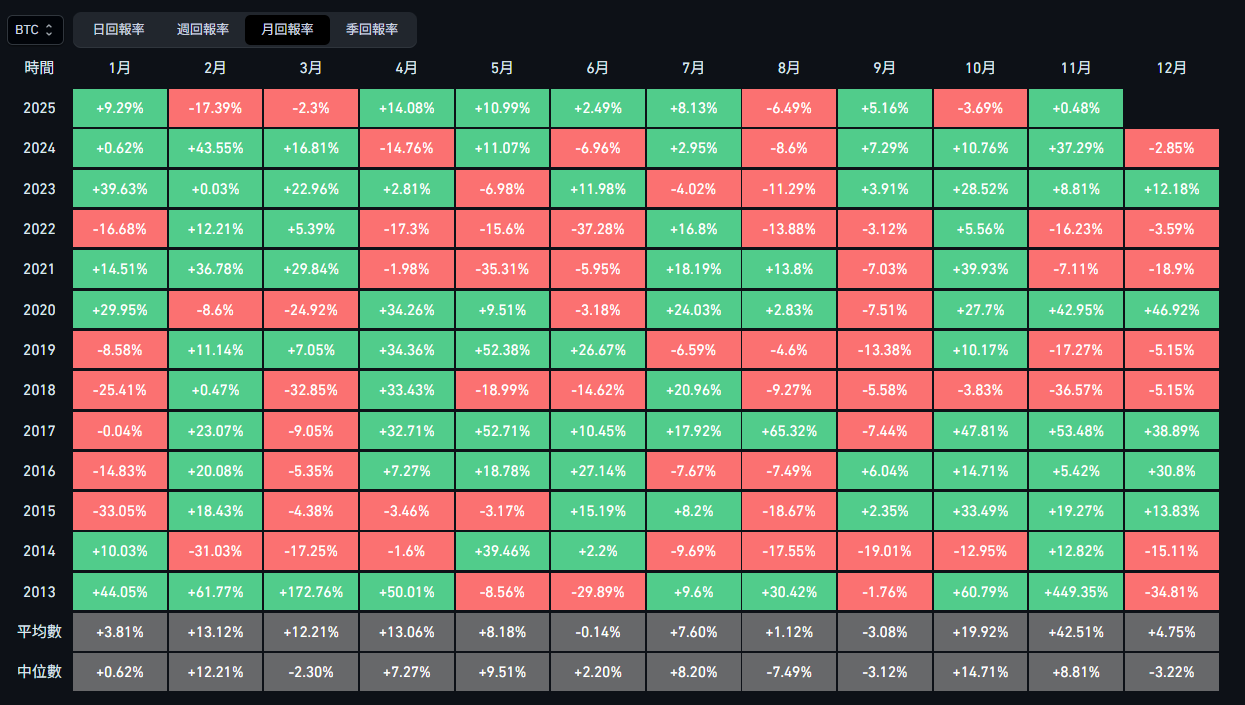
First, there are seasonal factors. Looking back at bitcoin's historical data from 2013 to 2024, November has always been the strongest month for bitcoin each year, with an average increase of up to 42.5%. If this historical pattern repeats, and based on the current price of around $110,000, bitcoin still has the opportunity to challenge $150,000 or even higher.
In addition to seasonal advantages, bulls' confidence also comes from favorable macro factors. First, there are signs of easing in the US-China trade tensions. After Trump and Xi Jinping met in South Korea, both sides reached a preliminary agreement: the US agreed to reduce some tariffs on China in exchange for China cracking down on fentanyl, resuming soybean purchases, and suspending rare earth export restrictions for one year. This move is seen as a key step in resolving the trigger for October's flash crash.
Secondly, the Federal Reserve has officially announced that it will end balance sheet reduction in early December. Although Powell's speech lowered expectations for a December rate cut, the market still believes there is a 63% chance of a rate cut in December.
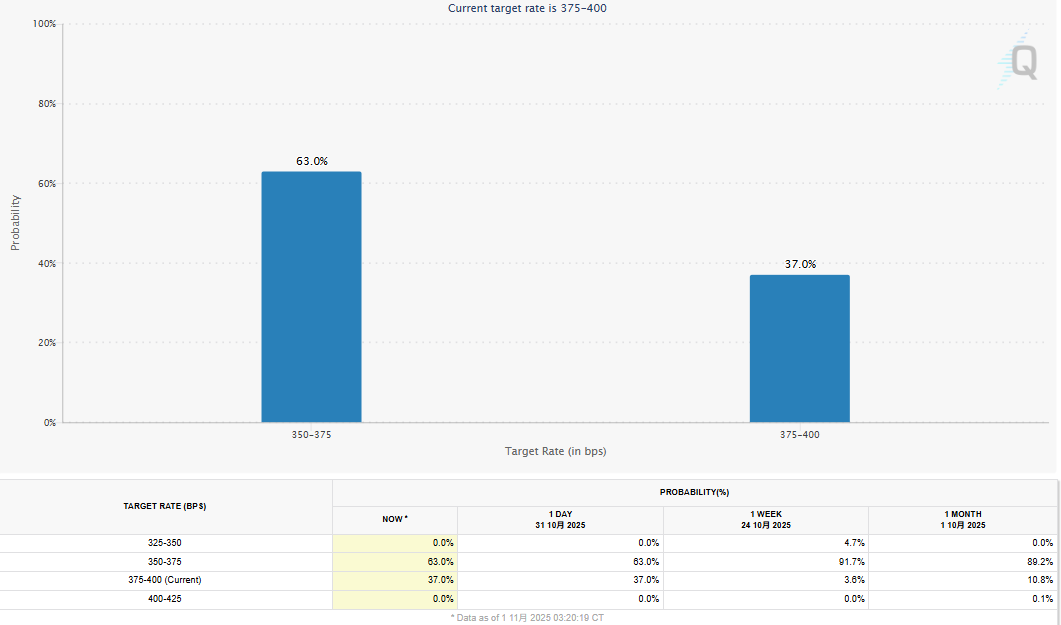
Image source: CME FedWatch Tool
However, the market is not without concerns. The US government shutdown has entered its fifth week, with Republicans and Democrats deadlocked over the budget bill. If the shutdown continues, it will further deepen market uncertainty.
Analyst: Intense volatility is coming
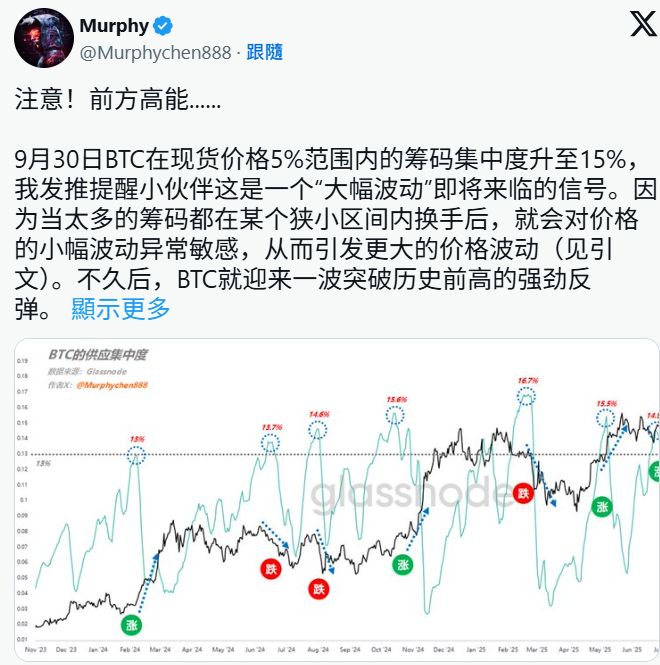
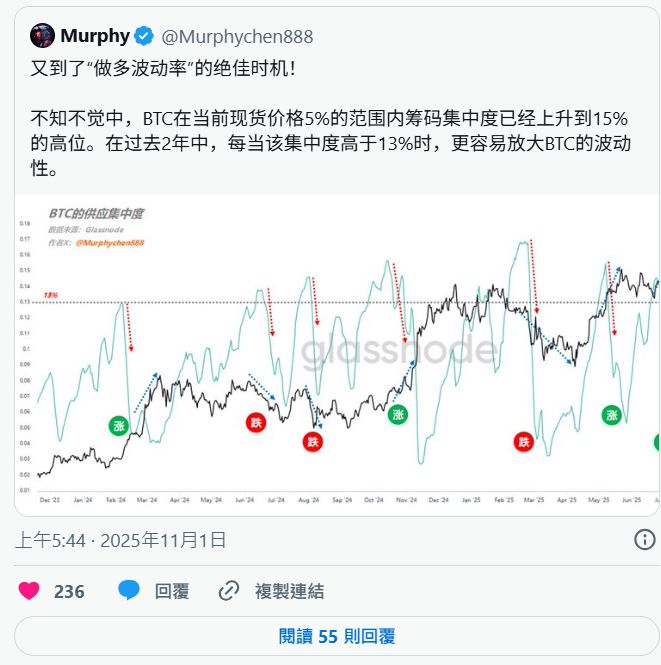
Additionally, cryptocurrency analyst Murphy posted on X today (1st) that the concentration of bitcoin spot price chips within a 5% range has soared to 17.6%, a nearly two-year high. This means a large amount of chips are being squeezed into a narrow range, and any small price movement could trigger a chain reaction, amplifying market volatility. However, whether the price will rise or fall is still uncertain at this point.
Disclaimer: The content of this article solely reflects the author's opinion and does not represent the platform in any capacity. This article is not intended to serve as a reference for making investment decisions.
You may also like
The AI boom may follow the path of the 19th-century railway bubble, and builders may not be the ultimate winners
Goldman Sachs analyst Bobby Molavi compared the current situation to the 19th-century British railway mania: 500 companies spent more than the nation's annual income building 8,000 miles of railway, with most early investors losing out, while the real beneficiaries were the later "passengers." He pointed out that the current AI craze is driven by both debt and momentum, and that the S&P 500’s forward P/E ratio of 18x is only "a bit cheaper." Whether the builders can retain value is uncertain, and history does not offer an optimistic answer.

If Anthropic's IPO goes smoothly and the stock price rises next week, then everything remains the same for AI. Otherwise, some companies will go bankrupt.
The shrinking valuations of two major giants have triggered a chain reaction—investors are adopting more conservative revenue multiples for AI startups and are directly halting high-valuation financing for companies with zero revenue. Multiple venture capital firms have advised their portfolio companies to lower valuation expectations and to quickly build up cash reserves. Market participants warn that the outcome of Anthropic’s IPO will be a barometer for the industry: if successful, the boom will continue; if it fails, some companies may face elimination.
After the Brazilian election, political discount deepens; Morgan Stanley remains bullish on Petrobras (PBR.US), focusing on fuel pricing and dividends
Morgan Stanley still maintains its most optimistic "Overweight" rating, but has lowered its year-end 2027 target price from $31 to $25.

Corning (GLW.US) receives initial "Buy" rating from Jefferies! AI factories driving a fiber optic rush, with a potential global supply gap of up to 30%
For Corning, the recent profit growth mainly comes from the expansion of AI clusters. As the number of optical links crossing cabinets and campuses increases, customers need to deploy more optical fibers within limited conduit and cabinet space, thus driving demand for high-density optical cables and connection systems.

Crypto prices
More


