
Silent for two years, the "Big Short" finally speaks! Subtle warning: Is there a deadly bubble hidden in the current market?

Source: Wallstreetcn
Original Title: "The Big Short" Burry Issues Cryptic Warning: Sometimes We See a Bubble, and the Only Winning Move Is Not to Play
After two years of silence, Michael Burry, the real-life inspiration for the movie "The Big Short," spoke out again on Friday, warning of the risk that a market bubble could burst.
Burry shared a still from "The Big Short" on social media platform X, showing actor Christian Bale, who plays him in the film, staring at a computer screen in shock. He captioned the post: "Sometimes we can see a bubble. Sometimes we can do something about it. Sometimes the only way to win is not to play."
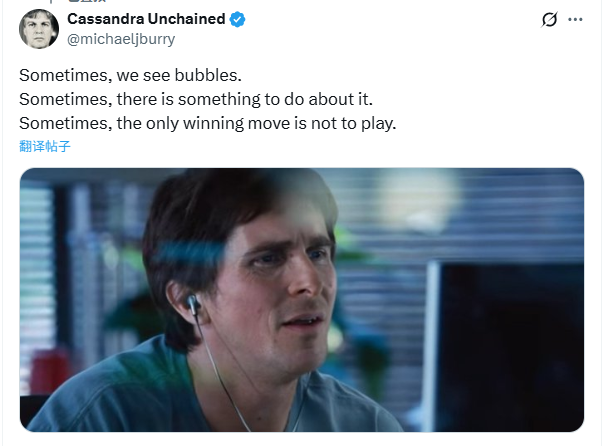
It is reported that Burry's quote is from the 1983 film "WarGames." In the movie, an artificial intelligence (AI) system simulates thousands of US-Soviet nuclear wars, only to find that all scenarios end in "mutual destruction." The system ultimately concludes: "A strange game. The only winning move is not to play."
Clearly, Burry's post implies that he believes the current market is filled with unsustainable speculative behavior and that the bubble will eventually burst. He himself has chosen not to participate in the AI frenzy, neither betting on it nor shorting it, which he sees as "the only way to win."
Although Burry did not specify exactly what the bubble is, many believe he is referring to the current AI boom. Amid the AI wave, the market value of major tech stocks like Nvidia has soared. Since the beginning of 2023, Nvidia's stock price has skyrocketed by more than 1200%, and this week its market value surpassed $5 trillion for the first time, driving the S&P 500 and Nasdaq indexes to new highs.
Burry updated his profile name to "Unbound Cassandra," referencing the cursed priestess from Greek mythology who could foresee the future but was never believed. His bio now reads: "Someone ready to share what he knows."
Similar to his return to social media in November 2021, Burry once again changed his homepage banner to Jan Brueghel the Younger's famous painting "A Satire of Tulip Mania," alluding to the first recorded asset bubble in human history. Notably, three months later, the Nasdaq peaked and then entered a bear market.
Burry is best known for successfully predicting the US subprime mortgage crisis, a feat that brought him fame after being featured in the book "The Big Short." He later took early positions in GameStop and shorted Tesla, Cathie Wood's flagship ARK fund, Apple, and chip stocks including Nvidia.
As early as the summer of 2021, Burry issued a warning that the market was in "the greatest speculative bubble of all time in all things," cautioning that meme stock and cryptocurrency buyers would face a "mother of all crashes."
This series of bearish predictions drew ridicule from Musk at the time, who called Burry "a broken clock" that always sends out the wrong signals.
At the beginning of 2023, Burry posted just one word on social media X: "Sell," sparking heated discussion in the market. However, not long after, he admitted he had misjudged the situation. Such an admission of error is extremely rare on Wall Street; analysts almost never do this, typically just issuing new forecasts after some time has passed.
Disclaimer: The content of this article solely reflects the author's opinion and does not represent the platform in any capacity. This article is not intended to serve as a reference for making investment decisions.
You may also like
The AI boom may follow the path of the 19th-century railway bubble, and builders may not be the ultimate winners
Goldman Sachs analyst Bobby Molavi compared the current situation to the 19th-century British railway mania: 500 companies spent more than the nation's annual income building 8,000 miles of railway, with most early investors losing out, while the real beneficiaries were the later "passengers." He pointed out that the current AI craze is driven by both debt and momentum, and that the S&P 500’s forward P/E ratio of 18x is only "a bit cheaper." Whether the builders can retain value is uncertain, and history does not offer an optimistic answer.

If Anthropic's IPO goes smoothly and the stock price rises next week, then everything remains the same for AI. Otherwise, some companies will go bankrupt.
The shrinking valuations of two major giants have triggered a chain reaction—investors are adopting more conservative revenue multiples for AI startups and are directly halting high-valuation financing for companies with zero revenue. Multiple venture capital firms have advised their portfolio companies to lower valuation expectations and to quickly build up cash reserves. Market participants warn that the outcome of Anthropic’s IPO will be a barometer for the industry: if successful, the boom will continue; if it fails, some companies may face elimination.
After the Brazilian election, political discount deepens; Morgan Stanley remains bullish on Petrobras (PBR.US), focusing on fuel pricing and dividends
Morgan Stanley still maintains its most optimistic "Overweight" rating, but has lowered its year-end 2027 target price from $31 to $25.

Corning (GLW.US) receives initial "Buy" rating from Jefferies! AI factories driving a fiber optic rush, with a potential global supply gap of up to 30%
For Corning, the recent profit growth mainly comes from the expansion of AI clusters. As the number of optical links crossing cabinets and campuses increases, customers need to deploy more optical fibers within limited conduit and cabinet space, thus driving demand for high-density optical cables and connection systems.

Crypto prices
More


