
Everyone’s Depressed in Crypto — But Bitwise’s CEO Says That’s What Winning Looks Like

Bitwise CEO Hunter Horsley believes the “depressed vibes” reflect crypto’s transition into maturity, as regulatory clarity rises and institutions pour in.
Crypto might be having a vibes crisis after Bitcoin slipped below $110,000. A wave of industry veterans say the mood across group chats and social media feels like a bear market.
However, according to Bitwise CEO Hunter Horsley, that disconnect might actually be a sign that crypto has finally matured.
Bitwise and Nick Carter Say Crypto’s Boredom Signals Its Maturity
“Crypto natives are now in a multi-month bear market sentiment.” These are the words of Hunter Horsley, the CEO of one of the largest crypto index fund managers.
The statement comes after Bitcoin slipped below $110,000 and was trading at $109,535 on Friday during the early hours of the US session.
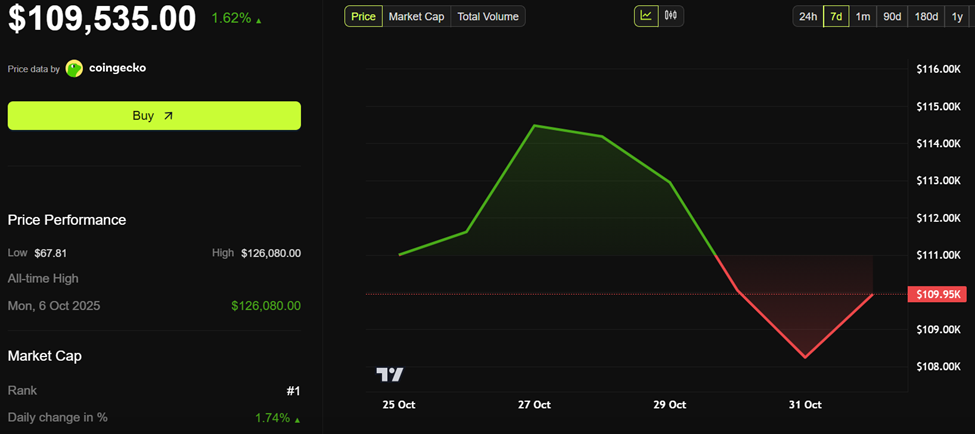 Bitcoin (BTC) Price Performance. Source:
Against this backdrop, sentiment on X (Twitter), like on crypto media, is sour. However, Horsley highlights the receding regulatory risk and the abounding institutional interest, noting unprecedented market growth.
“The sentiment off-Twitter is best it’s ever been. The market is changing,” he added.
Horsley’s post follows a viral comment from analyst and investor Will Clemente, who lamented that “the vibes in the crypto group chats are just sad… everyone seems jaded, depressed, and defeated.”
The vibes in the crypto groupchats that I'm in are just sad honestly, people completely giving up and pivoting to other asset classes if they haven't already. Everyone seems jaded, depressed, and defeated, & how can you blame them given how BTC has traded this year
— Will (@WClementeIII) October 30, 2025
His observation captures what many traders have been sharing, that despite a strong macro backdrop, enthusiasm feels muted.
However, venture capitalist Nick Carter of Castle Island Ventures argued that this so-called boredom is actually a victory lap in disguise.
“Crypto is boring because so many of the open questions have been answered. Will stablecoins be allowed? Yes. Will we be banned? No. Will we be incorporated into TradFi? Yes… These are the hallmarks of an industry that won,” Carter wrote.
Carter said the space’s reduced volatility and regulatory clarity reflect a “mature, de-risked technological substrate” that now attracts serious businesses and Web2 professionals rather than speculative risk-takers.
In his view, crypto’s chaos-driven edge has been replaced by a new competitive advantage, the ability to deliver real consumer value.
That shift, Carter added, means crypto natives no longer control the narrative. Instead, traditional finance, corporates, and payments players are increasingly shaping the next growth cycle.
“If you’re sad that volatility has been dampened, smile through the tears — it means we won,” he wrote.
In the same tone, Messari analyst Dan noted that quieter markets are not a bad thing.
“It makes me feel good when tourists leave and traders get rekt. It’s more comfortable when the ecosystem is dominated by people who actually understand the long run,” Dan chimed.
The irony is that crypto’s malaise may mark the moment it crosses into the mainstream of finance. As the speculative thrill fades and structure sets in, the mood might feel like a bear market.
However, the fundamentals suggest this may be what winning looks like.
Disclaimer: The content of this article solely reflects the author's opinion and does not represent the platform in any capacity. This article is not intended to serve as a reference for making investment decisions.
You may also like
The AI boom may follow the path of the 19th-century railway bubble, and builders may not be the ultimate winners
Goldman Sachs analyst Bobby Molavi compared the current situation to the 19th-century British railway mania: 500 companies spent more than the nation's annual income building 8,000 miles of railway, with most early investors losing out, while the real beneficiaries were the later "passengers." He pointed out that the current AI craze is driven by both debt and momentum, and that the S&P 500’s forward P/E ratio of 18x is only "a bit cheaper." Whether the builders can retain value is uncertain, and history does not offer an optimistic answer.

If Anthropic's IPO goes smoothly and the stock price rises next week, then everything remains the same for AI. Otherwise, some companies will go bankrupt.
The shrinking valuations of two major giants have triggered a chain reaction—investors are adopting more conservative revenue multiples for AI startups and are directly halting high-valuation financing for companies with zero revenue. Multiple venture capital firms have advised their portfolio companies to lower valuation expectations and to quickly build up cash reserves. Market participants warn that the outcome of Anthropic’s IPO will be a barometer for the industry: if successful, the boom will continue; if it fails, some companies may face elimination.
After the Brazilian election, political discount deepens; Morgan Stanley remains bullish on Petrobras (PBR.US), focusing on fuel pricing and dividends
Morgan Stanley still maintains its most optimistic "Overweight" rating, but has lowered its year-end 2027 target price from $31 to $25.

Corning (GLW.US) receives initial "Buy" rating from Jefferies! AI factories driving a fiber optic rush, with a potential global supply gap of up to 30%
For Corning, the recent profit growth mainly comes from the expansion of AI clusters. As the number of optical links crossing cabinets and campuses increases, customers need to deploy more optical fibers within limited conduit and cabinet space, thus driving demand for high-density optical cables and connection systems.

Crypto prices
More


