
Bitcoin ETFs Bleed $490 Million as BlackRock Faces Fraud Scandal

Bitcoin and Ethereum ETFs lost $672M in one day as BlackRock’s $500M private-credit fraud sparks investor caution and risk-off sentiment.
Major crypto ETFs (Bitcoin and Ethereum) posted $672 million in combined outflows on Thursday, October 30. BlackRock’s IBIT ETF lost $291 million, and ETHA shed $118 million.
Meanwhile, a $500 million telecom-financing fraud tied to BlackRock’s private-credit arm has rocked institutional markets, raising new concerns about risk management and due diligence.
Institutional ETF Redemptions Show Risk Aversion
Institutional clients of major asset managers pulled $490 million from Bitcoin ETFs on October 30, according to data from Farside Investors.
BlackRock’s IBIT led the exodus with $290.9 million in redemptions. Fidelity, Bitwise, ARK, Invesco, VanEck, and Grayscale also recorded heavy outflows. Ethereum ETFs saw $184 million in losses, with BlackRock’s ETHA responsible for $118 million.
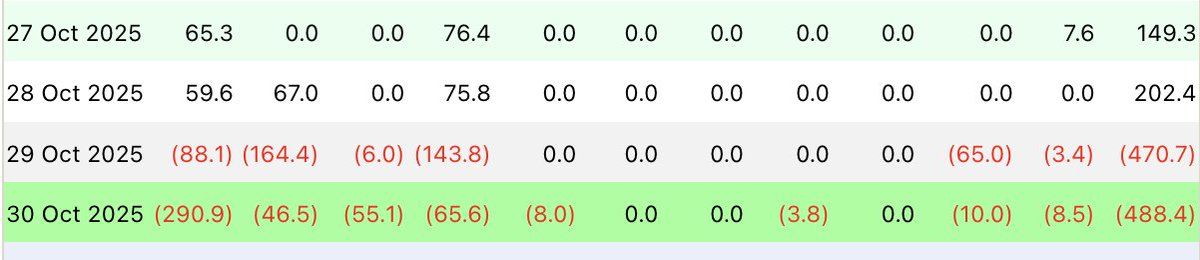 Bitcoin ETF outflows totaled $488.4 million on October 30, 2025. Source:
Farside Investors
The magnitude of these withdrawals signals a broader retreat from risk as macroeconomic uncertainty grows. Analysts see the outflows as profit-taking and portfolio trimming rather than panic selling.
Institutions are still trimming risk, $BTC and $ETH spot ETFs saw heavy outflows, led by BlackRock’s $IBIT (-$291M) and $ETHA (-$118M), totaling $488M and $184M.But $SOL ETFs quietly pulled in $37M. Looks like some capital’s rotating toward higher-beta plays again.
— Kyledoops (@kyledoops) October 31, 2025
Notably, this coincides with a closer scrutiny of BlackRock following revelations of large-scale fraud in its private credit division. The timing has increased anxiety among investors.
BlackRock Fraud Scandal Reveals Private Credit Risks
BlackRock’s difficulties go beyond ETF outflows. Bloomberg reports that its private-credit arm, HPS Investment Partners, lost over $500 million in a telecom-financing scheme involving fake accounts receivable.
Court filings in the New York Supreme Court allege that borrowers Broadband Telecom and Bridgevoice used forged contracts and invoices from companies like T-Mobile and Telstra as collateral for sizable loans. The court documents also outline years of systematic forgery and misrepresentation.
The fraud was uncovered in August 2025, resulting in bankruptcies and lawsuits. BNP Paribas, BlackRock’s partner in making these loans, is also named in the litigation.
The scandal emerged just 90 days after BlackRock acquired HPS for $12 billion. The purchase, finalized on July 1, 2025, aimed to expand BlackRock’s reach in private credit. Instead, the discovery has raised questions about the company’s due diligence and risk oversight during the process.
BlackRock’s private-credit arm was defrauded of over $500 million by an Indian named Bankim Brahmbhatt.Brahmbhatt ran a telecom-financing firm named Carriox Capital and fabricated customer contracts and invoices from major telecom companies such as T-Mobile, Telstra, and…
— AF Post (@AFpost) October 30, 2025
Notwithstanding, BlackRock remains the clear leader in the ETF space despite this turbulence. According to US Crypto News analysis, IBIT attracted $28.1 billion in net inflows since the start of 2025, outpacing all competitors combined.
Removing IBIT, the sector would have seen net outflows of $1.2 billion this year. Such concentration raises concerns about systemic risks if BlackRock were forced to cut exposure or faced major redemptions, potentially draining liquidity across the crypto ETFs market.
Short Liquidations and Market Volatility on the Horizon
As institutional money exits Bitcoin ETFs, leveraged traders now face more risk. Whale Insider noted on X that more than $3 billion in Bitcoin short positions could be liquidated if the price reaches $112,600.
JUST IN: Over $3,000,000,000 worth of $BTC short positions to be liquidated when price hits $112,600.
— Whale Insider (@WhaleInsider) October 31, 2025
With Bitcoin trading near $109,287 as of this writing, it is just 2.48% away from this threshold. Therefore, even a modest rally might trigger a short squeeze and rapid market turnaround.
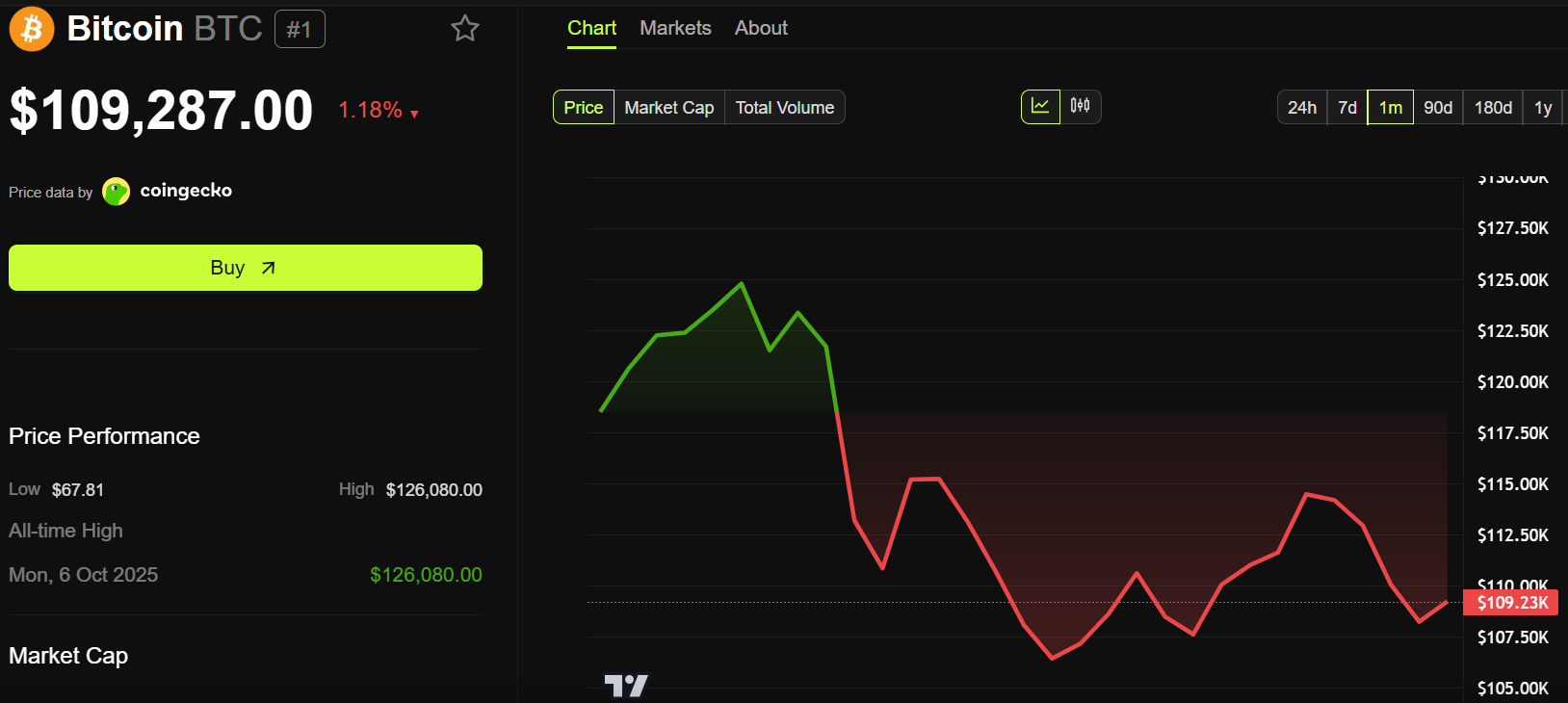 Bitcoin (BTC) Price Performance. Source:
BeInCrypto
This potential for sharp price moves complicates the bearish outlook suggested by ETF outflows. Liquidation data from Coinglass shows many short positions gathered just above current levels. Any upward move could spark a cascade of covering.
The interplay between institutional redemptions and leveraged bets creates a precarious scenario where sentiment may flip quickly.
Disclaimer: The content of this article solely reflects the author's opinion and does not represent the platform in any capacity. This article is not intended to serve as a reference for making investment decisions.
You may also like
The AI boom may follow the path of the 19th-century railway bubble, and builders may not be the ultimate winners
Goldman Sachs analyst Bobby Molavi compared the current situation to the 19th-century British railway mania: 500 companies spent more than the nation's annual income building 8,000 miles of railway, with most early investors losing out, while the real beneficiaries were the later "passengers." He pointed out that the current AI craze is driven by both debt and momentum, and that the S&P 500’s forward P/E ratio of 18x is only "a bit cheaper." Whether the builders can retain value is uncertain, and history does not offer an optimistic answer.

If Anthropic's IPO goes smoothly and the stock price rises next week, then everything remains the same for AI. Otherwise, some companies will go bankrupt.
The shrinking valuations of two major giants have triggered a chain reaction—investors are adopting more conservative revenue multiples for AI startups and are directly halting high-valuation financing for companies with zero revenue. Multiple venture capital firms have advised their portfolio companies to lower valuation expectations and to quickly build up cash reserves. Market participants warn that the outcome of Anthropic’s IPO will be a barometer for the industry: if successful, the boom will continue; if it fails, some companies may face elimination.
After the Brazilian election, political discount deepens; Morgan Stanley remains bullish on Petrobras (PBR.US), focusing on fuel pricing and dividends
Morgan Stanley still maintains its most optimistic "Overweight" rating, but has lowered its year-end 2027 target price from $31 to $25.

Corning (GLW.US) receives initial "Buy" rating from Jefferies! AI factories driving a fiber optic rush, with a potential global supply gap of up to 30%
For Corning, the recent profit growth mainly comes from the expansion of AI clusters. As the number of optical links crossing cabinets and campuses increases, customers need to deploy more optical fibers within limited conduit and cabinet space, thus driving demand for high-density optical cables and connection systems.

Crypto prices
More


