
Fed turns hawkish? Barclays: Powell aims to "break the expectation of inevitable rate cuts," and data supports more rate cuts

Barclays believes that the market's hawkish interpretation of Powell's remarks is a misjudgment.
Barclays believes the market's hawkish interpretation of Powell's remarks is a misjudgment.
Written by: Dong Jing
Source: Wallstreetcn
The market's "hawkish" interpretation of the latest remarks by Federal Reserve Chairman Powell may be a misjudgment. Barclays believes that Powell's real intention is to correct the market's overconfidence that "rate cuts are a done deal."
After the October FOMC meeting, the Federal Reserve Chairman stated at a press conference that inflation still faces upward pressure in the short term, employment faces downside risks, and the current situation is quite challenging. The committee remains divided on whether to cut rates again in December, and a rate cut is not set in stone. The market interpreted this statement as hawkish, leading to a sell-off in 2-year U.S. Treasury bonds, a sharp rise in yields, and a pullback in U.S. stocks.
On October 31, according to Chasing Wind Trading Desk, Barclays Bank put forward a clear opposing view in its latest research report, arguing that the market's panic may be a misjudgment. Powell's real intention is not to turn hawkish, but to manage the market's overly "certain" expectations of rate cuts.
The analyst team led by Anshul Pradhan at Barclays believes this is a communication strategy aimed at breaking the market's assumption that rate cuts are a foregone conclusion regardless of the data. The latest economic data show that labor demand continues to slow and underlying inflation is not far from the 2% target, both of which support the Fed's continued rate cuts.
Barclays pointed out in the research report that the current market pricing is too hawkish and fails to fully reflect the risk that the labor market could weaken significantly, as well as the risk that a new Fed chair might take a more dovish stance.
Not a Hawkish Shift, but Breaking the Market "Consensus"
Barclays stated in the report: "We believe the main motivation is to refute the market's assumption that a December rate cut is a done deal, rather than a hawkish shift in the Fed's response to data."
In other words, the Fed wants to reiterate that its decisions are data-dependent, not dictated by market expectations. Powell made it clear that the Fed will respond to the slowdown in labor demand, which is exactly what is happening.
The report emphasizes that the latest economic data not only do not support a hawkish stance, but actually provide grounds for further rate cuts.
In terms of the labor market, leading indicators such as Indeed job postings and the jobs plentiful vs hard to get differential all show that demand is slowing.
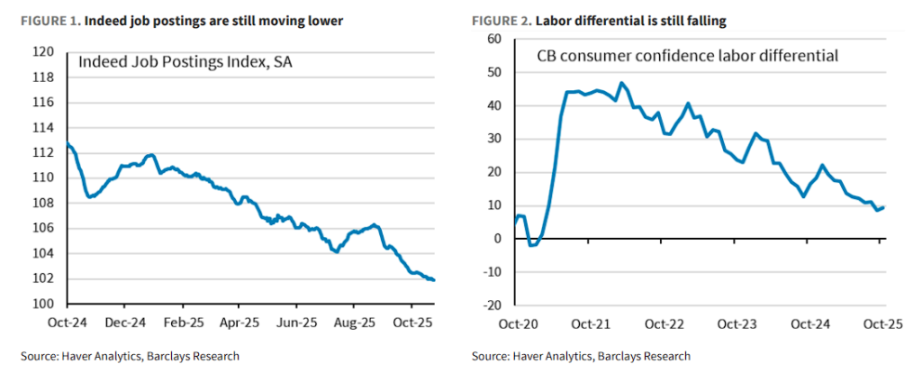
On inflation, Powell also acknowledged the recent weakness in data. Core inflation indicators have shown a downward trend. Barclays' analysis suggests that once the impact of tariffs is excluded, market-based core PCE inflation is already close to the 2% target.
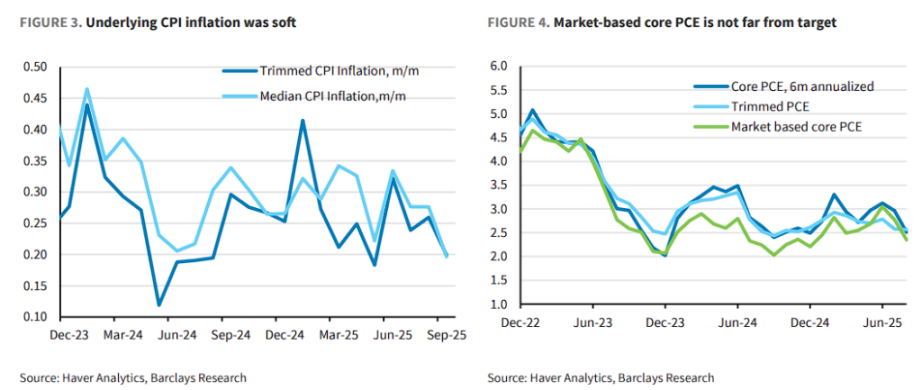
"Overall, if underlying inflation is only a few tenths of a percentage point above the target, and the unemployment rate is only a few tenths of a percentage point above the natural unemployment rate (NAIRU), then policy should be neutral."
This means that, given the current data, restrictive monetary policy is no longer necessary. Barclays observed that the market is currently only pricing in a cumulative 55 basis points of rate cuts by June 2026, which is "too one-sided."
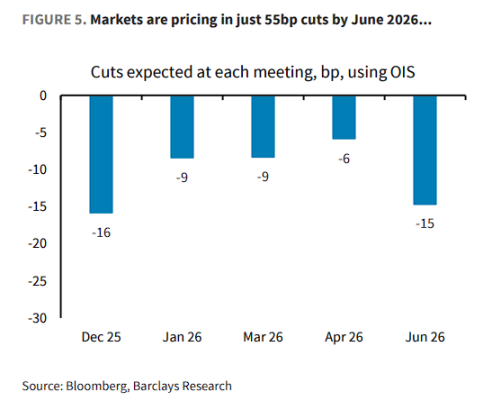
The current market expects only a 35 basis point rate cut by March 2026 and a 55 basis point cut by June, bringing the rate to 3.3%. The distribution implied by the options market shows that there is disagreement over the number of rate cuts in March and June, with the modal expectation being only one rate cut by June.
Disclaimer: The content of this article solely reflects the author's opinion and does not represent the platform in any capacity. This article is not intended to serve as a reference for making investment decisions.
You may also like
The AI boom may follow the path of the 19th-century railway bubble, and builders may not be the ultimate winners
Goldman Sachs analyst Bobby Molavi compared the current situation to the 19th-century British railway mania: 500 companies spent more than the nation's annual income building 8,000 miles of railway, with most early investors losing out, while the real beneficiaries were the later "passengers." He pointed out that the current AI craze is driven by both debt and momentum, and that the S&P 500’s forward P/E ratio of 18x is only "a bit cheaper." Whether the builders can retain value is uncertain, and history does not offer an optimistic answer.

If Anthropic's IPO goes smoothly and the stock price rises next week, then everything remains the same for AI. Otherwise, some companies will go bankrupt.
The shrinking valuations of two major giants have triggered a chain reaction—investors are adopting more conservative revenue multiples for AI startups and are directly halting high-valuation financing for companies with zero revenue. Multiple venture capital firms have advised their portfolio companies to lower valuation expectations and to quickly build up cash reserves. Market participants warn that the outcome of Anthropic’s IPO will be a barometer for the industry: if successful, the boom will continue; if it fails, some companies may face elimination.
After the Brazilian election, political discount deepens; Morgan Stanley remains bullish on Petrobras (PBR.US), focusing on fuel pricing and dividends
Morgan Stanley still maintains its most optimistic "Overweight" rating, but has lowered its year-end 2027 target price from $31 to $25.

Corning (GLW.US) receives initial "Buy" rating from Jefferies! AI factories driving a fiber optic rush, with a potential global supply gap of up to 30%
For Corning, the recent profit growth mainly comes from the expansion of AI clusters. As the number of optical links crossing cabinets and campuses increases, customers need to deploy more optical fibers within limited conduit and cabinet space, thus driving demand for high-density optical cables and connection systems.

Crypto prices
More


