
Solana Up 9%—But Long-Term Holders Are Selling Into Strength

Solana price is flashing signs of near-term weakness as long-term holders trim exposure and big money inflows remain muted. While short-term gains kept it steady this week, a near 3% dip could test key support near $192, where failure to hold might open the way for deeper losses.
Solana (SOL) is flashing warning signs again. It may have gained nearly 9% over the past week, but the Solana price is still down around 6% for the month — a clear sign that buyers are losing momentum. On-chain data shows that long-term holders are cutting exposure and large investors are staying on the sidelines.
Together, these trends point to a growing risk of a short-term pullback that could extend beyond 3% if key support levels give way.
Holders Drive the Selling as Big Money Stays Cautious
Steady outflows from mid- and long-term holders are undermining Solana’s recent strength. Glassnode’s HODL Waves metric — which tracks how long coins stay untouched before being moved — shows a clear drop among conviction holders.
Wallets holding Solana for 1–2 years have reduced their share of the supply from 20.33% to 18.48%, while 3–6 month holders fell from 12.7% to 11.55% this month.
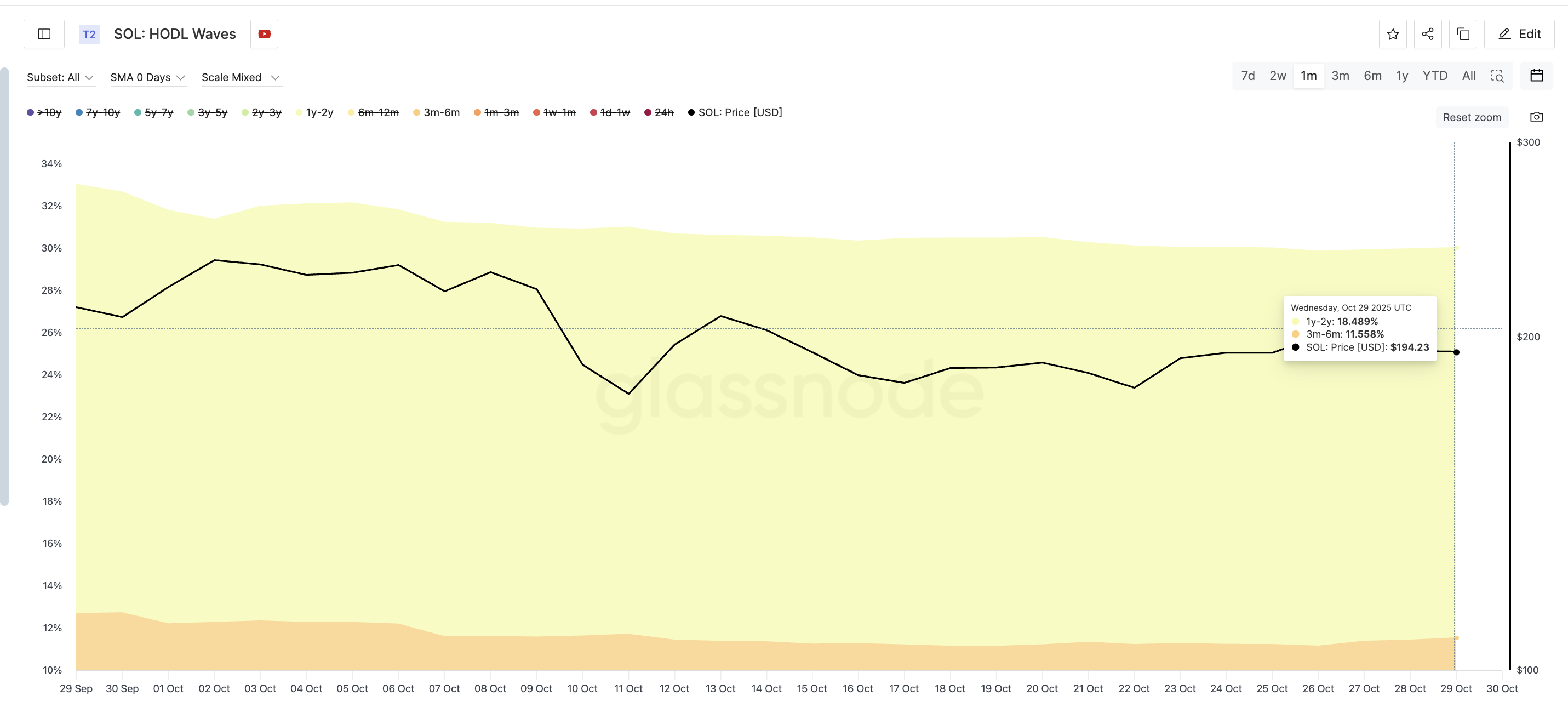 Solana Holders Dumping Hard:
This change signals profit-taking among patient investors, a bearish development that often precedes short-term corrections.
The Chaikin Money Flow (CMF) — a tool that measures big-money inflows and outflows — adds to this view. After briefly rising above zero on October 27, CMF turned negative again and has failed to recover since. That means institutional buyers are not adding aggressively, even after recent dips.
During recovery or range-bound moves, these big money flows often offset the cohort-based selling waves. That isn’t happening currently. Instead, CMF turning negative is adding to the “sell” pressure, strengthening the Solana price pullback narrative.
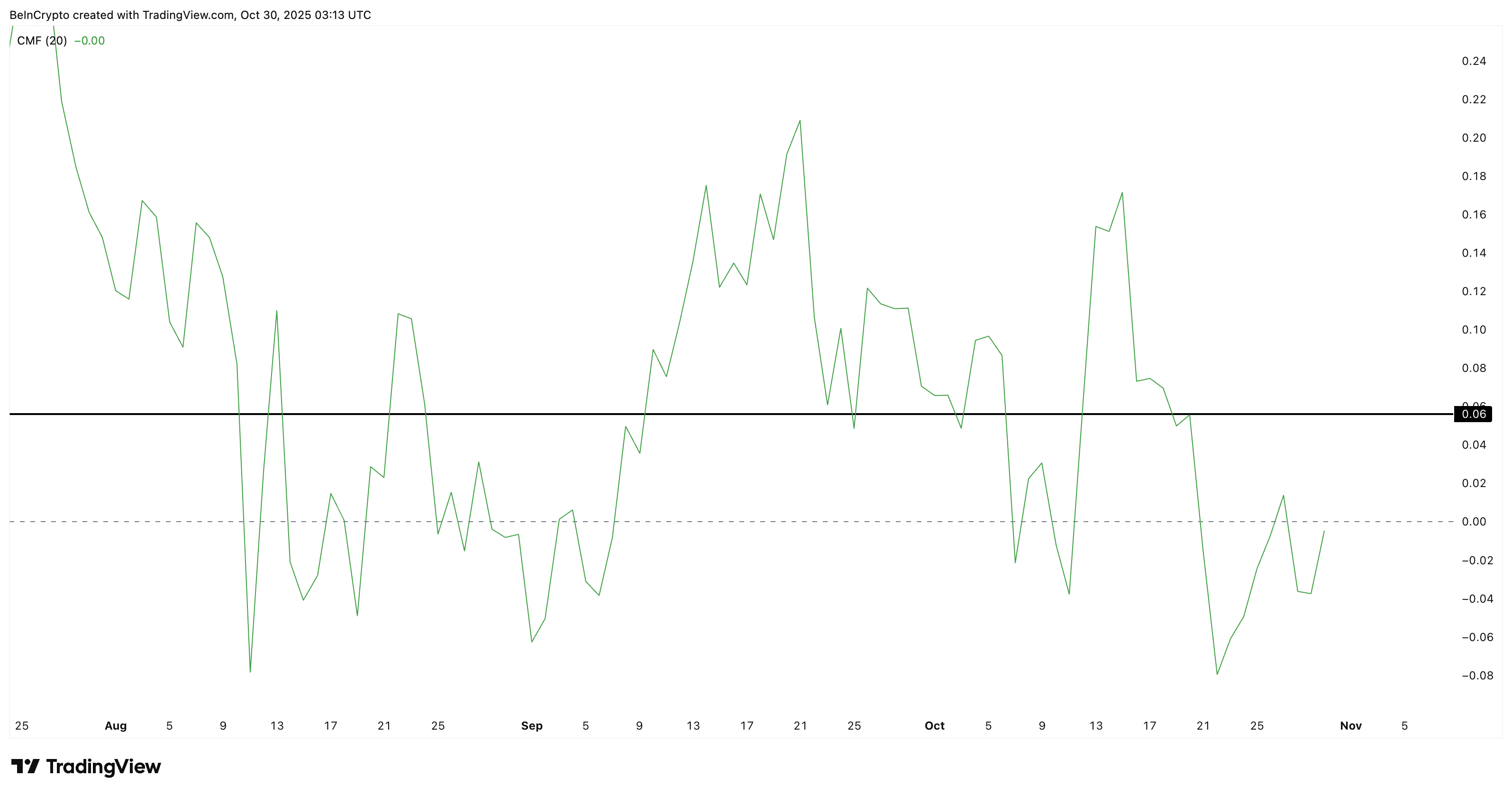 Big Money Flow Restricted:
Unless CMF climbs back above 0.06, Solana’s recovery will likely stay weak. These combined on-chain and big-money signals show why sellers remain in control despite last week’s bounce.
Weak Structure Points to Another Leg Down For The Solana Price
On the daily chart, Solana’s pattern supports the bearish setup. Between October 13 and October 30, the SOL price formed a lower high. The Relative Strength Index (RSI) — which measures buying and selling strength — made a higher high.
This formation is a hidden bearish divergence, and often appears before trend continuation to the downside. It shows that even though the momentum indicator rose, the actual price couldn’t keep up, indicating that selling pressure still dominates.
Solana has already slipped 6% over the past 30 days (a downtrend signal), suggesting this hidden divergence could soon play out. If the price falls below $192 (about 3% below the current level), it may confirm the start of a deeper pullback toward $182 and possibly $161.
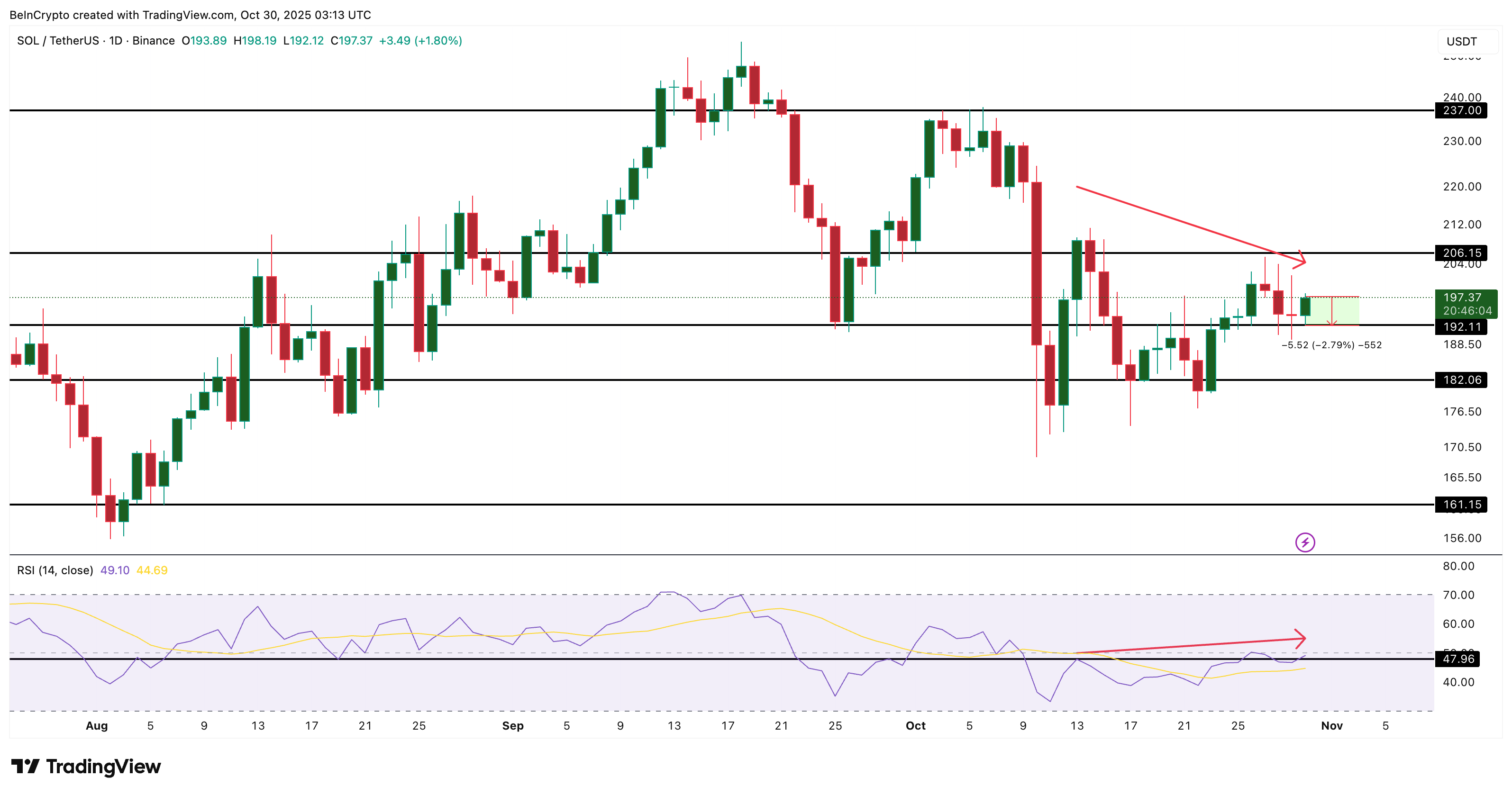 Solana Price Analysis:
The only way to invalidate this bearish view would be a daily candle close above $206. That could push Solana toward $237. Until then, the structure stays fragile and tilted toward more downside.
Disclaimer: The content of this article solely reflects the author's opinion and does not represent the platform in any capacity. This article is not intended to serve as a reference for making investment decisions.
You may also like
The AI boom may follow the path of the 19th-century railway bubble, and builders may not be the ultimate winners
Goldman Sachs analyst Bobby Molavi compared the current situation to the 19th-century British railway mania: 500 companies spent more than the nation's annual income building 8,000 miles of railway, with most early investors losing out, while the real beneficiaries were the later "passengers." He pointed out that the current AI craze is driven by both debt and momentum, and that the S&P 500’s forward P/E ratio of 18x is only "a bit cheaper." Whether the builders can retain value is uncertain, and history does not offer an optimistic answer.

If Anthropic's IPO goes smoothly and the stock price rises next week, then everything remains the same for AI. Otherwise, some companies will go bankrupt.
The shrinking valuations of two major giants have triggered a chain reaction—investors are adopting more conservative revenue multiples for AI startups and are directly halting high-valuation financing for companies with zero revenue. Multiple venture capital firms have advised their portfolio companies to lower valuation expectations and to quickly build up cash reserves. Market participants warn that the outcome of Anthropic’s IPO will be a barometer for the industry: if successful, the boom will continue; if it fails, some companies may face elimination.
After the Brazilian election, political discount deepens; Morgan Stanley remains bullish on Petrobras (PBR.US), focusing on fuel pricing and dividends
Morgan Stanley still maintains its most optimistic "Overweight" rating, but has lowered its year-end 2027 target price from $31 to $25.

Corning (GLW.US) receives initial "Buy" rating from Jefferies! AI factories driving a fiber optic rush, with a potential global supply gap of up to 30%
For Corning, the recent profit growth mainly comes from the expansion of AI clusters. As the number of optical links crossing cabinets and campuses increases, customers need to deploy more optical fibers within limited conduit and cabinet space, thus driving demand for high-density optical cables and connection systems.

Crypto prices
More


