
What Crypto Whales Are Buying After FOMC Rate Cuts

Crypto whales are quietly repositioning after the Fed’s 25-basis-point rate cut, accumulating select tokens showing early strength. Cardano, Ethena, and Aster are emerging as top targets, each flashing signs of recovery while testing key supports that could decide November’s next big moves.
The US Federal Reserve’s 25-basis-point rate cut didn’t excite the crypto market much. Bitcoin and Ethereum stayed in red, and total market capitalization slipped 1.6%, showing the decision was mostly priced in. Still, what crypto whales are buying after FOMC rate cuts has become a key talking point.
Large investors are quietly rotating into a few tokens showing reduced selling pressure and strong technical setups. Data points to three assets where whale accumulation has picked up since the policy shift — each showing signs of building conviction heading into November.
Cardano (ADA)
Whales holding between 1 million and 10 million ADA have added steadily since yesterday, increasing their stash from 5.57 billion to 5.59 billion ADA. That’s roughly 20 million ADA added, worth about $12.8 million at the current price of $0.64.
This smaller whale cohort often leads early buying cycles before larger holders follow. Cardano has dropped around 20% over the past month, but the reignited whale activity suggests a potential rebound.
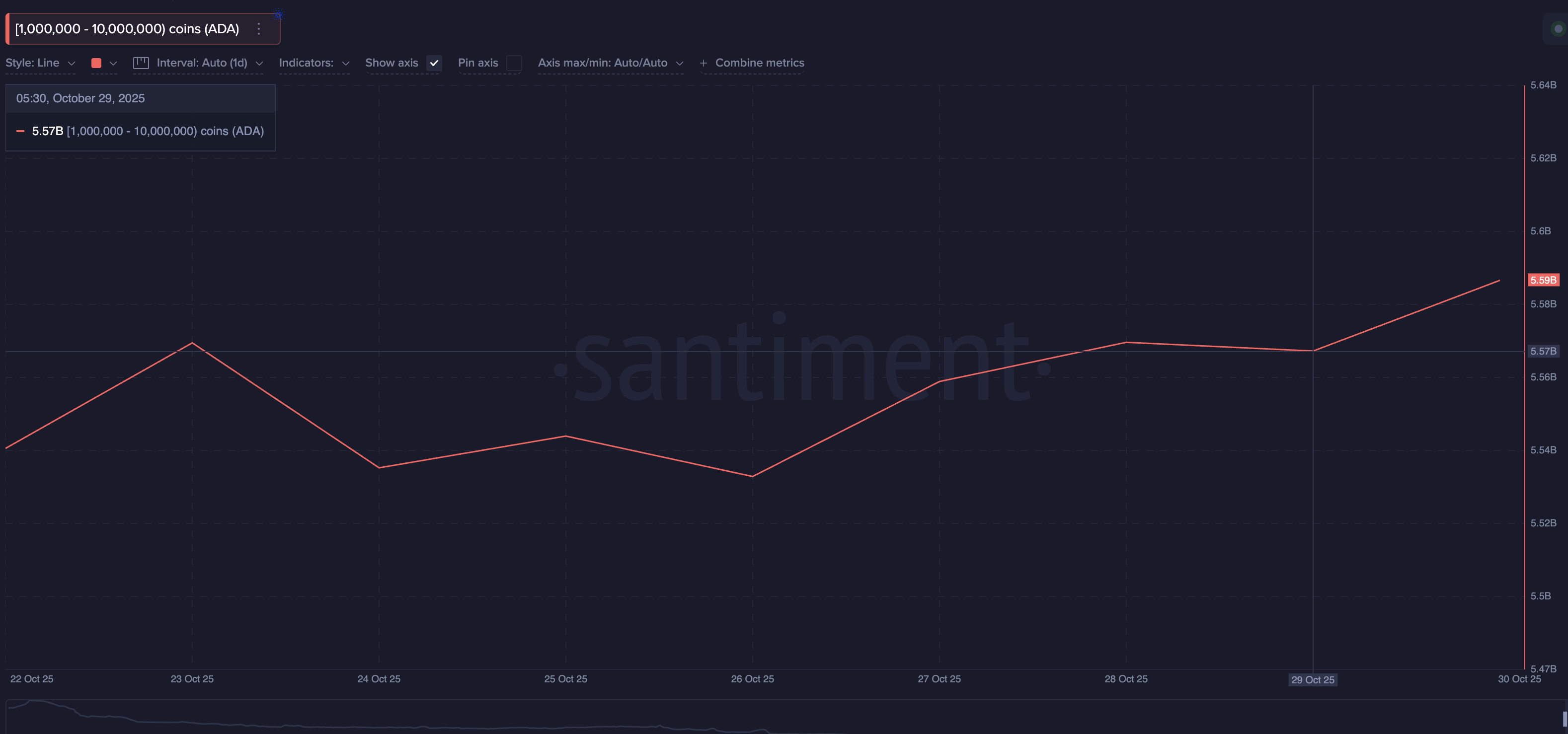 Smaller ADA Whales Accumulating:
Santiment
Want more token insights like this? Sign up for Editor Harsh Notariya’s Daily Crypto Newsletter here.
On the 12-hour chart, ADA trades inside a symmetrical triangle, reflecting indecision but also consolidation before a breakout. The token continues to hold the $0.64 support, and a move above $0.66 could send prices toward $0.68, a 6.5% upside.
If momentum continues, $0.73 would be the next resistance. The Wyckoff Volume Chart, which tracks buying and selling pressure through volume patterns, shows sellers losing control since October 29. A similar shift between October 22–23 led to a 9.37% price increase soon after.
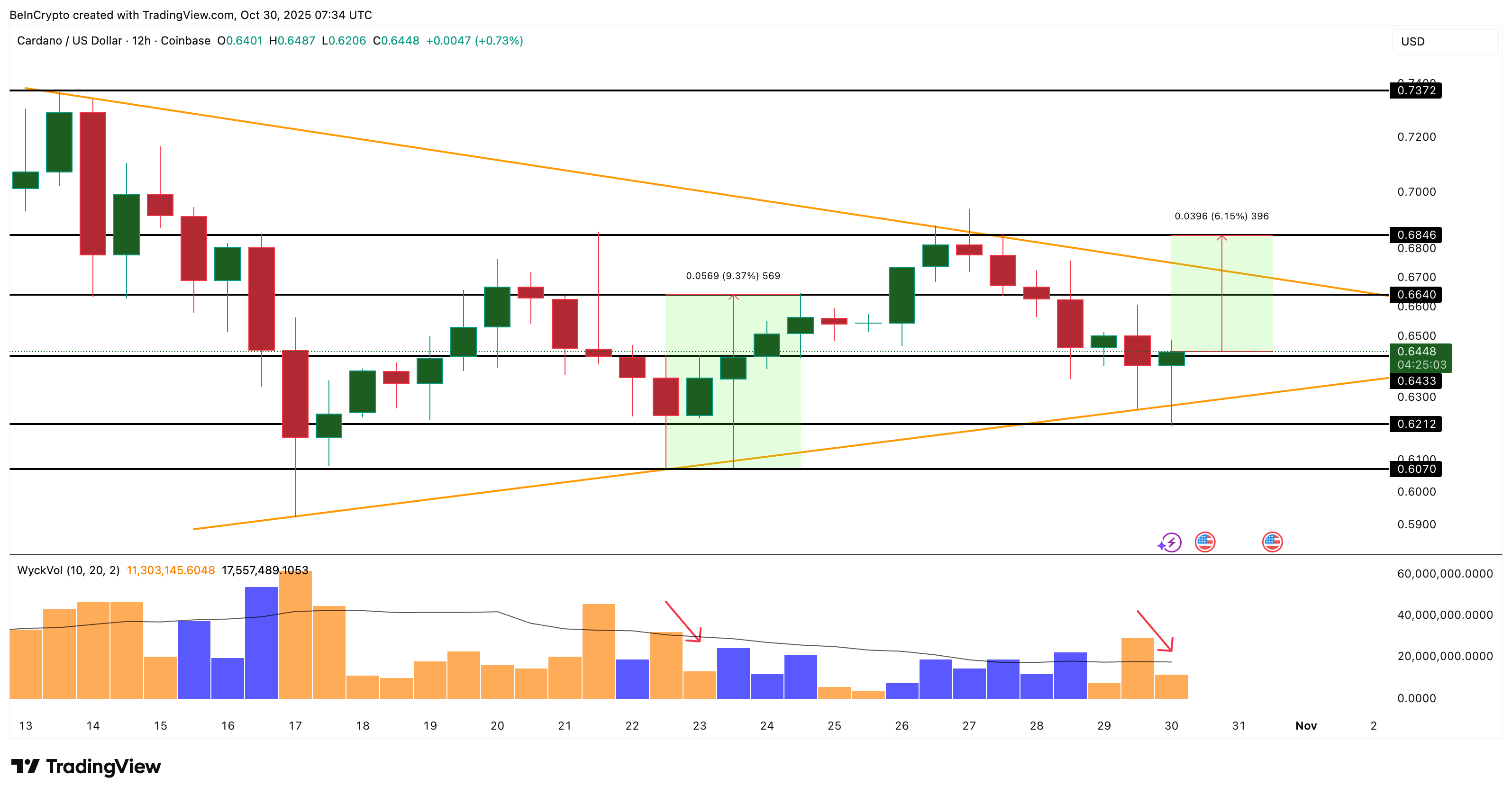 ADA Price Analysis:
TradingView
Whales may be betting on a repeat, making this one of the clearer examples of crypto whale purchases after the much-anticipated Fed rate cuts. Yet, losing $0.64 could push ADA prices lower, making $0.62 and even $0.60 possible. That would invalidate the whale-led optimism.
Ethena (ENA)
Besides Cardano, another token seeing renewed whale activity after the FOMC rate cuts is Ethena (ENA).
The 100 million to 1 billion ENA cohort — a large whale group capable of driving strong market moves — has added notably over the past 24 hours. Their combined holdings grew from 6.79 billion to 6.9 billion ENA, an increase of 0.11 billion ENA worth roughly $46.2 million at the current price.
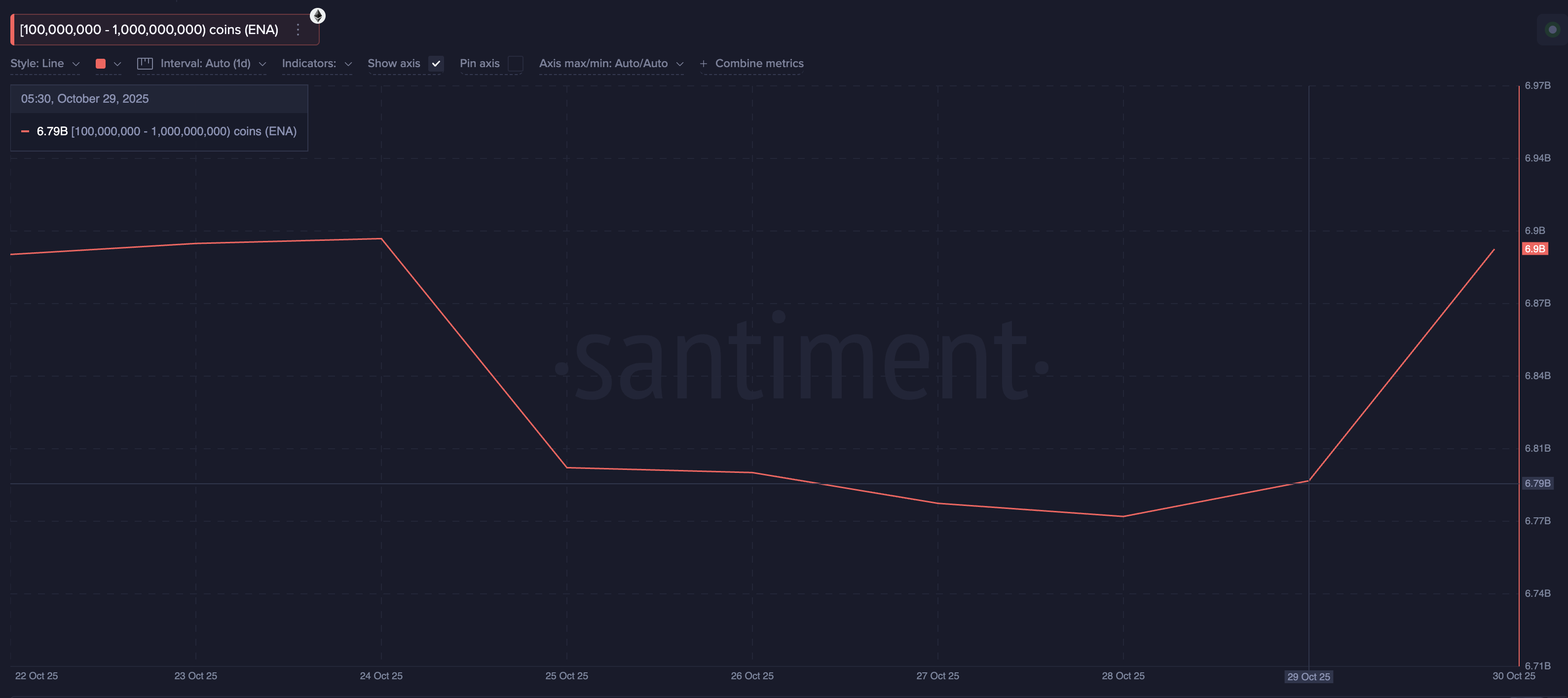 ENA Whales:
Santiment
This accumulation comes after a volatile month where Ethena’s price dropped 21%, mirroring Cardano’s trajectory. But the recent buying suggests whales are positioning for a potential upside reversal.
On the 12-hour chart, ENA trades inside a falling broadening wedge — a bullish pattern that typically signals a possible breakout higher once the structure tightens. Ethena attempted a breakout on October 27, but it failed as a hidden bearish divergence formed.
This occurs when the price makes a lower high while the Relative Strength Index (RSI) — which measures buying versus selling strength — makes a higher high. It indicates that sellers regained short-term control, cutting the rally short.
Still, Ethena has rebounded from the key $0.41 support, and if that level holds, a move toward $0.45 (immediate resistance) and then $0.53 could unfold. A sustained break above $0.49, where the upper trendline of the wedge currently lies, would confirm the bullish reversal, opening the door to $0.65.
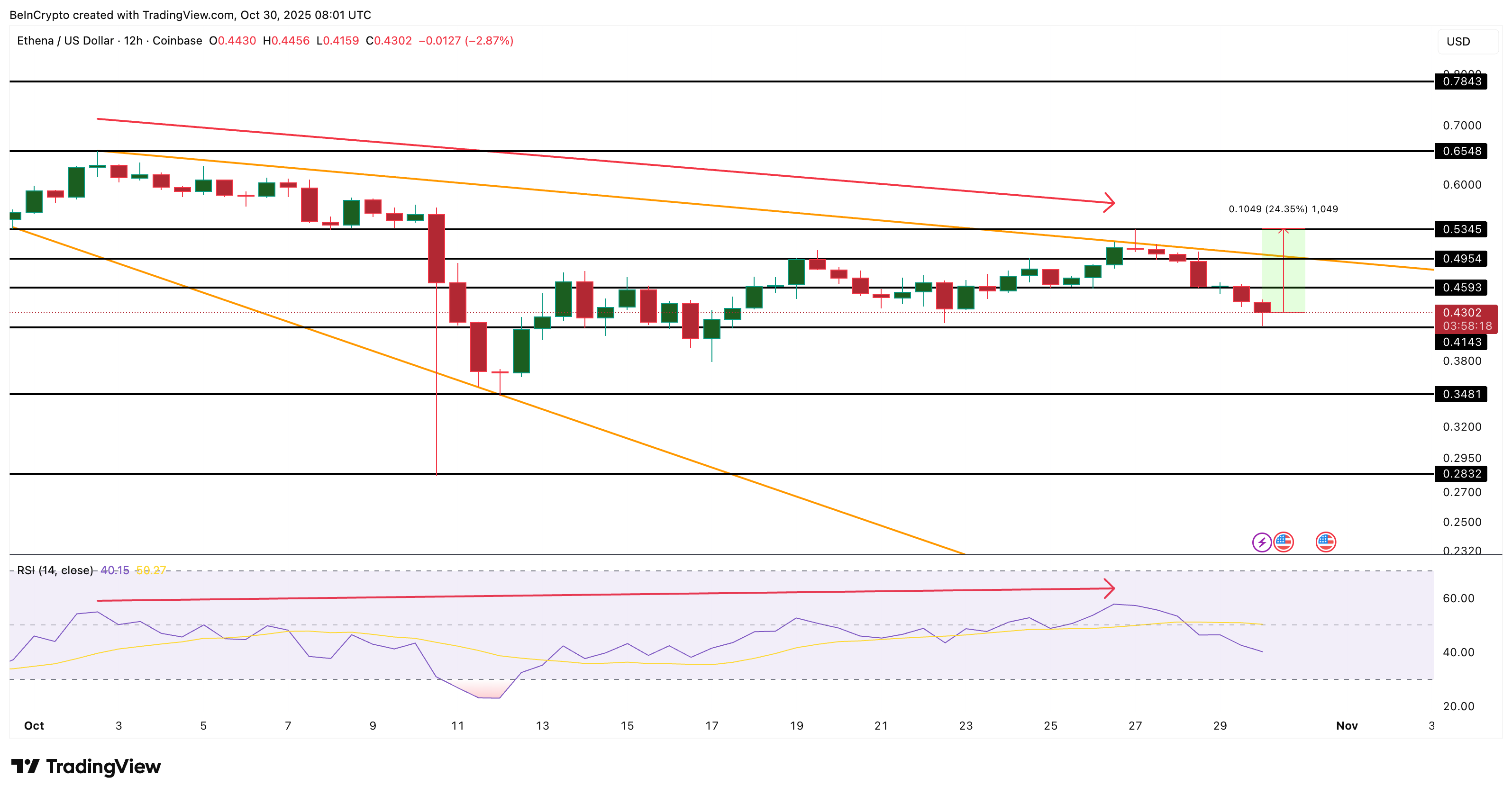 ENA Price Analysis:
TradingView
Notably, RSI and price have started to move in sync again, nullifying the earlier divergence.
If this alignment continues and $0.41 remains intact, whales could be right. ENA may be gearing up for a rebound from its post-FOMC lows. But if ENA breaks this key level, the bullish outlook might disappear. That would open the door to lower levels like $0.34 and even $0.28 in the near term.
Aster (ASTER)
The third token seeing increased accumulation since the FOMC rate cut is Aster (ASTER), a decentralized perpetual exchange platform.
Crypto whales have been buying ASTER aggressively in the past 24 hours, adding 26.43% to their stash. Their total balance now stands at 15.67 million ASTER. That’s roughly 3.27 million ASTER, worth about $3.33 million at the current price.
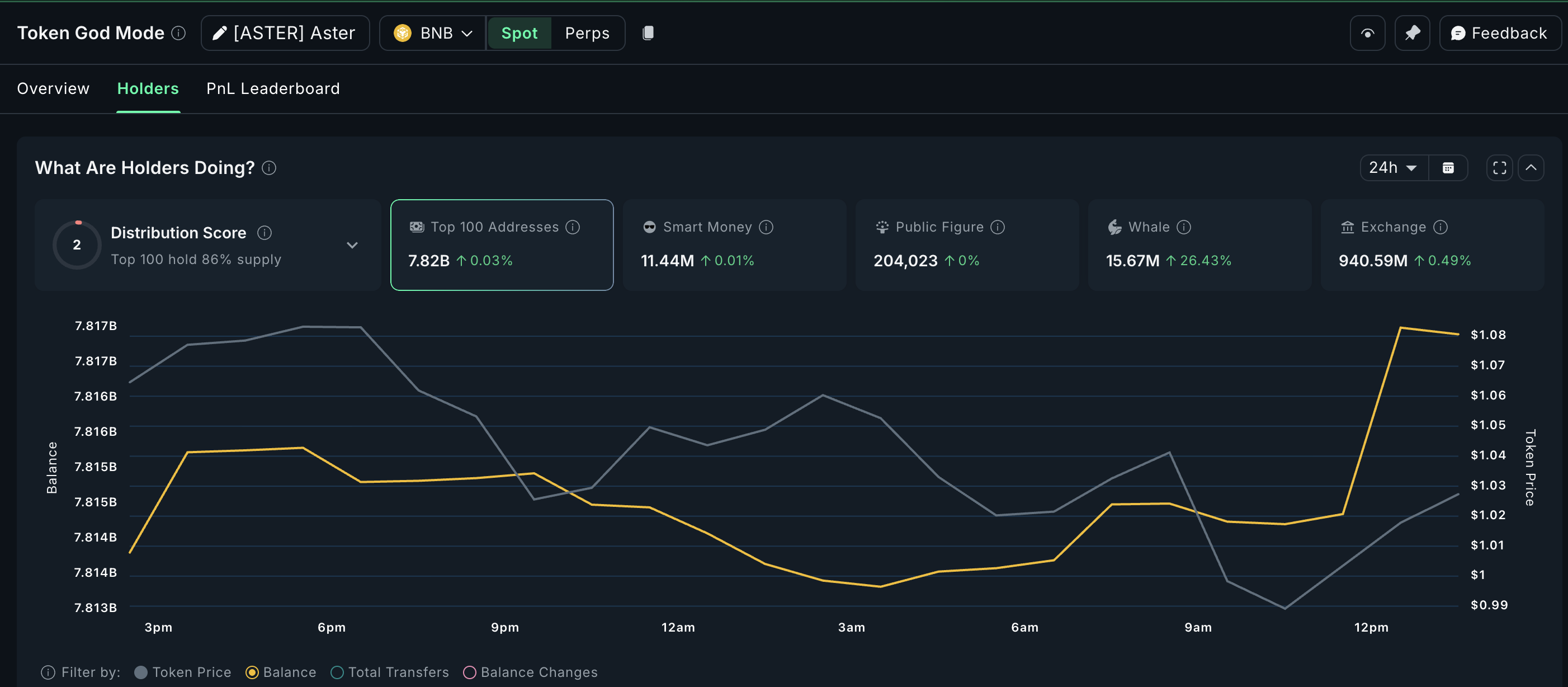 Aster Whales In Action:
Nansen
This sharp pickup in whale accumulation shows growing interest from large traders, making ASTER one of the strongest crypto whale purchases post the rate cuts.
Over the past month, ASTER has given away 43.2% of its gains, confirming that it has been in a clear downtrend. However, the trend might now be nearing a reversal. And the technicals do give it away.
On the 12-hour chart, ASTER trades within a falling broadening wedge. It is a bullish pattern that often leads to upside breakouts once the price clears the upper trendline. The $0.93 level has served as strong support and continues to hold. If ASTER can stay above this level, the next immediate target is $1.12, followed by $1.28. A decisive breakout above $1.79 would confirm the larger trend reversal.
Between October 10 and October 29, the price formed a lower low, while the RSI formed a higher low. This is a bullish divergence that often marks the start of a rebound. This setup, combined with rising whale accumulation, supports the idea that buyers may be regaining control.
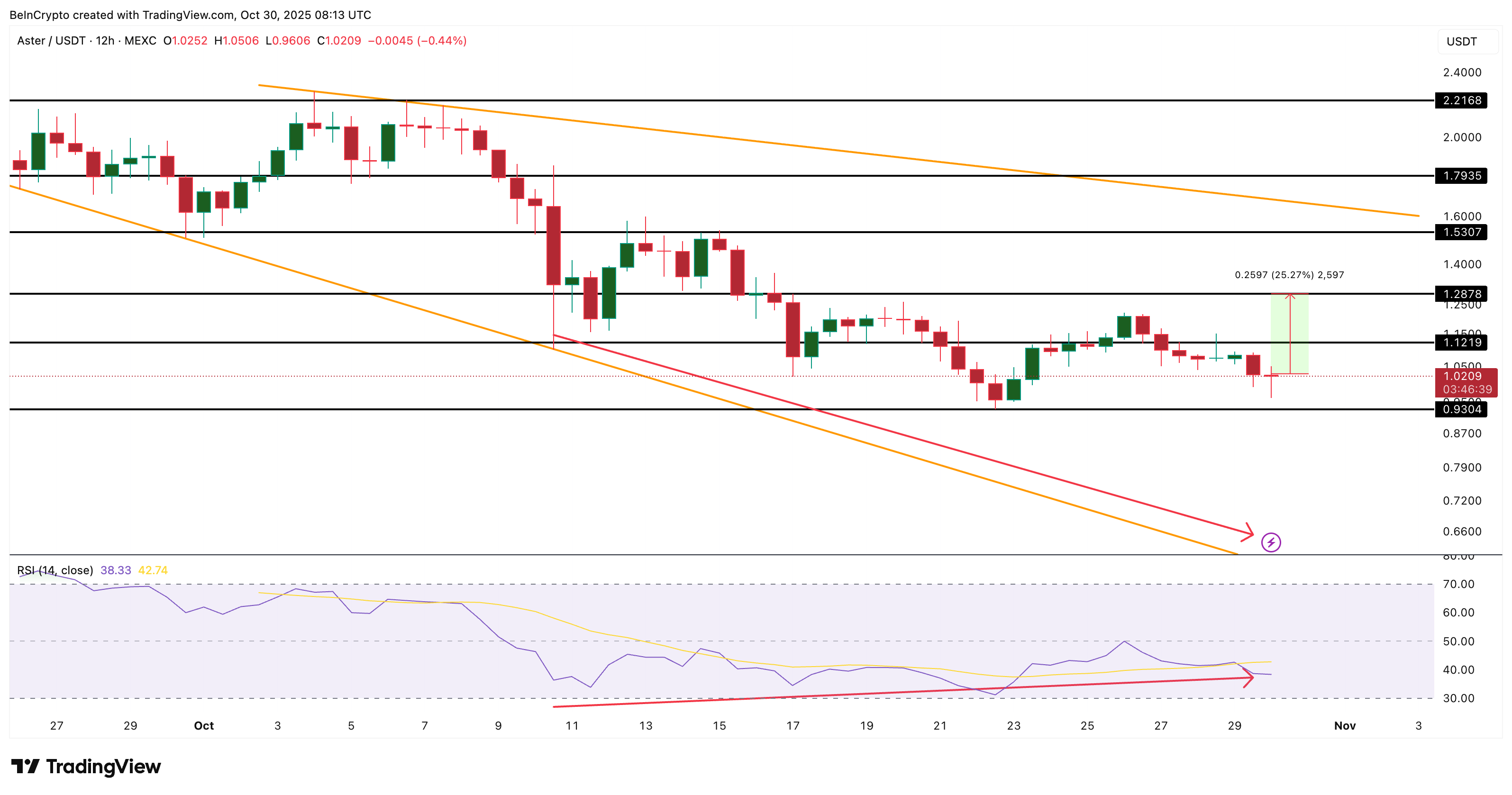 ASTER Price Analysis:
TradingView
If these levels hold, ASTER could be positioning for a strong recovery phase. That would put it firmly in focus among what crypto whales are buying this week. But losing $0.93 would end the near-term bullish projections, prepping ASTER for fresh lows.
Disclaimer: The content of this article solely reflects the author's opinion and does not represent the platform in any capacity. This article is not intended to serve as a reference for making investment decisions.
You may also like
The AI boom may follow the path of the 19th-century railway bubble, and builders may not be the ultimate winners
Goldman Sachs analyst Bobby Molavi compared the current situation to the 19th-century British railway mania: 500 companies spent more than the nation's annual income building 8,000 miles of railway, with most early investors losing out, while the real beneficiaries were the later "passengers." He pointed out that the current AI craze is driven by both debt and momentum, and that the S&P 500’s forward P/E ratio of 18x is only "a bit cheaper." Whether the builders can retain value is uncertain, and history does not offer an optimistic answer.

If Anthropic's IPO goes smoothly and the stock price rises next week, then everything remains the same for AI. Otherwise, some companies will go bankrupt.
The shrinking valuations of two major giants have triggered a chain reaction—investors are adopting more conservative revenue multiples for AI startups and are directly halting high-valuation financing for companies with zero revenue. Multiple venture capital firms have advised their portfolio companies to lower valuation expectations and to quickly build up cash reserves. Market participants warn that the outcome of Anthropic’s IPO will be a barometer for the industry: if successful, the boom will continue; if it fails, some companies may face elimination.
After the Brazilian election, political discount deepens; Morgan Stanley remains bullish on Petrobras (PBR.US), focusing on fuel pricing and dividends
Morgan Stanley still maintains its most optimistic "Overweight" rating, but has lowered its year-end 2027 target price from $31 to $25.

Corning (GLW.US) receives initial "Buy" rating from Jefferies! AI factories driving a fiber optic rush, with a potential global supply gap of up to 30%
For Corning, the recent profit growth mainly comes from the expansion of AI clusters. As the number of optical links crossing cabinets and campuses increases, customers need to deploy more optical fibers within limited conduit and cabinet space, thus driving demand for high-density optical cables and connection systems.

Crypto prices
More


