
European central bank pushes for CBDC launch in 2029: Report

The European Central Bank is reportedly aiming to launch its digital euro in 2029, provided a legal framework can be hammered out.
Officials working on the central bank digital currency will continue to lay the groundwork after the current preparation phase concludes this month, Bloomberg reported on Wednesday, citing people familiar with the matter.
ECB officials have been exploring a potential rollout of the digital euro since 2020, entering the preparation phase in late 2023 as part of their plans.
Preparatory work is expected to continue at a meeting this week in Italy, according to Bloomberg’s sources, in the hope that a legal framework will be agreed upon by lawmakers and passed within the next four years.
EU lawmakers still can’t agree whether a CBDC is a good idea
The project has faced significant skepticism from banks, lawmakers, member states and end-users, mainly due to concerns around privacy and other risks.
Legislation has been before the European Parliament since 2023, and has faced delays amid political concerns and the 2024 elections.
In September, ECB Board member Piero Cipolloni flagged the middle of 2029 as a possible launch date and predicted that the European Parliament would likely come to a consensus on a digital euro by May 2026.
Cipolloni said a digital euro would ensure all Europeans have access to free, universally accepted digital means of payment, even in the event of major disruptions such as war or cyberattacks.
Related: EU exploring Ethereum, Solana for digital euro launch: FT
CBDCs around the world
Only three CBDCs have officially launched, according to the American think tank, the Atlantic Council.
Its CBDC tracker lists Nigeria, the Bahamas and Jamaica as the only three jurisdictions with an active digital token. At the same time, there are another 49 countries in the pilot phase.
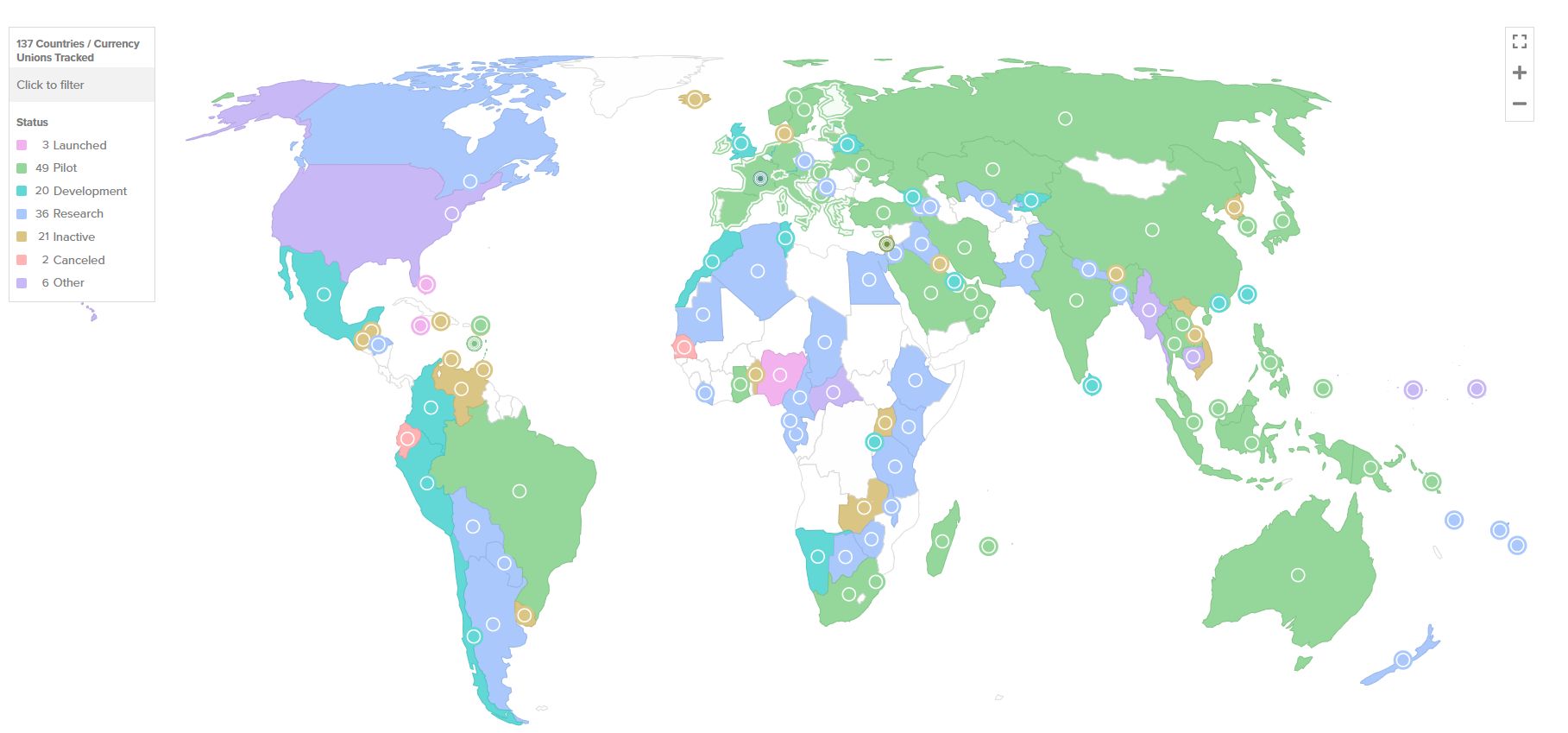
Information compiled by the Human Rights Foundation, which unveiled a CBDC tracker in November 2023, cites improved payment efficiency and expanded financial inclusion as potential benefits of CBDCs.
Drawbacks are listed as the currency’s potential to infringe on privacy and open up new avenues of government corruption, among other concerns.
Magazine: Bitcoin flashing ‘rare’ top signal, Hayes tips $1M BTC: Hodler’s Digest, Oct. 19 – 25
Disclaimer: The content of this article solely reflects the author's opinion and does not represent the platform in any capacity. This article is not intended to serve as a reference for making investment decisions.
You may also like
The AI boom may follow the path of the 19th-century railway bubble, and builders may not be the ultimate winners
Goldman Sachs analyst Bobby Molavi compared the current situation to the 19th-century British railway mania: 500 companies spent more than the nation's annual income building 8,000 miles of railway, with most early investors losing out, while the real beneficiaries were the later "passengers." He pointed out that the current AI craze is driven by both debt and momentum, and that the S&P 500’s forward P/E ratio of 18x is only "a bit cheaper." Whether the builders can retain value is uncertain, and history does not offer an optimistic answer.

If Anthropic's IPO goes smoothly and the stock price rises next week, then everything remains the same for AI. Otherwise, some companies will go bankrupt.
The shrinking valuations of two major giants have triggered a chain reaction—investors are adopting more conservative revenue multiples for AI startups and are directly halting high-valuation financing for companies with zero revenue. Multiple venture capital firms have advised their portfolio companies to lower valuation expectations and to quickly build up cash reserves. Market participants warn that the outcome of Anthropic’s IPO will be a barometer for the industry: if successful, the boom will continue; if it fails, some companies may face elimination.
After the Brazilian election, political discount deepens; Morgan Stanley remains bullish on Petrobras (PBR.US), focusing on fuel pricing and dividends
Morgan Stanley still maintains its most optimistic "Overweight" rating, but has lowered its year-end 2027 target price from $31 to $25.

Corning (GLW.US) receives initial "Buy" rating from Jefferies! AI factories driving a fiber optic rush, with a potential global supply gap of up to 30%
For Corning, the recent profit growth mainly comes from the expansion of AI clusters. As the number of optical links crossing cabinets and campuses increases, customers need to deploy more optical fibers within limited conduit and cabinet space, thus driving demand for high-density optical cables and connection systems.

Crypto prices
More


