
Rate cuts ≠ bull market, the market is not buying it this time

Original Source: Crypto Market Watch
Original Title: Why Did the Market Keep Falling After the Rate Cut?
In the early hours of today (East 8th time zone), the Federal Reserve announced a 25 basis point rate cut, lowering the federal funds rate range to 4.00%–4.25%.
At the same time, the Federal Reserve also stated: Quantitative Tightening (QT) will officially end on December 1.
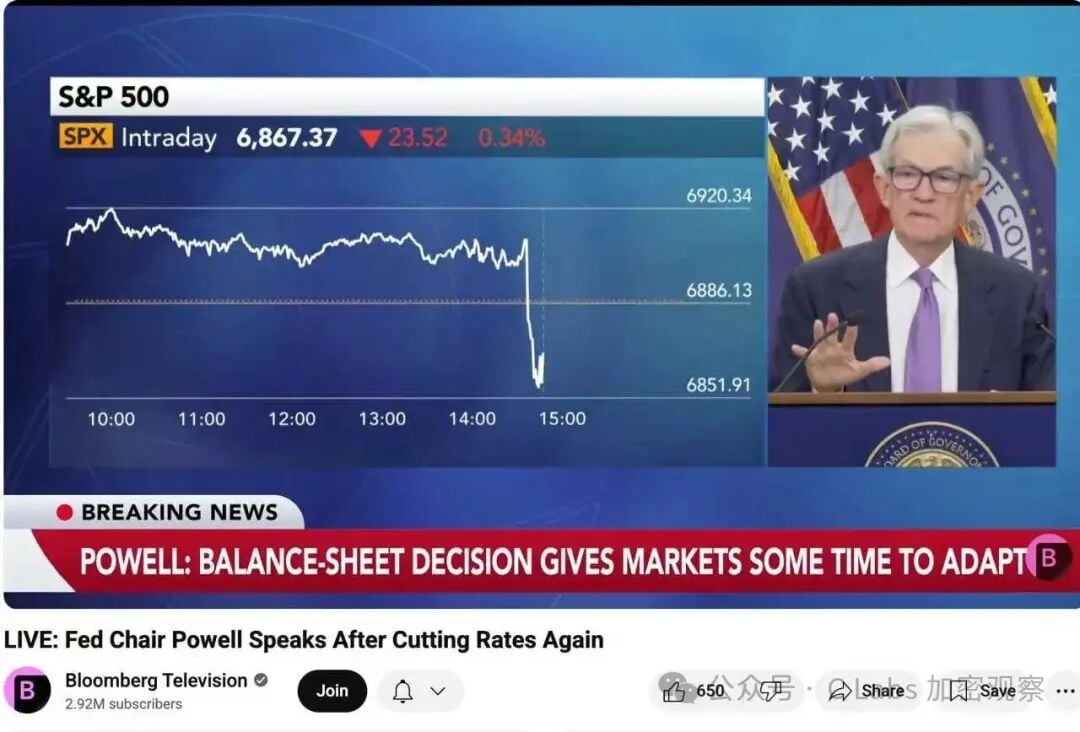
Logically, this should be “bullish”: rate cuts, the end of balance sheet reduction, and improved liquidity expectations. But the result left many puzzled—why did the stock market, cryptocurrencies, and even gold not rise, but instead fall across the board?
01. The Market’s “Bullish Expectations” Were Already Priced In
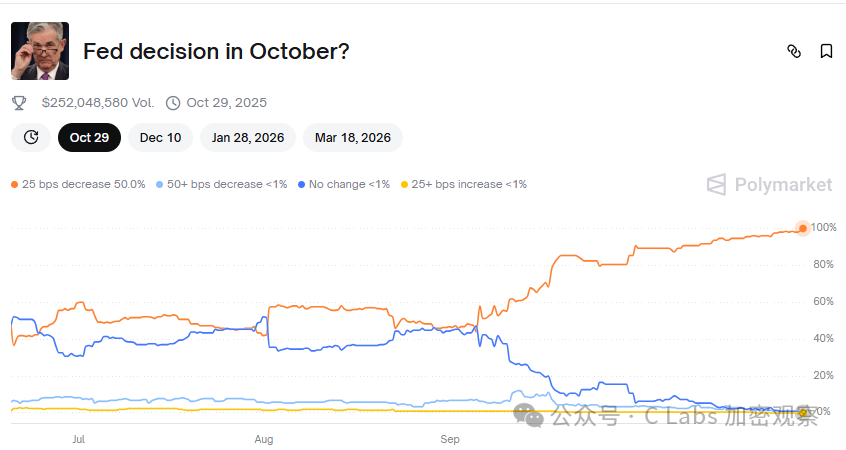
In fact, the market had already “bet” on this rate cut at the beginning of the month. According to CME FedWatch data, before the meeting, the market believed:
The probability of a 25bp rate cut was as high as 95%, and about 40% of investors expected the Federal Reserve to immediately announce the start of QE (balance sheet expansion again).
In the end, the Federal Reserve only opted for a “mild” rate cut.
In other words:
This rate cut was not a “new positive,” but rather “below expectations.”
When expectations are met but there are no surprises, the market often chooses to take profits. This is the classic “Buy the rumor, sell the news” scenario.
02. Ending Balance Sheet Reduction ≠ Starting Liquidity Injection
Many people saw “QT ending” and thought a “liquidity flood” was coming. But in reality, the Federal Reserve’s statement was very cautious:
“We will end balance sheet reduction, but will not start a new asset purchase program for now.”

That is to say:
From the “tightening” phase to the “wait-and-see” phase.
In financial market terms, this means:
Liquidity is no longer deteriorating, but it is not improving either.
For investment markets to rise, merely “stopping the decline” is not enough—“incremental funds” are needed. This is the biggest gap at present.
03. The Rate Cut Has Not Been Transmitted to “Actual Funding Rates”
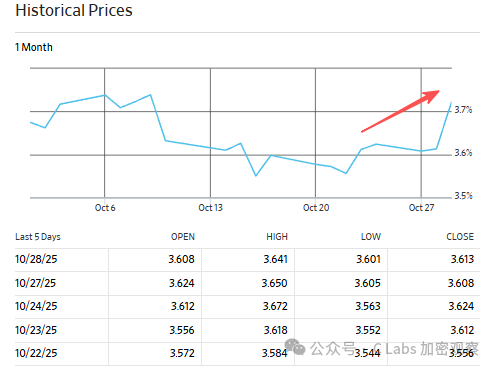
Theoretically, a rate cut should lower short-term rates and reduce funding costs. But this time, the situation is a bit special—although the nominal policy rate dropped by 25 points, medium- and long-term funding costs did not fall in tandem.
For example, the five-year Treasury yield rose from 3.6% to 3.7%:
The ten-year Treasury yield soared to above 4%:
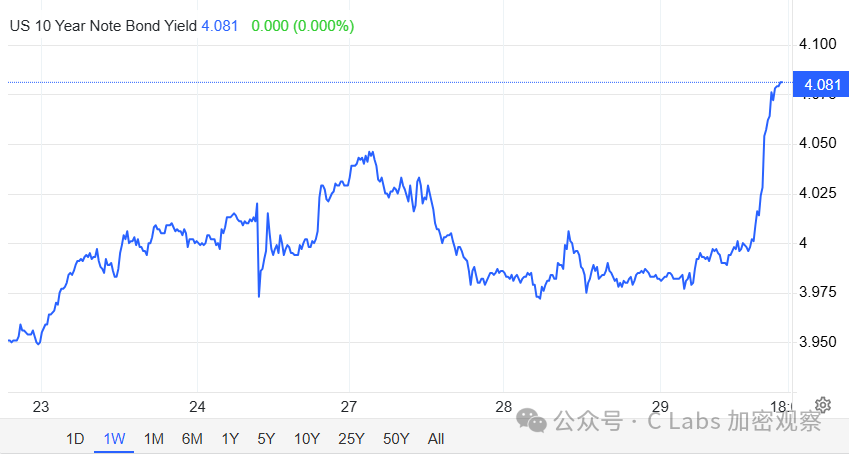
What does this indicate? It shows that real market liquidity remains tight, and investment institutions have not felt that “there’s more money.” The Federal Reserve’s rate cut is still just “talk,” and has not truly “flowed into the market.”
04. The Hidden Worry Behind the “Rate Cut”: Economic Downside Pressure Remains High
From a broader macro perspective, this rate cut by the Federal Reserve is actually a “defensive move.” Recent U.S. economic data shows:
-
Real estate and manufacturing have posted negative growth for two consecutive quarters;
-
The job market is slowing, with the unemployment rate rising again to 4.6%;
-
Corporate profit growth has nearly stalled.
This means the Federal Reserve has chosen to slightly loosen monetary policy to cushion downside risks, balancing “growth support” and “inflation control.”
But this move also sends a signal:
The U.S. economy may have already entered a “mild recession phase.”
In this situation, the market would rather lock in profits first than easily increase positions in risk assets.
05. Summary: Rate Cuts ≠ Bull Market, Liquidity Is the Core Variable
This rate cut, in fact, gave the market the clearest logic:
Short-term policy easing ≠ abundant liquidity ≠ asset price increases.
What can truly drive a full reversal in the stock and crypto markets is the central bank restarting asset expansion (QE), or fiscal stimulus combined with large-scale capital inflows.
Until then, a rate cut is only “neutral to slightly positive”—it can stabilize confidence, but is not enough to trigger a new bull market.
The market wants more than a 25-point rate cut; it wants a real liquidity injection.
Until then, ‘risk assets’ will have to wait a little longer.

Disclaimer: The content of this article solely reflects the author's opinion and does not represent the platform in any capacity. This article is not intended to serve as a reference for making investment decisions.
You may also like
The AI boom may follow the path of the 19th-century railway bubble, and builders may not be the ultimate winners
Goldman Sachs analyst Bobby Molavi compared the current situation to the 19th-century British railway mania: 500 companies spent more than the nation's annual income building 8,000 miles of railway, with most early investors losing out, while the real beneficiaries were the later "passengers." He pointed out that the current AI craze is driven by both debt and momentum, and that the S&P 500’s forward P/E ratio of 18x is only "a bit cheaper." Whether the builders can retain value is uncertain, and history does not offer an optimistic answer.

If Anthropic's IPO goes smoothly and the stock price rises next week, then everything remains the same for AI. Otherwise, some companies will go bankrupt.
The shrinking valuations of two major giants have triggered a chain reaction—investors are adopting more conservative revenue multiples for AI startups and are directly halting high-valuation financing for companies with zero revenue. Multiple venture capital firms have advised their portfolio companies to lower valuation expectations and to quickly build up cash reserves. Market participants warn that the outcome of Anthropic’s IPO will be a barometer for the industry: if successful, the boom will continue; if it fails, some companies may face elimination.
After the Brazilian election, political discount deepens; Morgan Stanley remains bullish on Petrobras (PBR.US), focusing on fuel pricing and dividends
Morgan Stanley still maintains its most optimistic "Overweight" rating, but has lowered its year-end 2027 target price from $31 to $25.

Corning (GLW.US) receives initial "Buy" rating from Jefferies! AI factories driving a fiber optic rush, with a potential global supply gap of up to 30%
For Corning, the recent profit growth mainly comes from the expansion of AI clusters. As the number of optical links crossing cabinets and campuses increases, customers need to deploy more optical fibers within limited conduit and cabinet space, thus driving demand for high-density optical cables and connection systems.

Crypto prices
More


