
AI: Microsoft Takes 27% of OpenAI

Artificial intelligence enters a new era with the official announcement from Microsoft: the tech giant now holds 27% of OpenAI. This stake, the result of a multi-billion dollar partnership, marks a strategic turning point for the industry. What are the stakes of this alliance and its repercussions on the AI market?
In Brief
- Microsoft now holds 27% of OpenAI, consolidating its leadership in AI with an investment exceeding $13 billion.
- OpenAI establishes itself as a strategic ecosystem, supported by major players like NVIDIA, Oracle, and governments.
- AI tokens emerge as an alternative to traditional cryptos like bitcoin, raising questions about their potential to dominate the economy.
AI: Microsoft Acquires 27% of OpenAI
One year after having sealed a surprise deal with OpenAI, Microsoft today confirms its holding of 27% of OpenAI’s shares! A revised figure, after initial speculations suggested 21%. This investment is part of a long-term collaboration, with over $13 billion injected since 2019. OpenAI, whose valuation reaches record highs, thus becomes a central pillar of Microsoft’s AI strategy.
The terms of this acquisition remain partially confidential, but Microsoft clearly strengthens its influence over OpenAI’s strategic decisions. This stake adds to an already advanced technological integration, notably via Azure AI and Copilot, which leverage OpenAI models like GPT-4.
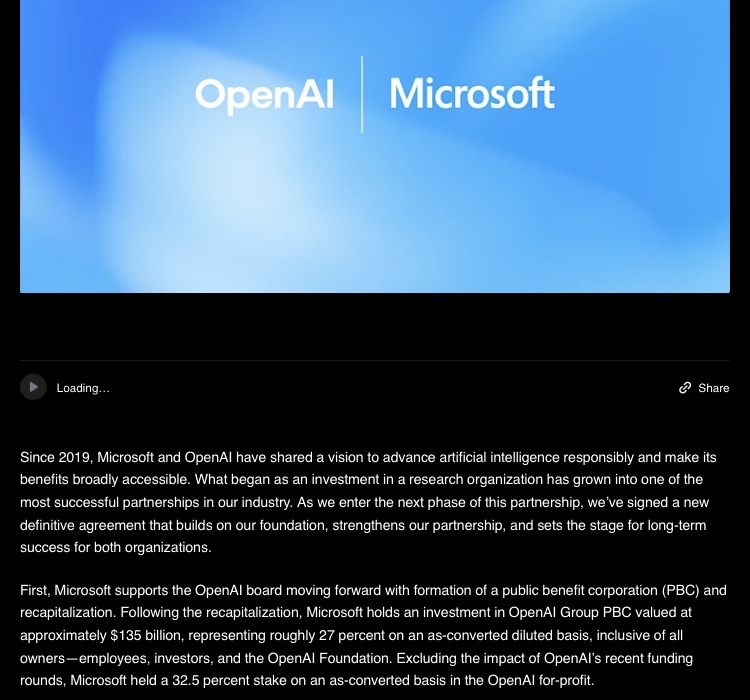 Microsoft now holds 27% of OpenAI
For Microsoft, the goal is to dominate the AI tools market, competing with rivals like Google and Amazon. An alliance that could accelerate AI adoption in companies while intensifying competition among tech giants.
OpenAI at the Heart of an AI Empire
The 27% acquisition of OpenAI by Microsoft shows that Sam Altman’s company is no longer a simple startup. Rather, it is an ecosystem supported by major players. Alongside Microsoft, companies like NVIDIA, Oracle, and SoftBank play key roles in its development. NVIDIA provides essential chips for training AI models, while Oracle offers robust cloud solutions. SoftBank, meanwhile, acts as a strategic investor.
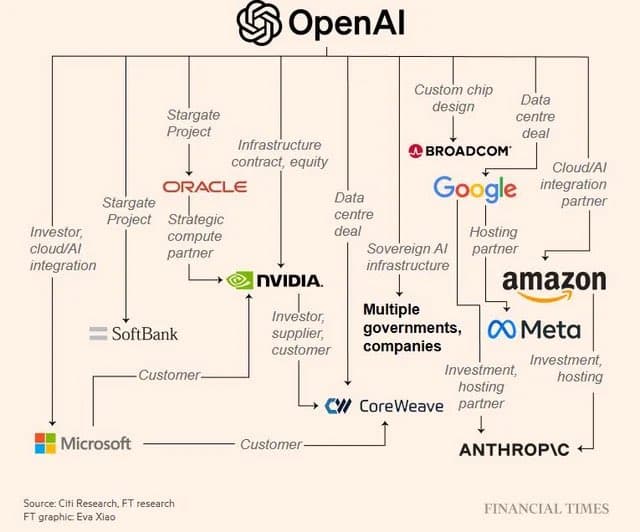 OpenAI’s AI Empire
Governments and sovereign enterprises are also interested in OpenAI. Partnerships with entities like CoreWeave or states underline the geopolitical stakes of AI. Google, Amazon, and Meta are not standing still: each develops its own solutions, such as Gemini, Bedrock, or Llama, to counter the Microsoft-OpenAI alliance.
This concentration of players around OpenAI raises questions about innovation and competition. While it stimulates technological advances, it also risks creating monopolies, limiting access for small companies and startups.
AI Tokens VS Crypto: Could the Rise of AI Eclipse Bitcoin?
AI tokens are emerging as a new asset class, attracting investor attention. Unlike traditional cryptocurrencies like bitcoin , these tokens are often linked to decentralized AI platforms, offering concrete utility. Their growing popularity is explained by their integration into rapidly expanding technological ecosystems.
However, AI tokens face major challenges. Regulators closely watch these assets, fearing risks of speculation or manipulation. Their widespread adoption will depend on their ability to demonstrate tangible value beyond mere technological hype.
Could the rise of AI relegate bitcoin to the background? If AI tokens gain credibility, they could complement or even compete with traditional cryptocurrencies. The coming years will be decisive in determining whether AI becomes the new engine of decentralized finance.
The alliance between Microsoft and OpenAI marks a turning point in the artificial intelligence industry, with major implications for tech and financial players. As AI tokens gain ground, one question remains: is artificial intelligence redefining the rules of the economic game?
Disclaimer: The content of this article solely reflects the author's opinion and does not represent the platform in any capacity. This article is not intended to serve as a reference for making investment decisions.
You may also like
If Anthropic's IPO goes smoothly and the stock price rises next week, then everything remains the same for AI. Otherwise, some companies will go bankrupt.
The shrinking valuations of two major giants have triggered a chain reaction—investors are adopting more conservative revenue multiples for AI startups and are directly halting high-valuation financing for companies with zero revenue. Multiple venture capital firms have advised their portfolio companies to lower valuation expectations and to quickly build up cash reserves. Market participants warn that the outcome of Anthropic’s IPO will be a barometer for the industry: if successful, the boom will continue; if it fails, some companies may face elimination.
After the Brazilian election, political discount deepens; Morgan Stanley remains bullish on Petrobras (PBR.US), focusing on fuel pricing and dividends
Morgan Stanley still maintains its most optimistic "Overweight" rating, but has lowered its year-end 2027 target price from $31 to $25.

Corning (GLW.US) receives initial "Buy" rating from Jefferies! AI factories driving a fiber optic rush, with a potential global supply gap of up to 30%
For Corning, the recent profit growth mainly comes from the expansion of AI clusters. As the number of optical links crossing cabinets and campuses increases, customers need to deploy more optical fibers within limited conduit and cabinet space, thus driving demand for high-density optical cables and connection systems.

Crypto prices
More


