
XRP Whales’ $500 Million Accumulation Pushes Price Past $2.5

XRP’s price surge past $2.50 follows massive whale accumulation exceeding $500 million, boosting investor confidence and signaling potential upside toward $3.00 if momentum holds.
XRP has witnessed a sharp increase in price as strong investor support, particularly from whales, drives renewed bullish momentum.
The altcoin’s recent recovery follows a notable accumulation phase, with large holders leading the charge. Their activity has strengthened market confidence and also helped push XRP’s price above $2.50.
XRP Holders Are Lifting The Load
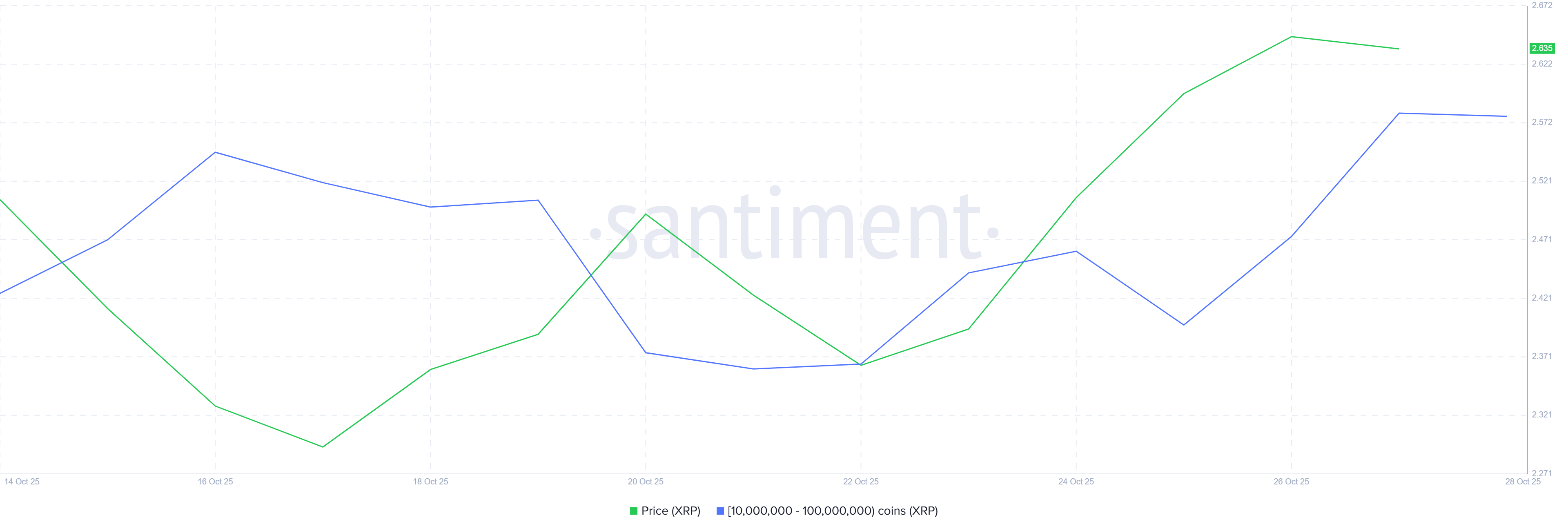
XRP whales have played a key role in fueling the asset’s upward movement. On-chain data shows that addresses holding between 10 million and 100 million XRP accumulated over 190 million tokens in the past week. This accumulation, valued at more than $505 million, reflects growing confidence in XRP’s long-term potential.
The buying spree followed a recent price dip, signaling that large holders are buying the correction instead of exiting positions. Such activity often indicates strong conviction among institutional and high-net-worth investors.
Want more token insights like this? Sign up for Editor Harsh Notariya’s Daily Crypto Newsletter
 XRP Whale Holding. Source:
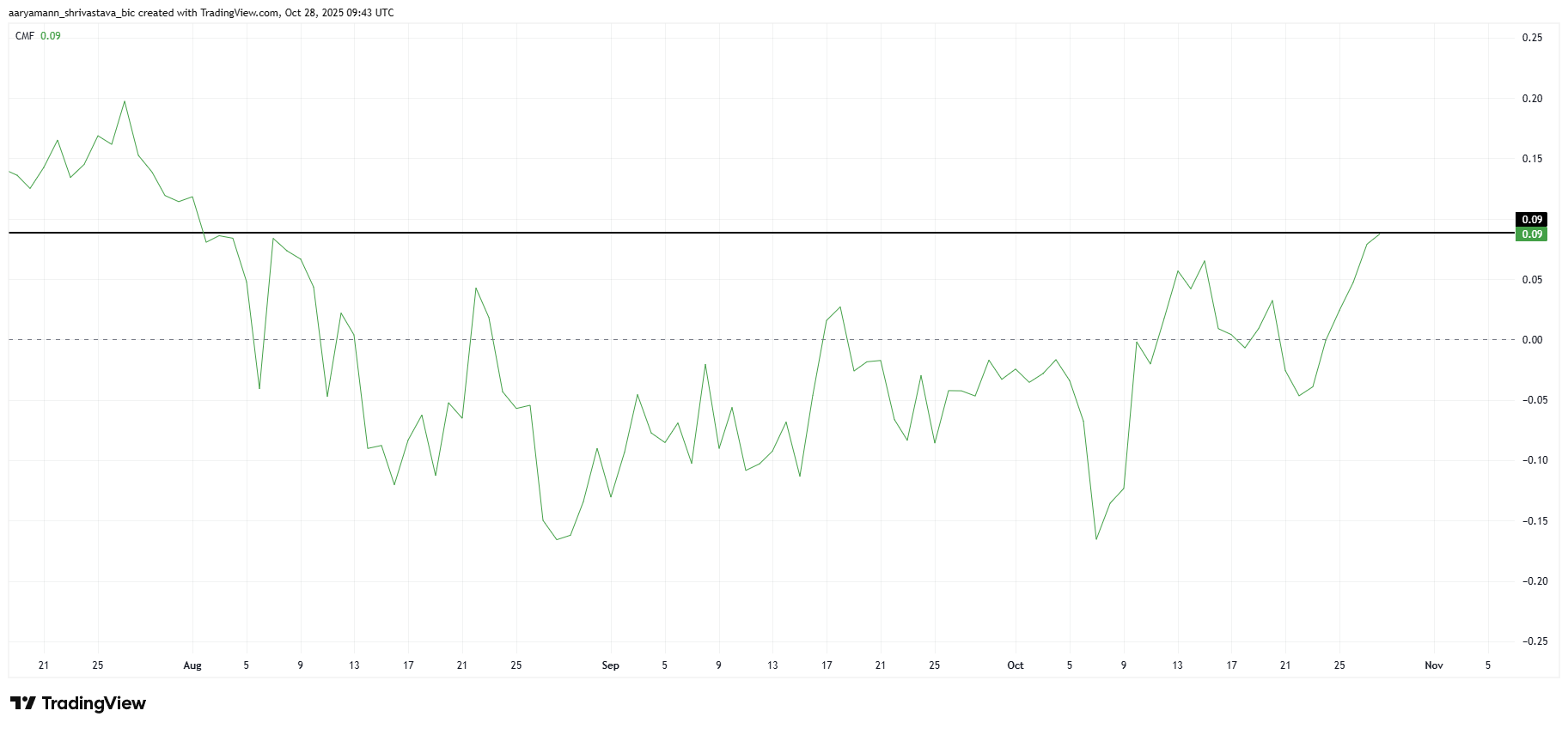
The broader market momentum for XRP is also showing signs of improvement. The Chaikin Money Flow (CMF), a key indicator of capital inflows and outflows, has recorded a notable spike over the past few days. The CMF now sits near a three-month high, confirming growing investor participation across both whale and retail cohorts.
A rising CMF typically indicates increasing buying pressure, and XRP’s recent readings confirm that inflows outweigh outflows. This shift suggests that market participants are positioning for continued upside.
 XRP CMF. Source:
XRP Price Needs To Secure Support
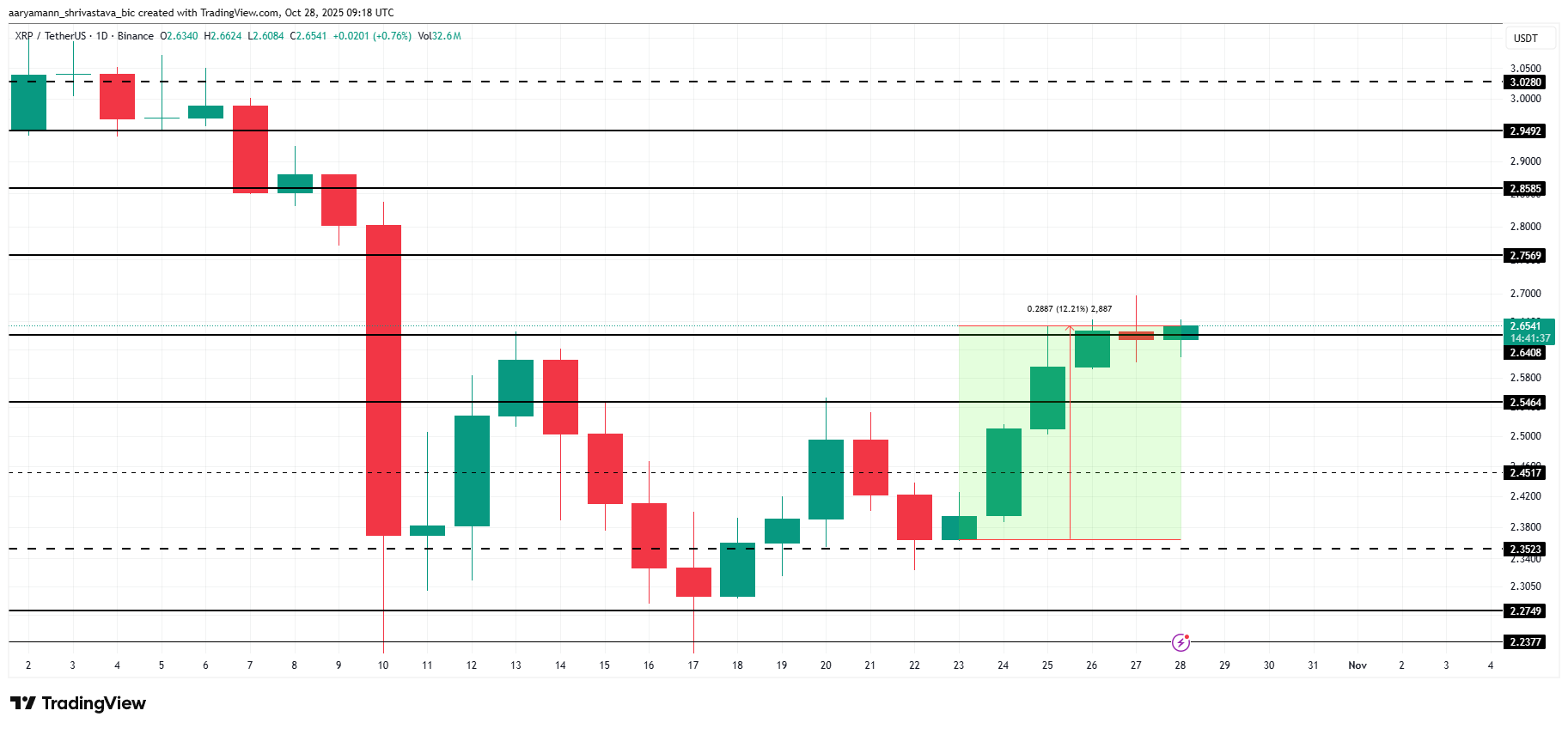
At the time of writing, XRP trades at $2.65, attempting to establish $2.64 as a new support floor. The token has climbed more than 12% in the past week, marking one of its strongest short-term rallies in months.
If bullish sentiment continues, XRP could extend its rise toward the $2.75 resistance level. Investor support, particularly from whales, may help drive the asset closer to the $3.00 mark, signaling a broader recovery phase.
 XRP Price Analysis. Source:
However, if XRP faces renewed selling or bearish market cues, it could retrace to $2.54 or even $2.35. Such a decline would invalidate the current bullish outlook and suggest short-term exhaustion among investors.
Disclaimer: The content of this article solely reflects the author's opinion and does not represent the platform in any capacity. This article is not intended to serve as a reference for making investment decisions.
You may also like
If Anthropic's IPO goes smoothly and the stock price rises next week, then everything remains the same for AI. Otherwise, some companies will go bankrupt.
The shrinking valuations of two major giants have triggered a chain reaction—investors are adopting more conservative revenue multiples for AI startups and are directly halting high-valuation financing for companies with zero revenue. Multiple venture capital firms have advised their portfolio companies to lower valuation expectations and to quickly build up cash reserves. Market participants warn that the outcome of Anthropic’s IPO will be a barometer for the industry: if successful, the boom will continue; if it fails, some companies may face elimination.
After the Brazilian election, political discount deepens; Morgan Stanley remains bullish on Petrobras (PBR.US), focusing on fuel pricing and dividends
Morgan Stanley still maintains its most optimistic "Overweight" rating, but has lowered its year-end 2027 target price from $31 to $25.

Corning (GLW.US) receives initial "Buy" rating from Jefferies! AI factories driving a fiber optic rush, with a potential global supply gap of up to 30%
For Corning, the recent profit growth mainly comes from the expansion of AI clusters. As the number of optical links crossing cabinets and campuses increases, customers need to deploy more optical fibers within limited conduit and cabinet space, thus driving demand for high-density optical cables and connection systems.

Crypto prices
More


