
Virtuals Robotics: Why Did We Enter the Embodied Intelligence Field?

Digital intelligence gains physical embodiment, with thought and action integrated in the field of robotics.
Original Title: Introducing Virtuals Robotics.
Original Source: Virtuals Protocol
Original Translation: TechFlow
Since its inception, the core goal of Virtuals has always been to build a society composed of AI agents—a network where agents can collaborate, transact, and create value.
· Through ACP, we have enabled commercial transactions between agents.
· Through Butler, we have built a bridge for collaboration between humans and agents.
· Through Unicorn, we have solved the problem of capital formation for agents.
Each layer expands the boundaries of digital intelligence. And now, this network is extending into the physical world through robotics, where intelligence gains a tangible presence and actions are materialized.
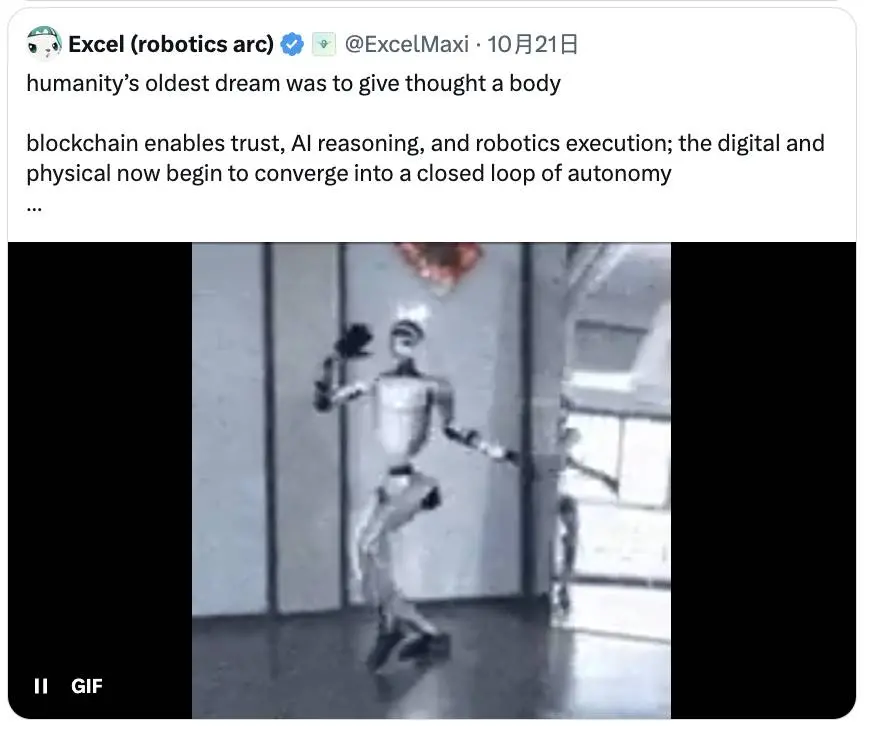
Artificial intelligence has achieved automated reasoning, blockchain has empowered large-scale collaboration, and robotics is approaching physical execution.
These three forces together form a closed loop, building a self-sustaining system in which ideas, actions, and transactions can propagate autonomously.
This integration defines agentic GDP (aGDP), which is the total output generated by the collaboration of humans, agents, and machines in both digital and physical domains.

Our exploration of robotics began with our internal venture capital department, investing in cutting-edge teams at the intersection of perception, control, and automation. These early experiments revealed two core bottlenecks limiting the embodiment of agents:
· Data: Without rich spatial datasets, embodied AI cannot learn to perceive or act effectively.
· Capital: Without scalable financing mechanisms, innovation in robotics will remain slow and fragmented.
Solving these two problems is key to accelerating the development of physical intelligence.

Virtuals has chosen a "Middle Way" strategy to address the challenges of robotics.
We do not directly participate in hardware or model development, but instead focus on those invisible yet decisive levers, building the data and capital infrastructure that supports the ecosystem.
· Through SeeSaw: We have launched a self-centered data platform that redefines how the world is captured and learned, enabling robots to "see" and understand space through human-recorded experiences.
· Through Unicorn: We have reimagined the financing of frontier technologies.

With the integration of these systems, Virtuals has evolved from a digital agent platform into a full-stack intelligence engine.
If the past decade was defined by information technology, then the next decade will be defined by embodiment—the moment when ideas regain tangible form.
Through robotics, the internet of agents extends into the physical world, completing the closed loop between intelligence, collaboration, and existence.

Disclaimer: The content of this article solely reflects the author's opinion and does not represent the platform in any capacity. This article is not intended to serve as a reference for making investment decisions.
You may also like
S&P 500 rebounds to just 2.6% below record high, Bitcoin lags 40% under peak
Oil Giant Returns to Venezuela! ExxonMobil (XOM.US) Reportedly Obtains Rights to Assess 7 Regions, One-Year Exclusive Negotiation Window Opens
According to informed sources, ExxonMobil has reached a preliminary agreement with the Venezuelan government and the national oil company PDVSA. The US oil giant is allowed to assess the development potential of seven blocks, which cover undeveloped oil fields, mature oil fields, and one exploration block.

Qualcomm (QCOM.US) Targets $15 Billion in Data Center Revenue, Bernstein Issues Bearish Report: Riding the AI Wave May Not Reverse Profitability
After discussions with Qualcomm management, Bernstein acknowledged Qualcomm's progress in business diversification—especially recognizing its ambitious entry into data center CPUs and AI inference chips. However, the institution maintained a "market perform" cautious rating and a target price of $155, indicating that, in Bernstein's view, Qualcomm has a potential downside of up to 12%.
Crypto prices
More


