
Bulls anticipate a reversal, bears await a crash—who will be proven right?

In the past few weeks, the sentiment in the crypto market has been more divided than ever before.
On one side are the staunch bulls, convinced that last week’s plunge was the final shakeout;
On the other side are the stubborn bears, certain that a deeper correction is still on the way.
So—who is right?
We must return to the macro level to find the answer.
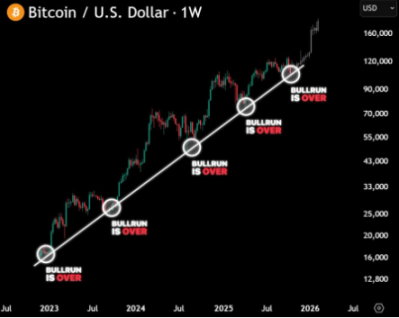
❶ Macro Uncertainty: Rates Are Falling, But the Market Isn’t Rising
The Federal Reserve has cut interest rates three times this year, lowering the benchmark rate to 4.00–4.25%.
Logically, this should be a bullish signal for risk assets—
But the market has not cheered as expected.
The reasons are:
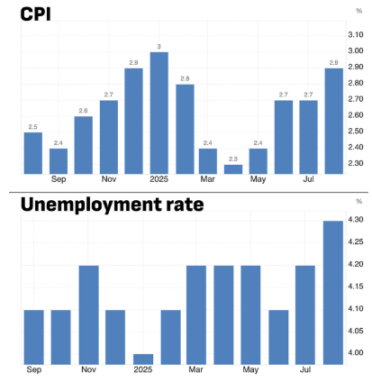
Inflation has rebounded to 2.9%
Unemployment rate has risen to 4.3% (a three-year high)
The U.S. government has experienced a partial shutdown, delaying economic data releases
The Federal Reserve is “flying blind,” and both institutions and retail investors lack direction
When uncertainty rises, volatility returns.
This is the fundamental backdrop for October’s plunge.
❷ Charts Don’t Lie: The Crash Was Triggered by “External Shocks”
In just a few days:
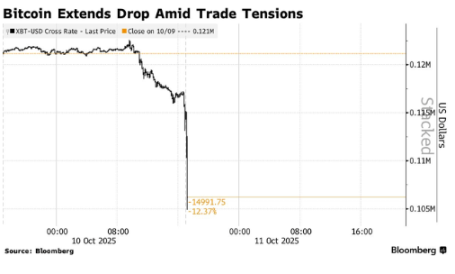
BTC fell from $126,000 to $104,000
ETH dropped from $4,950 to $3,430
Most major altcoins were cut in half
The trigger came from Trump announcing a 100% tariff on China.
Global markets panicked instantly, and in 24 hours, crypto contract liquidations exceeded $19 billions.
This was a typical macro event-driven deleveraging—
Fear first destroys the most liquid assets: cryptocurrencies.
❸ But Institutions Didn’t Panic—They Increased Their Positions
While retail investors were panic selling,
Crypto ETFs recorded nearly $6 billions in net inflows in the same week:
Bitcoin ETFs saw $3.5 billions in inflows
Ethereum ETFs saw $1.5 billions in inflows
In other words:
Retail investors sold in panic, while institutions bought in calm.
The bull market hasn’t ended; it’s just moved from exchange accounts to cold wallets.
❹ Subtle Policy Shifts: The Government Begins Absorbing Crypto
Even more surprisingly, the U.S. Treasury is adjusting its strategy:
Seized bitcoin reserves are no longer being sold
Stablecoin legislation is bringing a clearer regulatory framework
Some policies even allow banks to participate in ETH staking
This signals one thing:
Crypto assets are gradually being absorbed by the system, not rejected.
Bitcoin is becoming part of the financial system, not an external threat.
❺ Ethereum’s “Silent Rebound”
ETH held key support levels during the crash,
On-chain data shows:
Active addresses have reached a multi-year high
ETH demand has hit a historical peak
U.S. financial institutions have begun allowing ETH staking services
Even without major bullish news,
ETH is steadily rebuilding its structure.
This kind of “silent strength” is often the prelude to a major move.
❻ The Current Core Contradiction: Macro Risks vs. Liquidity Game
The market is currently in a tug-of-war between “macro and liquidity”:
If the global economy continues to deteriorate, the market will pause its rise;
If the pace of rate cuts accelerates, the market will explode again.
This is why the market now looks “like both a bull and a bear market.”
Because we are in a period of structural transition.
❼ Has the Bull Market Really Ended?
The answer is: No.
It’s just that this bull market is completely different from the frenzy of 2021.
Deeper corrections, but faster recoveries
Retail investors are leaving, but institutions are taking the lead
The market is calmer, but the structure is healthier
This is not the end of the bull market,
but a new type of bull market driven by liquidity, institutions, and long-term capital.
Conclusion:
The current crypto market is not “collapsing,” but “rebuilding.”
When short-term leverage is flushed out, sentiment returns to rationality, and institutions reposition—
This is the stage where the next trend is gathering strength.
What investors need to do is not to guess the top or bottom,
but to observe the structure:
When fear stabilizes, capital returns, and volatility converges—
The true second phase of the bull market will quietly begin.
This time, the winner is not the fastest, but the most stable.
Disclaimer: The content of this article solely reflects the author's opinion and does not represent the platform in any capacity. This article is not intended to serve as a reference for making investment decisions.
You may also like
CoreWeave's surge gives AI cloud a breather, now all eyes are on the Anthropic IPO and Nvidia
CoreWeave’s Q3 revenue and guidance both exceeded expectations, with its stock price surging 25% in a single day and the new cloud sector soaring over 12%. Reports of Anthropic’s potential $1.5 trillion IPO valuation, OpenAI’s quarterly revenue surpassing $10 billion for the first time, and these three positive catalysts together have boosted confidence in the AI computing power industry chain, which was previously troubled by doubts about AI returns. Next week’s Nvidia earnings report and Anthropic’s IPO will be the true test of whether this rally can continue.

AI Computing Power and Semiconductors Stage a Strong Rebound—Why Is Wall Street Cautious About U.S. Stocks? Key Indicators Reveal the Bottom Hasn't Been Reached
The sharp volatility in the US stock market has prompted investors to carefully analyze various data to determine whether the sell-off has ended. Early indicators suggest that it may be too soon to declare that the market has resumed its normal upward trajectory.

Nvidia (NVDA.US) Governance Crisis Escalates: Jensen Huang Exposed for Another Affair, Board Considers Dismissal, and Wall Street Begins Pricing in a “No Jensen” Scenario
The world's most valuable semiconductor company is experiencing the most severe corporate governance crisis since its establishment.
Crypto prices
More


