
What’s Going On With US XRP ETFs? Status, Price Outlook, and ExpectationsWill a Spot Approval Move XRP Price? A Realistic Take

The race to launch an XRP exchange-traded fund (ETF) is heating up, but investors remain divided on how much it could move the altcoin’s price.
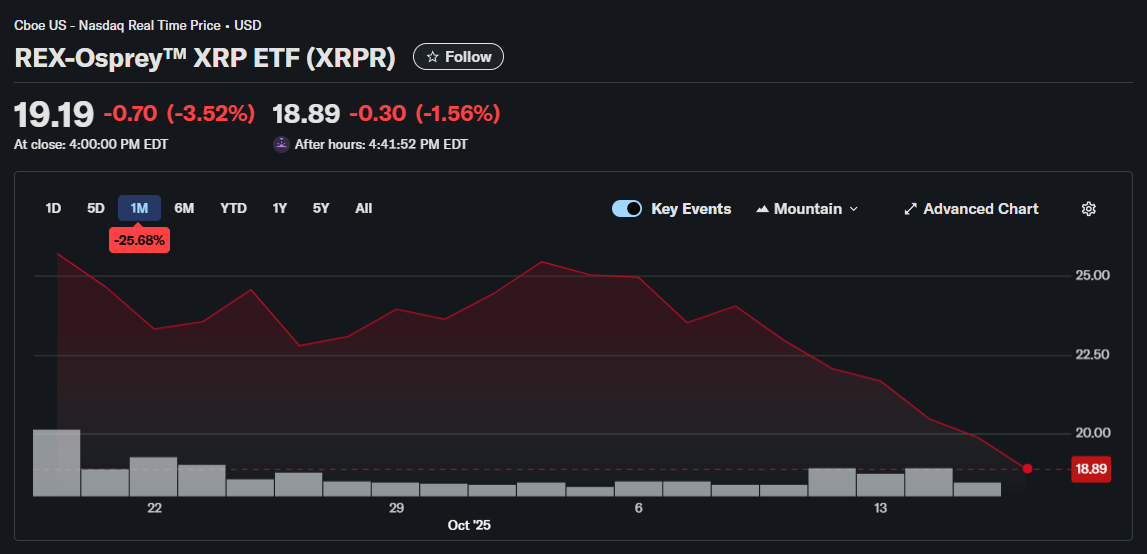
The US market already has one XRP-linked ETF — the REX-Osprey XRPR — but traditional spot products are still awaiting approval from the Securities and Exchange Commission (SEC).
Current Status: XRP ETFs in the US (October 2025)
- A live US product exists: REX-Osprey’s XRPR began trading in mid-September. It uses a ’40-Act hybrid structure (holds XRP directly and via other XRP ETPs). It is not the classic ’33-Act “pure spot” design.
- Traditional “spot” filings are queued: Multiple issuers, including CoinShares, Grayscale, Bitwise, WisdomTree, 21Shares, and others, have filed or signaled intent for spot XRP ETFs using the standard 19b-4/S-1 path.
- Process friction remains: US regulatory bandwidth has been tight. Filings bunch around October decision windows, but review delays and procedural steps temper near-term odds.
- Leveraged wrappers surfaced: At least one issuer has floated leveraged XRP ETF concepts. Those require separate scrutiny and say little about spot approval odds.
What a true “spot XRP ETF” would change
The XRPR ETF, which began trading in September, gives investors indirect exposure to XRP through a hybrid structure.
It holds XRP directly and through other XRP-based funds, offering regulated access to the token without requiring crypto wallets.
Despite a strong debut, XRPR’s performance has been muted, reflecting broader market caution and thin inflows.
Meanwhile, several asset managers — including CoinShares, Grayscale, and Bitwise — have filed for traditional spot XRP ETFs. Several of them have an upcoming SEC approval deadline between October 18 and 25.
October is ETF month. Many final deadlines by mid October.
— Daan Crypto Trades (@DaanCrypto) September 28, 2025
We're expected to see approvals on ETFs from a variety of major altcoins like $SOL, $XRP, $LTC & $DOGE.
Non of the ones with the deadline in October were issued by Fidelity or Blackrock, which are the two major players… pic.twitter.com/yFWRyuJy3O
These filings follow the 19b-4 and S-1 process under the Securities Act of 1933, the same path used by Bitcoin and Ethereum ETF applicants.
However, the US government shutdown and SEC backlog have delayed decisions expected between October 18 and 25.
If approved, a spot XRP ETF would allow investors to gain exposure through mainstream brokerage platforms.
It would also enable institutional funds and registered investment advisors to hold XRP in compliance with portfolio rules. This access could tighten trading spreads, increase liquidity, and deepen market participation.
Will a Spot Approval Move XRP Price? A Realistic Take
Short term: a tradable catalyst—tempered
- Expect a pre-decision run-up if approval odds rise, then a “buy-the-rumor/sell-the-news” dynamic around the event.
- The move’s size hinges on how much is already priced from XRPR’s launch and earlier speculation.
Medium term: flows determine trend
- Sustained upside needs persistent net creations and evidence that wealth platforms actually place the fund on approved lists.
- If advisors allocate even small model weights, price support can compound. If allocations stall, the post-launch drift can fade.
Why the move may be smaller than BTC/ETH events
- Precedent effect: BTC and ETH were “firsts” in their lanes; XRP would follow after the market learned how to route crypto ETF orders.
- Existing proxy: XRPR already channels demand. A pure spot fund is incremental, not revolutionary.
- Issuer mix and fees: If fees land high or distribution is narrow, inflows soften.
- Supply optics: Ongoing escrow releases and legacy distribution overhangs can blunt net-inflow impact.
Ultimately, the approval of a spot XRP ETF would be directionally bullish but not transformative on its own.
The real test will come after launch — when capital flows, liquidity, and institutional adoption reveal whether the product truly changes how investors engage with XRP.
Until then, the altcoin’s price will continue to move more with market sentiment and macro conditions than with regulatory headlines.
The post What’s Going On With US XRP ETFs? Status, Price Outlook, and Expectations appeared first on BeInCrypto.
Disclaimer: The content of this article solely reflects the author's opinion and does not represent the platform in any capacity. This article is not intended to serve as a reference for making investment decisions.
You may also like

Wall Street giants collectively raise rate hike forecasts, US Treasury futures continue to fall, gold drops over 1% to break 4000
After the US October CPI exceeded expectations, Goldman Sachs and Nomura added a forecast for an interest rate hike in March next year, while Deutsche Bank included a forecast for a rate hike in January next year. Currently, the market has fully priced in a 25 basis point rate hike in December, with a 13% probability for a 50 basis point hike. On Wednesday, the US Treasury spot market was closed, but Treasury futures continued to fall, with corresponding yields rising by about 2 to 4 basis points, and spot gold came under pressure, dropping by 1.1%.

No Need to Worry About the Cooling Down of AI Data Center Construction? The US Import Boom Is Unlikely to Subside in the Short Term, Real Impact May Come in 2029
It takes an average of 4.8 years from finalizing investment to starting construction of a data center project, and an additional 2.6 years from construction start to becoming operational. Servers usually cannot be installed until after the building structure and racks are completed. For trade partners such as Taiwan (China), South Korea, and Mexico who rely on US data center supply chain demand, the inertia in construction timelines provides at least a one- to two-year buffer for future exports.

Federal Reserve Major Debate: When Should the Tenure of “Number Three” Williams End?
The main point of contention is whether Williams should step down in June 2028, upon completing a full 10-year term, or in June 2027, when he reaches the mandatory retirement age of 65. Analysts point out that the Federal Reserve Board holds ultimate discretion; if he leaves early, Fed Chair Waller would be able to assert greater control over the appointment to this critical position. However, forcing Williams to shorten his term could easily be interpreted as political manipulation. Williams himself is expected to serve until June 2028.

Crypto prices
More


