
Brevis receives collective praise from the Ethereum community—Is ZK finally becoming practical?

Brevis has achieved proof for 99.6% of Ethereum blocks within 12 seconds, with an average of only 6.9 seconds, using just 64 RTX 5090 GPUs.
Original Title: "Ethereum Community Applauds: Has ZK Technology Finally Moved from the Lab to Production-Grade Tools?"
Original Author: 1912212.eth, Foresight News
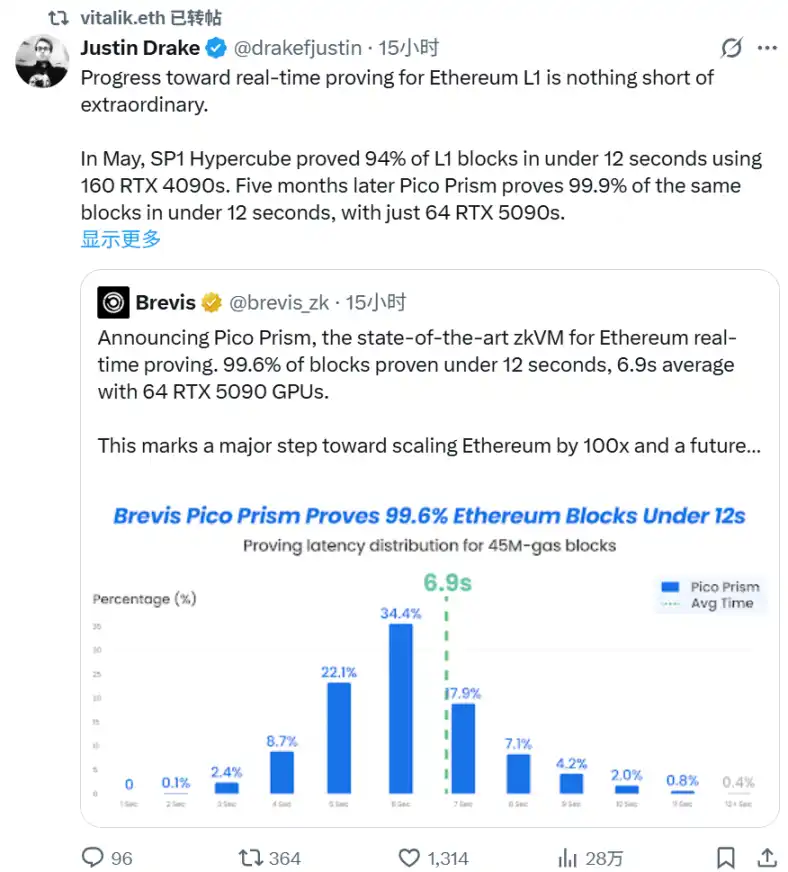
Recently, discussions about Brevis have spread from technical forums to social media. Ethereum's official Twitter, renowned Ethereum researcher Justin Drake, and even Vitalik have reposted and commented at length. What breakthrough has Brevis achieved to suddenly be thrust into the center of the technical stage?
ZK Data Computation and Verification Platform
Brevis is a cross-chain data computation and verification platform powered by ZK technology. It enables smart contracts to easily access and utilize multi-chain historical data, much like reading an open encyclopedia.
To understand the core value of Brevis, we must start with Ethereum’s fundamental challenges. As the world’s largest smart contract platform, Ethereum holds vast amounts of on-chain data. However, developers often face a dilemma when building dApps: how to process this data efficiently and securely? Traditional methods either rely on centralized oracles (such as Chainlink), introducing trust risks, or perform computations directly on-chain, incurring massive gas fees and limiting scalability.
The emergence of Brevis fills this gap. Simply put, Brevis acts as a "smart assistant": it performs complex computations off-chain, then generates zero-knowledge proofs to allow on-chain contracts to verify the correctness of the results. This design not only reduces costs but also ensures data integrity and availability.
Brevis’s tech stack is built on advanced ZK frameworks. It supports multiple blockchains, including Ethereum mainnet and its Layer 2 solutions. Users can use it to read complete on-chain historical data—from transaction records to state changes. For example, a DeFi protocol can use Brevis to calculate users’ cross-chain credit scores without manually aggregating data; an NFT marketplace can verify asset on-chain history in real time, preventing forgery risks.
Brevis is developed by Celer Network, founded by Dong Mo, who holds a Ph.D. from the University of Illinois at Urbana-Champaign. He is an expert in applying algorithmic game theory to protocol design and teaches full-stack smart contract courses. In November 2024, Brevis Network completed a $7.5 million seed round led by Polychain Capital and Binance Labs, with participation from IOSG Ventures, Nomad Capital, Bankless Ventures, Hashkey, and others.
ZK: From Lab Technology to "Production-Grade Tools"
Ethereum’s official Twitter reposted and gave high praise: "This is a big step towards the future of Ethereum. ZK technologies like Pico Prism will help Ethereum scale to meet global demand while maintaining its credibility and decentralization."
Pico Prism is a distributed multi-GPU zkVM (zero-knowledge virtual machine) released by the Brevis team in October 2025. Essentially, it is an evolved version of Pico zkVM, optimized for real-time Ethereum block proofs.
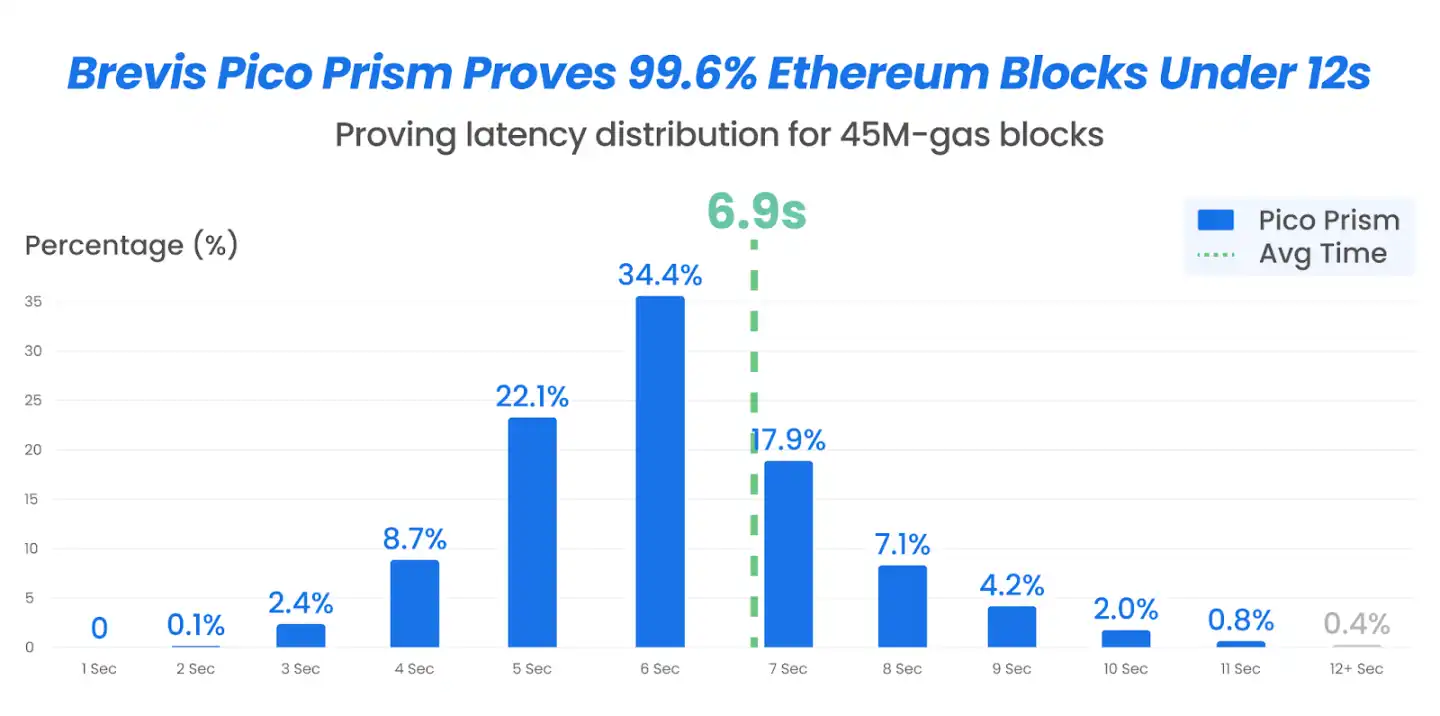
In traditional ZK systems, generating proofs is often time-consuming and resource-intensive, requiring high-end hardware and several minutes of computation, which limits real-time applications. Pico Prism breaks this bottleneck: it achieves proof generation for 99.6% of Ethereum blocks within 12 seconds, with an average of just 6.9 seconds, using only 64 RTX 5090 GPUs.
Succinct’s SP1 Hypercube solution achieves a 40.9% real-time proof coverage rate (latency less than 10 seconds) on blocks with a 36 million gas limit, using 160 GPUs and a hardware capital expenditure of about $256,000. Compared to competitors like SP1, Pico Prism is 32 times faster and reduces GPU hardware costs by 50%.
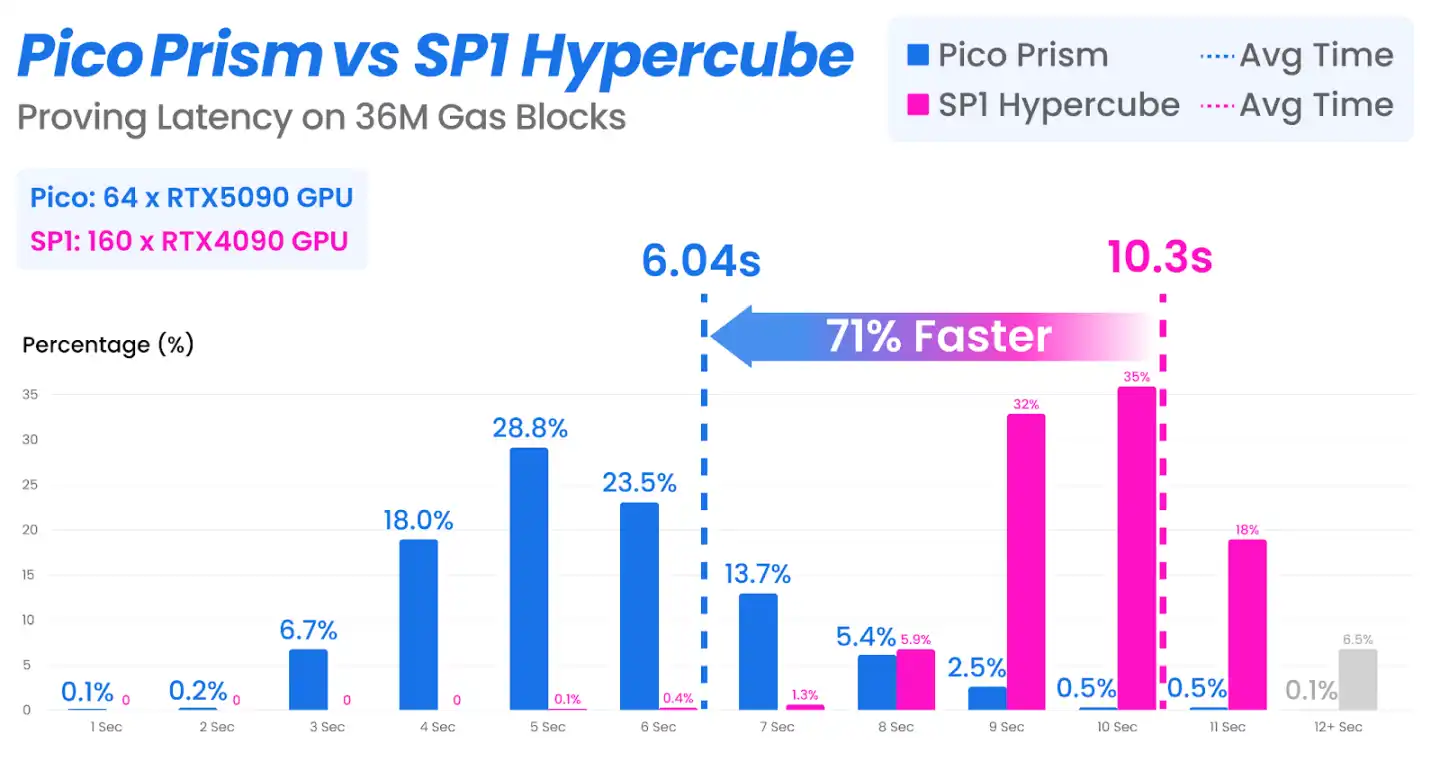
This efficiency is due to its modular architecture: Pico Prism breaks the proof process into parallel tasks, utilizing multiple GPUs working together and avoiding single-machine bottlenecks.
Pico Prism’s advantages also lie in its expansion of practical application scenarios. It shifts Ethereum’s verification model from "re-execution" to "one-time verification," theoretically increasing network capacity by 100 times. Imagine a real-time DeFi lending scenario: a user submits a transaction, Pico Prism instantly generates a ZK proof to confirm the borrower’s on-chain credit history, without requiring full nodes to recalculate. This not only reduces gas fees but also enhances security—the proof process is fully zero-knowledge, protecting user privacy.
In the past, each validator needed to re-execute every transaction to verify a block. This required expensive hardware and created a fundamental bottleneck: the more transactions, the greater the workload for each validator. Real-time proofs break this model. One prover generates a proof, and everyone else can verify it in milliseconds. Pico Prism has already demonstrated that its technology is feasible at production scale.
Another highlight of Pico Prism is its compatibility: it supports custom computations, allowing users to adjust proof logic according to dApp needs, rather than being limited to fixed templates. This makes it highly valuable in Layer 2 Rollups or cross-chain bridges, for example, helping Optimism or Arbitrum verify mainnet data in real time and reduce latency risks.
Through Pico Prism, Brevis not only solves the pain point of proof speed but also lowers the threshold: previously, hundreds of GPUs were required, but now consumer-grade hardware is sufficient. This is great news for small and medium developers, who can easily integrate Brevis to build smarter dApps. Pico Prism’s parallel optimization and cost reduction are moving ZK from lab technology to production-grade tools.
Of course, Brevis and Pico Prism are not perfect; there is still a 2.2% gap to achieving the goal of "real-time proofs within 10 seconds." According to the official statement, the next step for Pico Prism is to focus on reducing proof costs. The plan is to achieve 99% real-time proofs using fewer than 16 RTX 5090 GPUs in the coming months.
Disclaimer: The content of this article solely reflects the author's opinion and does not represent the platform in any capacity. This article is not intended to serve as a reference for making investment decisions.
You may also like

Wall Street giants collectively raise rate hike forecasts, US Treasury futures continue to fall, gold drops over 1% to break 4000
After the US October CPI exceeded expectations, Goldman Sachs and Nomura added a forecast for an interest rate hike in March next year, while Deutsche Bank included a forecast for a rate hike in January next year. Currently, the market has fully priced in a 25 basis point rate hike in December, with a 13% probability for a 50 basis point hike. On Wednesday, the US Treasury spot market was closed, but Treasury futures continued to fall, with corresponding yields rising by about 2 to 4 basis points, and spot gold came under pressure, dropping by 1.1%.

No Need to Worry About the Cooling Down of AI Data Center Construction? The US Import Boom Is Unlikely to Subside in the Short Term, Real Impact May Come in 2029
It takes an average of 4.8 years from finalizing investment to starting construction of a data center project, and an additional 2.6 years from construction start to becoming operational. Servers usually cannot be installed until after the building structure and racks are completed. For trade partners such as Taiwan (China), South Korea, and Mexico who rely on US data center supply chain demand, the inertia in construction timelines provides at least a one- to two-year buffer for future exports.

Federal Reserve Major Debate: When Should the Tenure of “Number Three” Williams End?
The main point of contention is whether Williams should step down in June 2028, upon completing a full 10-year term, or in June 2027, when he reaches the mandatory retirement age of 65. Analysts point out that the Federal Reserve Board holds ultimate discretion; if he leaves early, Fed Chair Waller would be able to assert greater control over the appointment to this critical position. However, forcing Williams to shorten his term could easily be interpreted as political manipulation. Williams himself is expected to serve until June 2028.

Crypto prices
More


