
Mt. Gox’s 34,000 Bitcoin Deadline Sparks Market Jitters — Analysts Warn of FUD

Mt. Gox’s recent on-chain movement has reignited fears of a major Bitcoin selloff ahead of its October 31 repayment deadline, with analysts warning that weak liquidity could intensify volatility if funds hit the market.
The long-running Mt. Gox saga has returned to center stage as blockchain analysts detect new movement in the defunct exchange’s wallets for the first time in seven months.
The move comes just weeks before a key repayment deadline, sparking concerns about renewed market FUD (fear, uncertainty, and doubt).
Mt. Gox Wallet Moves Ahead of 34,000 BTC Repayment Deadline
Data on Arkham shows that Mt. Gox still holds around 34,000 Bitcoin that still need to be repaid to creditors. The court-approved extension expires on October 31, 2025 (Japan Time).
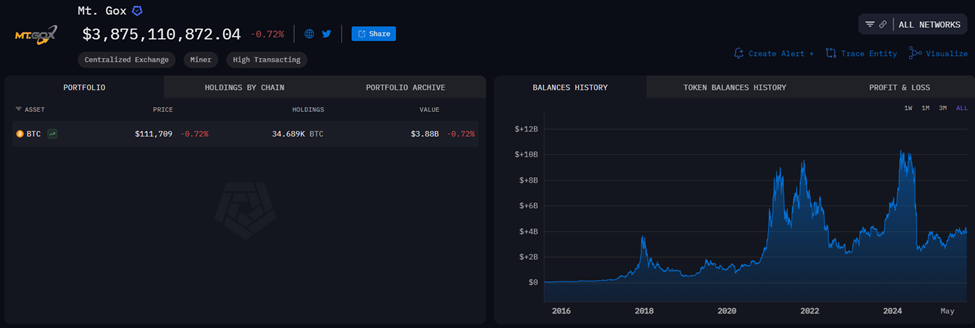 Bitcoin Held By Mt. Gox. Source:
Arkham Intelligence
The extension came as some creditors had not completed the necessary procedures or encountered issues during repayment. As the repayment deadline approaches, investor concerns about imminent sell-pressure grow.
According to CryptoQuant analyst Mignolet, if the trustee fails to secure another delay, the remaining funds, valued at over $3.88 billion, could soon enter the market. Such an outcome could unleash a fresh wave of selling pressure and fear.
“When the extension was announced, action must be taken by October 31…If there is no further extension, these 34,000 bitcoins will eventually enter the market, which could clearly become a catalyst for creating FUD once again,” said Mignolet.
Weakening Liquidity Raises Market Concerns
Mt. Gox began distributing Bitcoin and Bitcoin Cash repayments in July 2024, marking a milestone after nearly a decade of legal proceedings.
While previous sales and government liquidations were largely absorbed by over-the-counter (OTC) demand, analysts warn that this may not be the case this time.
“Last year, about 80% of the German government’s volume was processed through OTC trading,” Mignolet noted, referencing Coinbase Prime’s role as a key institutional liquidity venue. “But unlike last year, that volume is now weakening. It remains uncertain whether the market can absorb 34,000 Bitcoins at once as it did before.”
The analyst added that if OTC channels fail to soak up the supply, the coins could spill directly into public markets, amplifying volatility.
The timing is also seen as “unfavorable,” coming amid declining institutional demand and broader macro uncertainty.
Strive’s Bitcoin Strategy in Question
One potential buffer, Strive (ASST), had previously announced plans to follow MicroStrategy’s playbook by purchasing Bitcoin as a corporate treasury asset from May 2025.
The firm, led by Vivek Ramaswamy, suggested helping absorb part of the Mt. Gox distribution. However, Mignolet expressed doubts about the feasibility of that plan.
“Strive raised $750 million through a PIPE offering, which was entirely used to purchase 5,800 bitcoins at an average price of $116,000…Absorbing the Mt. Gox volume would require at least $4 billion in funding, and it’s unclear whether such funds can be secured in the current situation,” he said.
With MicroStrategy stock under pressure and similar firms facing investor fatigue, Strive’s ability to act as a stabilizing force looks increasingly limited. Another extension to the repayment schedule could be possible, but that would “leave the bad news lingering.”
Familiar Wallet Activity Sparks Speculation
Adding to the tension, Mt. Gox-linked wallets have recently shown on-chain activity reminiscent of past pre-repayment tests.
“After seven months, movement has been detected in the Mt. Gox wallet…In the past, just before repayment, Mt. Gox conducted small-scale Bitcoin transfers for transaction testing. Now, a similar movement is being observed,” Mignolet posted on X.
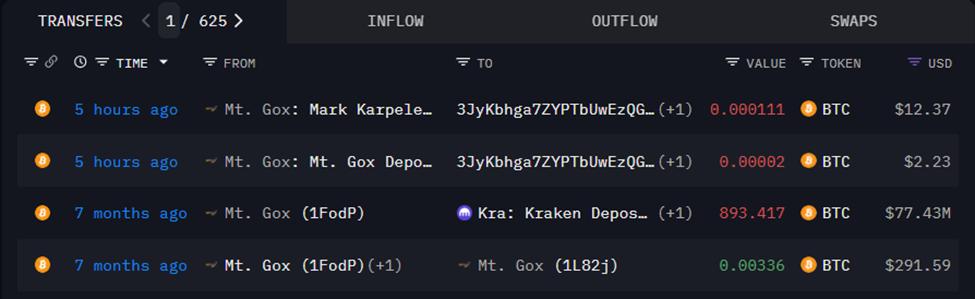 Mt. Gox Moves BTC After Seven Months. Source:
Arkham
While it is not yet confirmed whether these transactions signal imminent repayment, the coincidence has revived fears of a renewed Mt. Gox-driven selloff, just as market liquidity and sentiment appear most fragile.
Disclaimer: The content of this article solely reflects the author's opinion and does not represent the platform in any capacity. This article is not intended to serve as a reference for making investment decisions.
You may also like

Wall Street giants collectively raise rate hike forecasts, US Treasury futures continue to fall, gold drops over 1% to break 4000
After the US October CPI exceeded expectations, Goldman Sachs and Nomura added a forecast for an interest rate hike in March next year, while Deutsche Bank included a forecast for a rate hike in January next year. Currently, the market has fully priced in a 25 basis point rate hike in December, with a 13% probability for a 50 basis point hike. On Wednesday, the US Treasury spot market was closed, but Treasury futures continued to fall, with corresponding yields rising by about 2 to 4 basis points, and spot gold came under pressure, dropping by 1.1%.

No Need to Worry About the Cooling Down of AI Data Center Construction? The US Import Boom Is Unlikely to Subside in the Short Term, Real Impact May Come in 2029
It takes an average of 4.8 years from finalizing investment to starting construction of a data center project, and an additional 2.6 years from construction start to becoming operational. Servers usually cannot be installed until after the building structure and racks are completed. For trade partners such as Taiwan (China), South Korea, and Mexico who rely on US data center supply chain demand, the inertia in construction timelines provides at least a one- to two-year buffer for future exports.

Federal Reserve Major Debate: When Should the Tenure of “Number Three” Williams End?
The main point of contention is whether Williams should step down in June 2028, upon completing a full 10-year term, or in June 2027, when he reaches the mandatory retirement age of 65. Analysts point out that the Federal Reserve Board holds ultimate discretion; if he leaves early, Fed Chair Waller would be able to assert greater control over the appointment to this critical position. However, forcing Williams to shorten his term could easily be interpreted as political manipulation. Williams himself is expected to serve until June 2028.

Crypto prices
More


