
House of Doge Hype Meets $130 Million Coin Dump — What Happens to the Price Next?

The House of Doge NASDAQ merger hype briefly lifted Dogecoin by over 45%, but the recovery also triggered a massive $130 million exit from whales and holders. With the price now stalling near $0.20, traders are watching whether this rebound was a reset or just another setup for a pullback.
The much-hyped House of Doge announcement — a planned merger that could list Dogecoin’s corporate arm on NASDAQ in early 2026 — briefly reignited optimism across the DOGE community. The hype around it helped the Dogecoin price rebound almost 45% by October 13, recovering sharply from its “Black Friday” crash lows.
However, this recovery also became an exit window. Key holder groups offloaded portions of their holdings, signaling that optimism may have come more from hype than conviction. Over the past 24 hours, the price has mostly traded flat, prompting traders to zoom in on the 4-hour chart for early signs of Dogecoin’s next move.
Whales and Long-Term Holders Exit Through and After the Rebound
Following the House of Doge buzz, on-chain data shows that major wallets and long-term investors both reduced their positions substantially.
Whale wallets — those holding between 100 million and 1 billion DOGE — lowered their balances from 28.83 billion DOGE on October 13 (day of merger announcement) to 28.47 billion DOGE two days later. That’s roughly 360 million DOGE sold, worth about $74 million at the current Dogecoin price.
Want more token insights like this? Sign up for Editor Harsh Notariya’s Daily Crypto Newsletter.
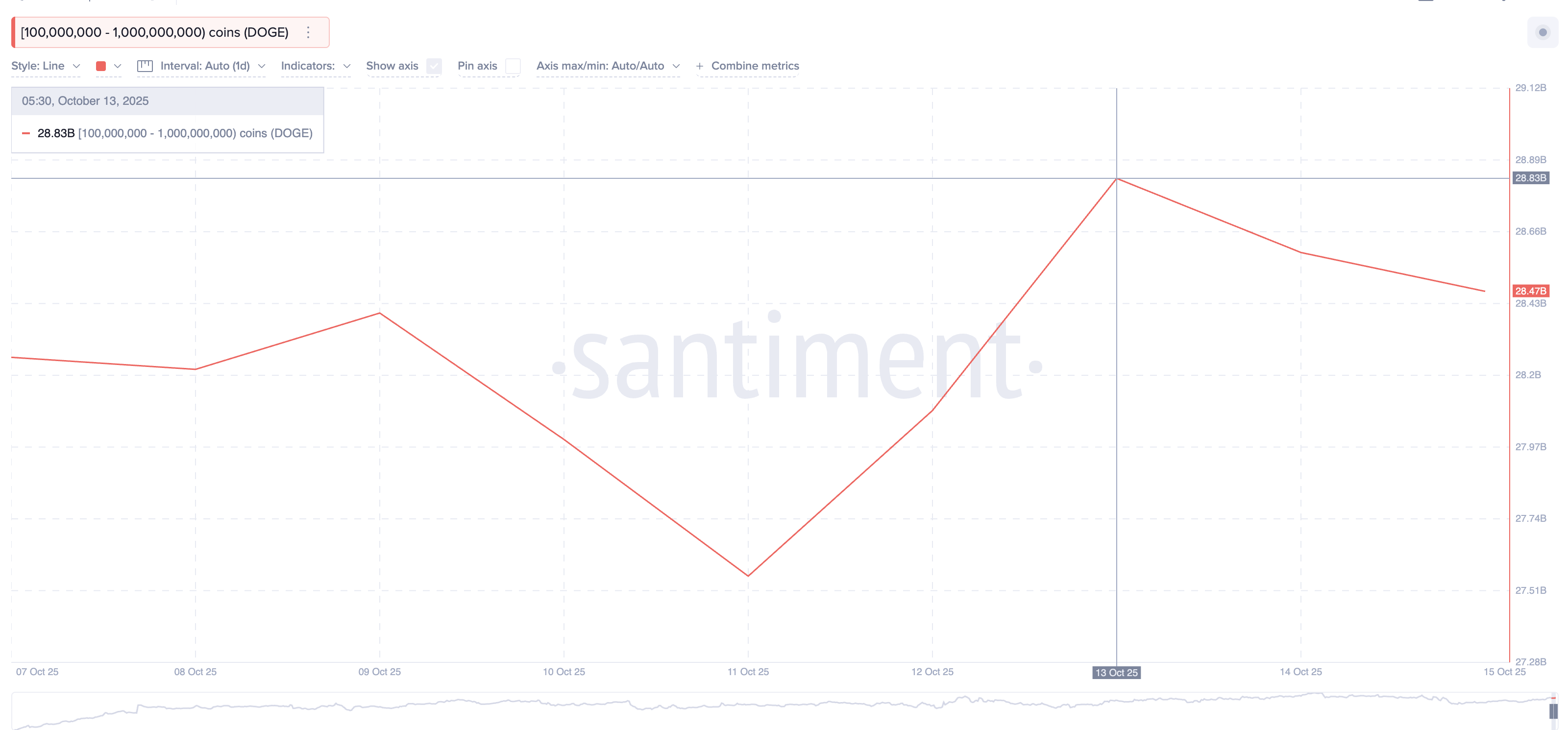 Dogecoin Whales Dump:
Glassnode
Meanwhile, the Holder Net Position Change, an indicator that tracks whether long-term investors are buying or selling, remained negative and worsened. Between October 9 and October 14, net selling grew from –48 million DOGE to –329 million DOGE, a clear sign that even committed holders moved out. While the crash sentiment had a role to play, things didn’t get much better even when the Black Friday jitters eased out.
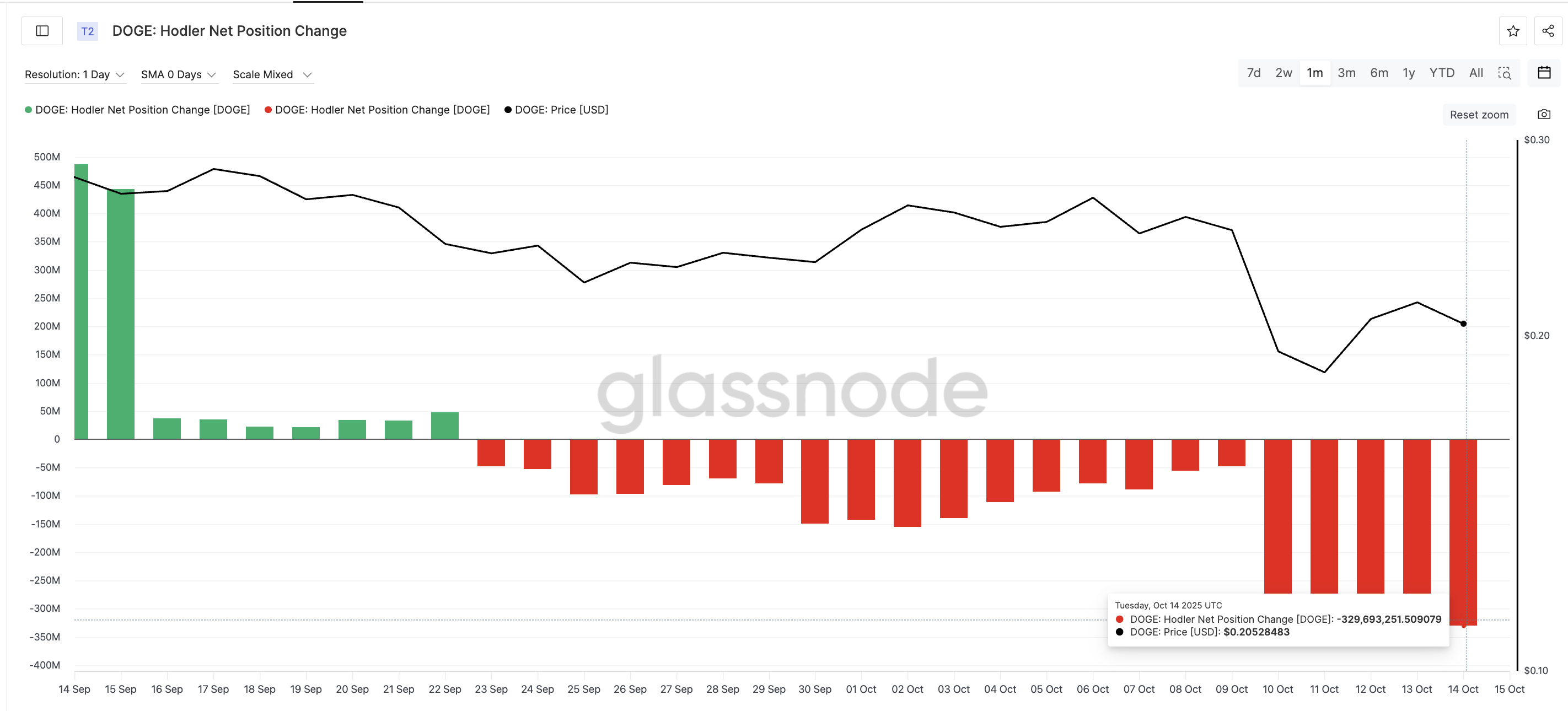 Dogecoin Investors Keep Selling:
Glassnode
Note: There’s one small positive: compared to October 12, when the figure sat near –366 million DOGE, the current value of –329 million DOGE suggests that some slow buying may be returning post the merger news.
In total, nearly 640 million DOGE, valued at around $130 million, exited whale and holder wallets during and after the 45% bounce. The pattern suggests that many took advantage of the temporary strength to cut exposure or lock in smaller losses.
Dogecoin Price Faces Key Test Near $0.20
On the 4-hour chart (used to locate early trend shifts). The Dogecoin price continues to trade inside a descending triangle — a pattern that usually signals potential weakness if buyers fail to defend key levels. The upper resistance zone lies near $0.206, and a daily close above it would indicate short-term strength.
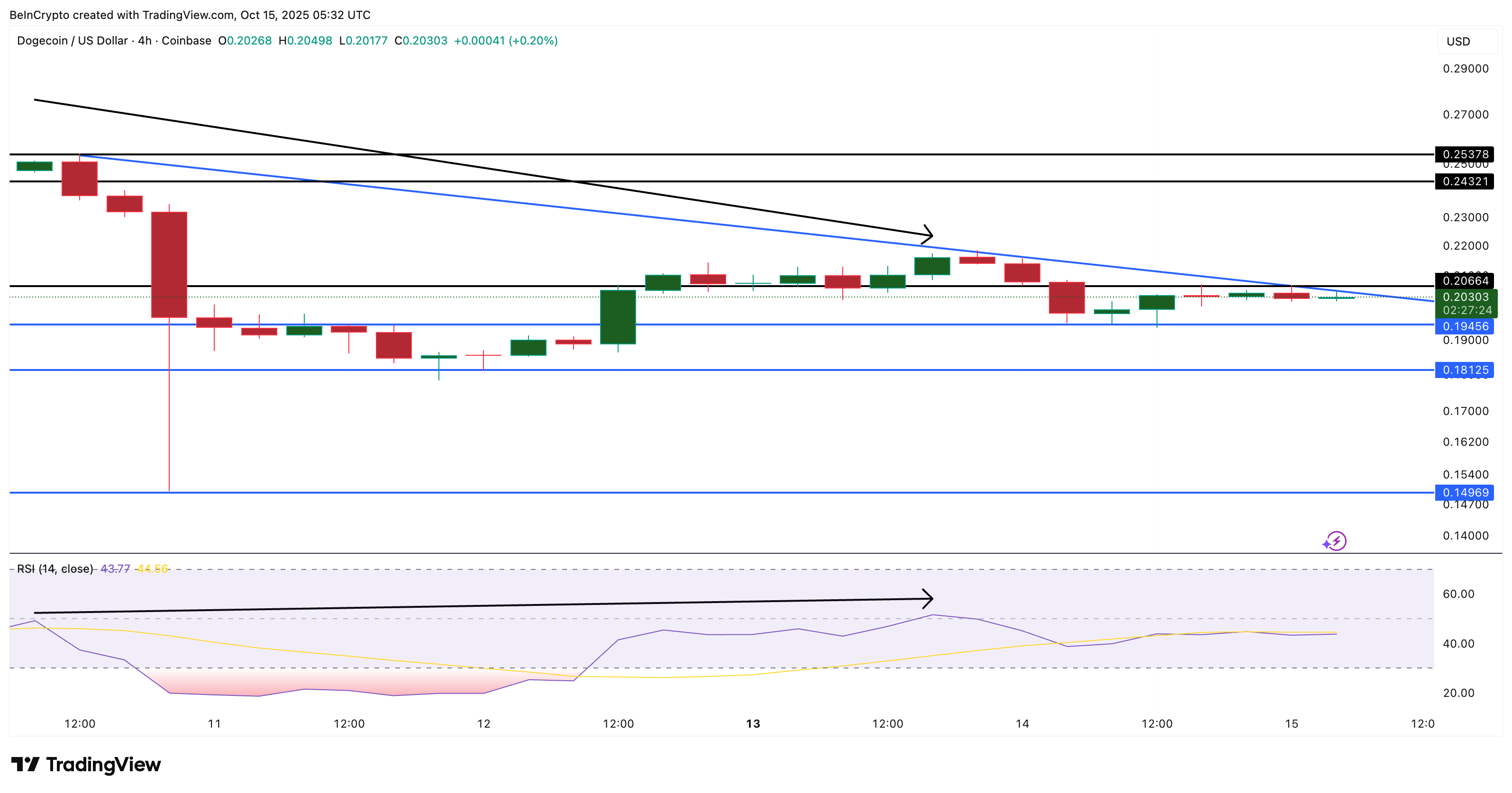 Dogecoin Price Analysis:
TradingView
However, all’s not bullish with the chart. The Relative Strength Index (RSI) — which measures momentum and identifies overbought or oversold conditions — shows a hidden bearish divergence. Prices have made lower highs while RSI has made higher highs, suggesting fading buying power. This kind of divergence hints at a correction in the shorter time frame.
However, $0.194 remains a critical support line and a key base for the bearish triangle. A decisive break below this level could open the way to deeper corrections. That would open levels of $0.181 and even $0.149 for the Dogecoin price (acting as other lower bases for the descending triangle).
Disclaimer: The content of this article solely reflects the author's opinion and does not represent the platform in any capacity. This article is not intended to serve as a reference for making investment decisions.
You may also like

Wall Street giants collectively raise rate hike forecasts, US Treasury futures continue to fall, gold drops over 1% to break 4000
After the US October CPI exceeded expectations, Goldman Sachs and Nomura added a forecast for an interest rate hike in March next year, while Deutsche Bank included a forecast for a rate hike in January next year. Currently, the market has fully priced in a 25 basis point rate hike in December, with a 13% probability for a 50 basis point hike. On Wednesday, the US Treasury spot market was closed, but Treasury futures continued to fall, with corresponding yields rising by about 2 to 4 basis points, and spot gold came under pressure, dropping by 1.1%.

No Need to Worry About the Cooling Down of AI Data Center Construction? The US Import Boom Is Unlikely to Subside in the Short Term, Real Impact May Come in 2029
It takes an average of 4.8 years from finalizing investment to starting construction of a data center project, and an additional 2.6 years from construction start to becoming operational. Servers usually cannot be installed until after the building structure and racks are completed. For trade partners such as Taiwan (China), South Korea, and Mexico who rely on US data center supply chain demand, the inertia in construction timelines provides at least a one- to two-year buffer for future exports.

Federal Reserve Major Debate: When Should the Tenure of “Number Three” Williams End?
The main point of contention is whether Williams should step down in June 2028, upon completing a full 10-year term, or in June 2027, when he reaches the mandatory retirement age of 65. Analysts point out that the Federal Reserve Board holds ultimate discretion; if he leaves early, Fed Chair Waller would be able to assert greater control over the appointment to this critical position. However, forcing Williams to shorten his term could easily be interpreted as political manipulation. Williams himself is expected to serve until June 2028.

Crypto prices
More


