
"10.11" Survivors' Review and Survival Guide

In the post-crash era, where should cryptocurrency investment head?
In the post-crash era, where should cryptocurrency investment go?
Written by: Route 2 FI
Translated by: Saoirse, Foresight News
Editor's note: When the cryptocurrency market experienced the cliff-like "10.11" crash, with altcoins plummeting by an average of 62%, the author, from a first-hand perspective, reviews survival logic: from the unexpected survival of a delta-neutral strategy to deep reflections on leverage usage and market speculation. The article reveals both the stress test faced by DeFi and perpetual contract platforms, and raises the core proposition that "passion drives the survivors of the industry." The following is the full translation:
I've been reflecting a lot on my life choices recently—over the past four years, I've devoted myself almost entirely to the cryptocurrency space, and "entirely" is no exaggeration: I have almost no other hobbies, and most of my waking hours are directly or indirectly centered around crypto: researching trades, testing new protocols, communicating with others, posting content on X, reading others' opinions, browsing industry newsletters, and reading podcast transcripts (I prefer text because I can read five times faster than watching videos or listening to audio).
I genuinely love the process of working hard, even to the point of obsession. This doesn't mean crypto is my only interest, but it is currently my main focus. Maybe one day I'll get tired of it, spend weeks or months thinking about my life's direction, and eventually find a new goal. But looking back, my obsession with numbers and speculation is obvious.
The "10.11" crash was shocking, but I was almost unscathed. Over the weekend, I used a delta-neutral strategy on the Lighter platform, and my short positions were not auto-liquidated as they would have been on platforms like Hyperliquid; on the long side, I only held spot assets. I had no perpetual contract positions open on Bybit, and the day before the crash, I closed a sizable DOGE/BTC pair trade—my intention was just to have a peaceful weekend. Looking back, if I hadn't closed that trade, I would have suffered heavy losses. So surviving this time was indeed partly due to luck.
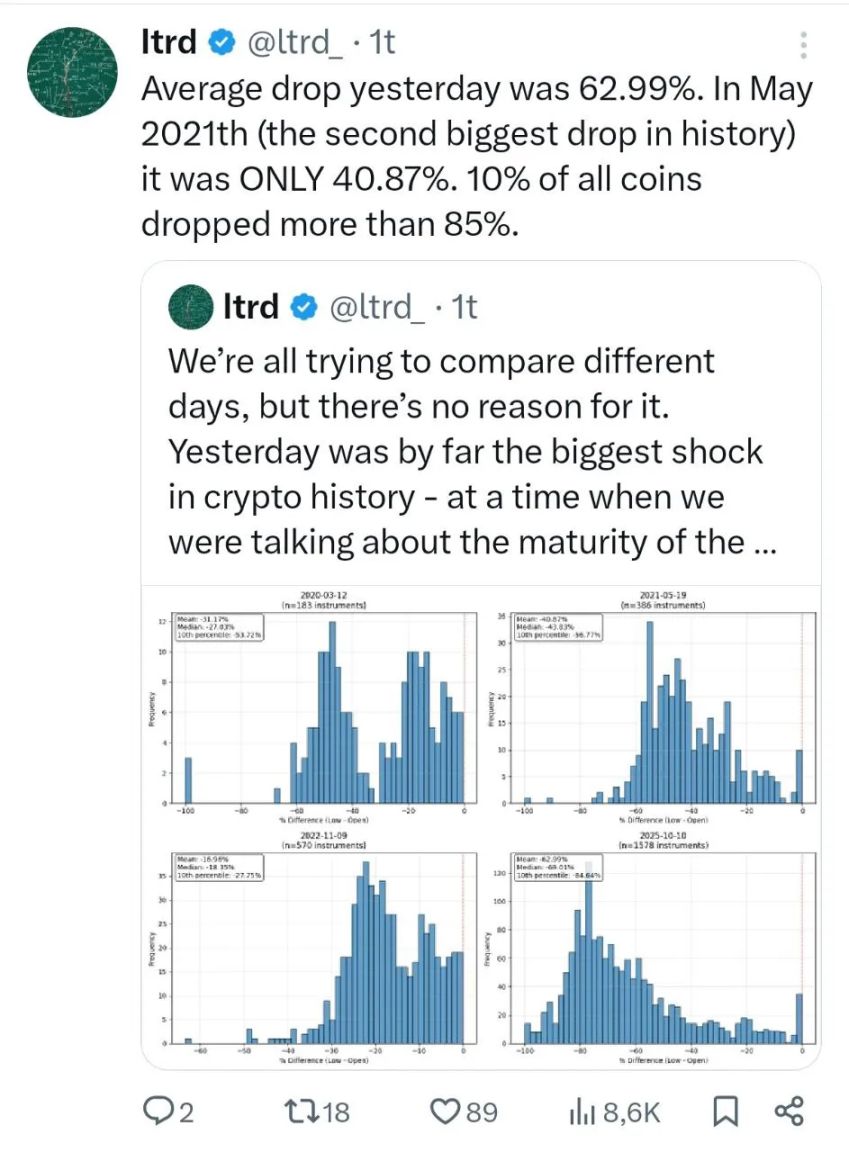
I usually use low leverage of 2-3x to reduce the margin required on centralized exchanges (CEX) or decentralized exchanges (DEX). But this crash still shocked me: altcoins dropped an average of 62%, with some coins plunging 85%-99%—which means all leveraged long traders were "liquidated." In recent years, many aggressive traders (known as "degens" in the community) have flocked to crypto trading, first battling it out in the Solana space, then moving into perpetual contracts. Now, leveraged trading has become the industry norm, and I myself use leverage every day. Some may accuse these traders of lacking risk management, but in my view, 2-3x leverage is actually quite conservative. And honestly, I don't think people will give up leverage because of this crash—within 1-2 weeks, those aggressive traders will return to the market as if nothing happened.
Just imagine, facing an average 63% drop in altcoins (and that's just the average—most coins fell much more), how would you hedge your risk? It's just insane.
So, after this crash, who will stay and continue to "fight" in this cycle?
The answer is those who are "stubborn and cautious": they mainly hold spot assets and observe new coins or projects for a long time before getting involved. They don't blindly "go all in," so they usually can't get super high returns, but at the same time, their portfolios can achieve stable compound growth year after year.

The most severely impacted were perpetual contract traders; ironically, many "altcoin diehards" (such as traders in the Solana space) ended up relatively better off—because most of them trade without leverage. Of course, some did get involved in the perpetual contract market, and if so, they probably suffered heavy losses. But most still stick to "spot positions," so even if they lose, it's not a total wipeout.
For decentralized perpetual contract exchanges (Perp DEX), the impact of this crash is worth noting: short positions on Hyperliquid were auto-liquidated, resulting in profits for its platform token HLP; while short positions on Lighter were not liquidated, causing losses for its platform token LLP. No one can predict the future of decentralized perpetual contract exchanges, but this "10.11" "stress test" has left the industry with many lessons and areas for improvement. For example, does the HYPE token buyback model need adjustment? Is a 100% buyback sustainable?
Will I stop using leverage? The answer is no. I know I have to take responsibility for all my trades and decisions, and risk is always present—if there were no risk, there would be no returns.
As for the DeFi space, I expect a wave of liquidations in the future. Although DeFi performed well in the "10.11" crash, market panic has spread, and many people may prefer to keep their assets in their own wallets rather than entrust them to third parties. Fortunately, USDe remained stable during this event. In my view, Ethena is the "pillar" of DeFi—it supports the entire DeFi ecosystem, and if Ethena has problems, it will trigger a chain reaction (for example, 70% of Pendle's total value locked (TVL) depends on Ethena).
Looking ahead, I've been thinking about which altcoins are worth buying. Right now, I'm more inclined toward MNT and those "veteran tokens" that have been around for a long time. In addition, I think the future "altcoin speculation frenzy" will cool down, so PUMP and Fartcoin won't be my main investment targets. Currently, I mainly hold stablecoins and plan to use a "pure news/narrative-driven" trading model—this approach may not bring the highest returns, but at least it can protect my account funds well in the short term.
Finally, I want to say:
Most people can't achieve their dream wealth goals because they don't have the qualities of a winner.
Your competitors are those who are "born for this field": they don't care about working hours and don't back down in the face of adversity. They don't slack off in good times and don't give up in bad times—this has long become their way of life.
Wealth may be their apparent goal, but what truly drives them is "the process of pursuit," "the joy of growth," "the honing of skills," and the quiet improvement of their professional abilities when no one is watching.
They are not obsessed with the "finish line," but deeply love "the scenery along the way."
That's why, when others choose to get tired or quit, they can keep "winning"—not because they "must win," but because they can't imagine leaving the "game" they love.
Disclaimer: The content of this article solely reflects the author's opinion and does not represent the platform in any capacity. This article is not intended to serve as a reference for making investment decisions.
You may also like

Wall Street giants collectively raise rate hike forecasts, US Treasury futures continue to fall, gold drops over 1% to break 4000
After the US October CPI exceeded expectations, Goldman Sachs and Nomura added a forecast for an interest rate hike in March next year, while Deutsche Bank included a forecast for a rate hike in January next year. Currently, the market has fully priced in a 25 basis point rate hike in December, with a 13% probability for a 50 basis point hike. On Wednesday, the US Treasury spot market was closed, but Treasury futures continued to fall, with corresponding yields rising by about 2 to 4 basis points, and spot gold came under pressure, dropping by 1.1%.

No Need to Worry About the Cooling Down of AI Data Center Construction? The US Import Boom Is Unlikely to Subside in the Short Term, Real Impact May Come in 2029
It takes an average of 4.8 years from finalizing investment to starting construction of a data center project, and an additional 2.6 years from construction start to becoming operational. Servers usually cannot be installed until after the building structure and racks are completed. For trade partners such as Taiwan (China), South Korea, and Mexico who rely on US data center supply chain demand, the inertia in construction timelines provides at least a one- to two-year buffer for future exports.

Federal Reserve Major Debate: When Should the Tenure of “Number Three” Williams End?
The main point of contention is whether Williams should step down in June 2028, upon completing a full 10-year term, or in June 2027, when he reaches the mandatory retirement age of 65. Analysts point out that the Federal Reserve Board holds ultimate discretion; if he leaves early, Fed Chair Waller would be able to assert greater control over the appointment to this critical position. However, forcing Williams to shorten his term could easily be interpreted as political manipulation. Williams himself is expected to serve until June 2028.

Crypto prices
More


