
NYC mayor launches official digital assets office to drive crypto adoption

In a move to formalize its crypto policy, New York City has launched the nation’s first office dedicated to digital assets and blockchain technology.
- NYC becomes the first U.S. city to launch an official digital assets and blockchain office.
- The office will coordinate crypto policy and foster collaboration between city agencies and blockchain innovators.
- Moises Rendon has been appointed as the executive director to lead the city’s blockchain coordination efforts.
New York City has launched the U.S.’ first-ever municipal office focused on digital assets and blockchain, marking a strategic step in the national movement to integrate crypto into public and private infrastructure.
Mayor Eric Adams signed the executive order on Oct. 14, establishing the NYC Office of Digital Assets and Blockchain, designed to coordinate city agencies and private industry in promoting the responsible use of blockchain and digital currencies.
The newly created office is tasked with overseeing policy development, supporting innovation in blockchain applications, and fostering collaboration across regulatory and industry stakeholders.
According to the city’s official report, the office will also focus on ensuring regulatory compliance, raising public awareness about digital asset risks, and improving access for underbanked communities.
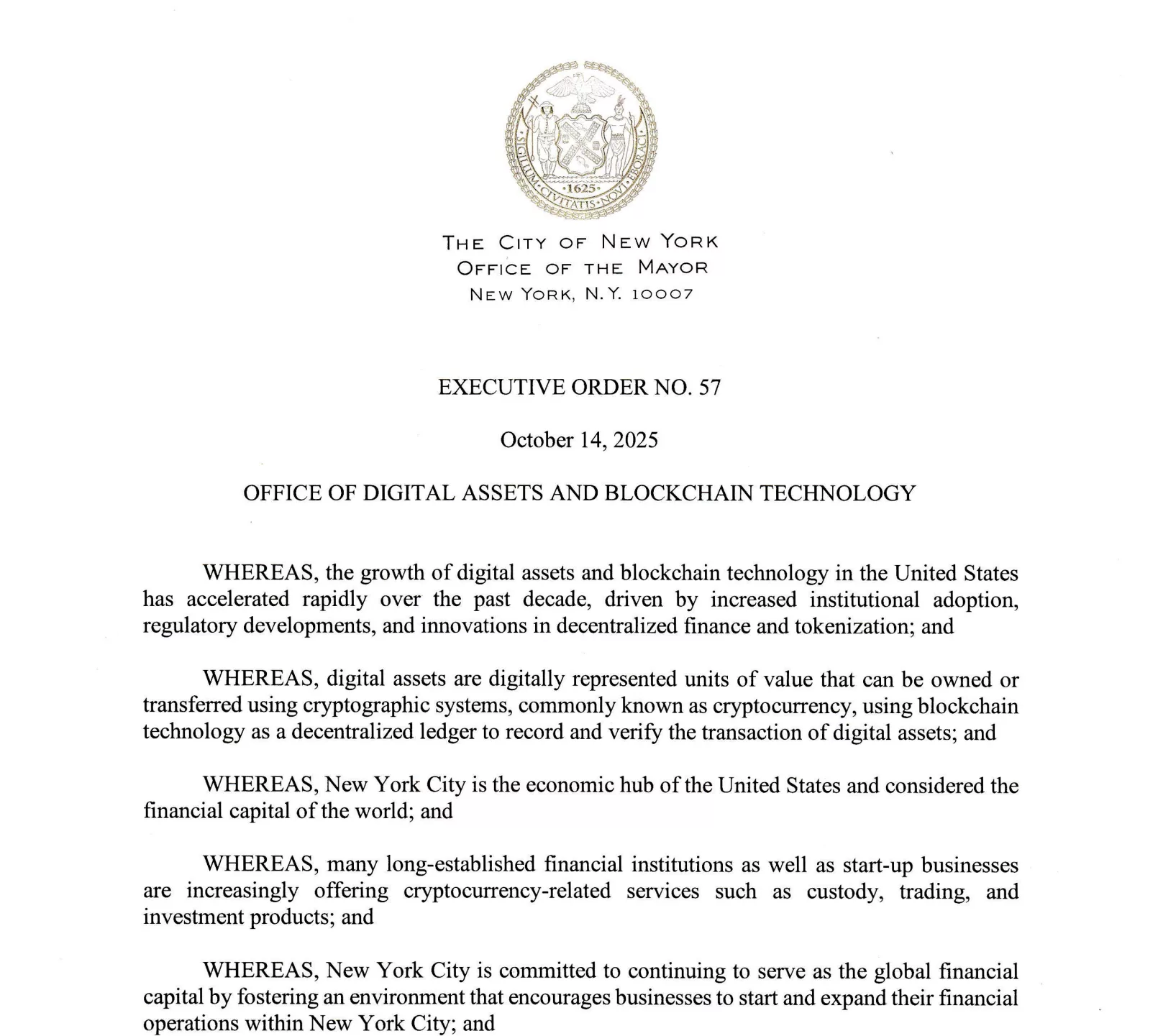 New York City creates Office of Digital Assets and Blockchain | Source: nyc.gov
The office’s mandate includes forming a commission of digital asset leaders to advise on policy and implementation, reflecting a cooperative stance between local governments and the crypto industry.
“Meanwhile, Moises Rendon, a former technology policy expert, has been appointed as the office’s executive director. ‘I am honored to lead the nation’s first municipal office dedicated to the successful and responsible deployment of these technologies,’ Rendon said.”
NYC’s crypto push joins broader U.S. efforts
Mayor Adams, who famously took his first three paychecks in Bitcoin, has remained a vocal advocate for crypto innovation since taking office. The creation of the Office of Digital Assets and Blockchain builds on his earlier efforts, including the formation of a digital assets advisory board in May and NYC’s first-ever crypto summit earlier this year.
While NYC’s initiative reflects a proactive approach to crypto governance, it also aligns with a broader U.S trend of local and state governments moving to shape the role of blockchain in public services.
Notably, Wyoming recently launched FRNT, the nation’s first state-issued stablecoin, while California approved legislation to allow crypto payments for government services. The state of Louisiana also recently created a legislative subcommittee to study the impact of cryptocurrency, blockchain technology, and Artificial Intelligence.
Collectively, these efforts align with President Donald Trump’s own goal of positioning the U.S. as a global leader in crypto development.
Disclaimer: The content of this article solely reflects the author's opinion and does not represent the platform in any capacity. This article is not intended to serve as a reference for making investment decisions.
You may also like

Wall Street giants collectively raise rate hike forecasts, US Treasury futures continue to fall, gold drops over 1% to break 4000
After the US October CPI exceeded expectations, Goldman Sachs and Nomura added a forecast for an interest rate hike in March next year, while Deutsche Bank included a forecast for a rate hike in January next year. Currently, the market has fully priced in a 25 basis point rate hike in December, with a 13% probability for a 50 basis point hike. On Wednesday, the US Treasury spot market was closed, but Treasury futures continued to fall, with corresponding yields rising by about 2 to 4 basis points, and spot gold came under pressure, dropping by 1.1%.

No Need to Worry About the Cooling Down of AI Data Center Construction? The US Import Boom Is Unlikely to Subside in the Short Term, Real Impact May Come in 2029
It takes an average of 4.8 years from finalizing investment to starting construction of a data center project, and an additional 2.6 years from construction start to becoming operational. Servers usually cannot be installed until after the building structure and racks are completed. For trade partners such as Taiwan (China), South Korea, and Mexico who rely on US data center supply chain demand, the inertia in construction timelines provides at least a one- to two-year buffer for future exports.

Federal Reserve Major Debate: When Should the Tenure of “Number Three” Williams End?
The main point of contention is whether Williams should step down in June 2028, upon completing a full 10-year term, or in June 2027, when he reaches the mandatory retirement age of 65. Analysts point out that the Federal Reserve Board holds ultimate discretion; if he leaves early, Fed Chair Waller would be able to assert greater control over the appointment to this critical position. However, forcing Williams to shorten his term could easily be interpreted as political manipulation. Williams himself is expected to serve until June 2028.

Crypto prices
More


