
Bitcoin, Ethereum ETFs bounce back with $339m inflows as market steadies

After several consecutive days of losses, institutional appetite for crypto appears to be returning as Bitcoin and Ethereum ETFs show renewed inflows.
- Bitcoin and Ethereum ETFs rebound with $339 million in inflows, reversing heavy losses from last week’s market crash and signaling renewed institutional interest.
- Bitcoin ETFs added $102.6 million, led by Fidelity’s FBTC, while Ethereum ETFs drew $236.2 million, with Fidelity’s FETH driving the majority of inflows.
- Market sentiment stabilizes as BTC holds above $112,000 and ETH trades near $4,100, with total crypto ETF assets nearing the $1 trillion milestone.
Bitcoin spot ETFs saw a strong rebound on Oct. 14, recording total daily net inflows of $102.6 million according to data from SoSoValue. The largest inflows came from Fidelity’s FBTC, which added about $133 million, followed by Bitwise’s BITB with $8 million and Ark & 21Shares’ ARKB with $6.8 million.
Offsetting the gains were outflows from BlackRock’s IBIT and Valkyrie’s BRRR, which together saw withdrawals totaling $44.85 million. Meanwhile, Grayscale’s GBTC and six other issuers remained flat for the day, showing no new movement.
Ethereum ETFs posted an even stronger rebound, recording a combined $236.2 million in net inflows. Fidelity’s FETH led the recovery, attracting $154.6 million, while Grayscale’s ETH & ETHE saw $50 million in new investments. Other products, including Bitwise’s ETHW and VanEck’s ETHV, reported modest gains, while BlackRock’s ETHA saw no new activity, alongside 21Shares and Invesco.
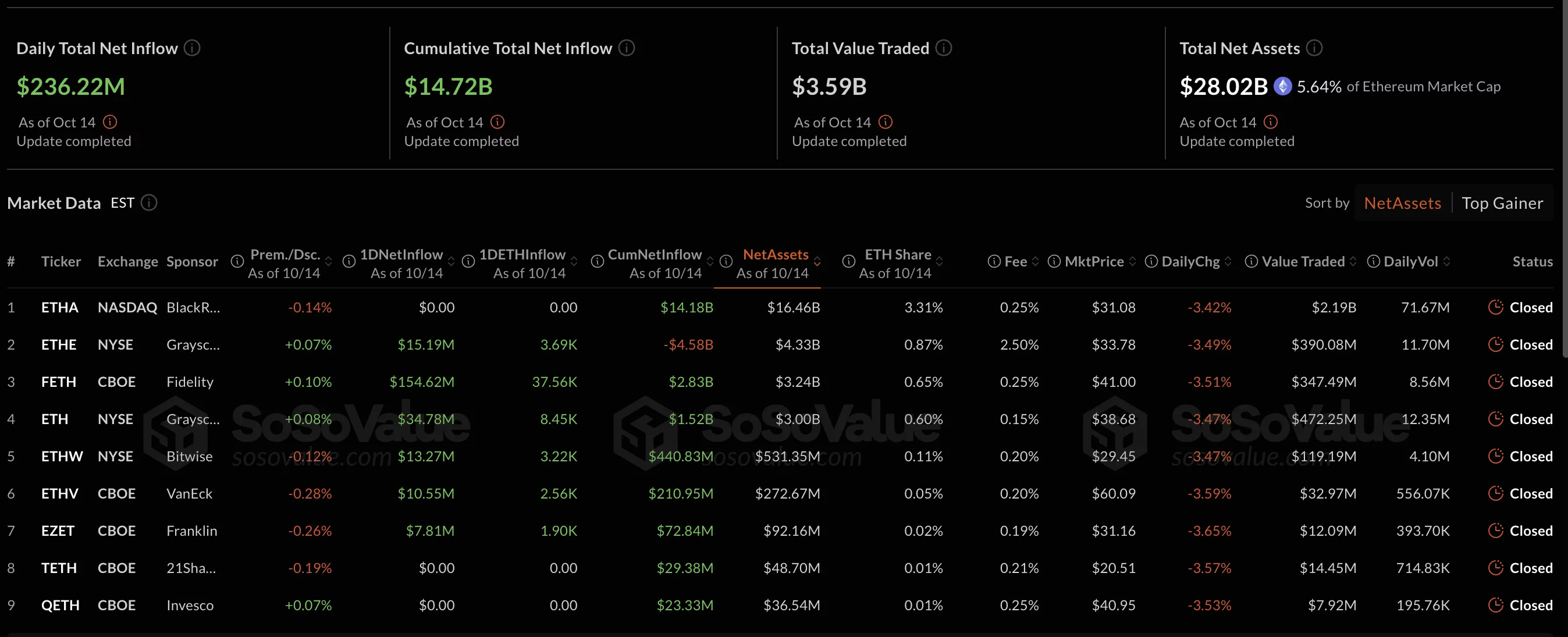 ETH ETF inflows resume | Source: SoSoValue
The renewed inflows come after a turbulent stretch for crypto ETFs. On Oct. 13, the Bitcoin-tracking funds saw $326.5 million in outflows, while Ethereum ETFs lost $428.5 million. These outflows followed additional drawdowns of $4.5 million and $174.8 million, respectively, on Oct. 10.
With the latest influx of capital, both Bitcoin and Ethereum ETFs are back in positive territory, signaling that investor confidence is gradually returning after the recent volatility.
Bitcoin and Ethereum ETF inflows resume amid post-crash rebound
Bitcoin ( BTC ) is up a modest 0.34% in the past 24 hours, currently trading at $112,431, per crypto.news data. The recovery from lows near $105,000 comes as institutional inflows pick up and leveraged positions reset .
Although the top crypto remains down about 11% from its pre-crash high of $125,000, price action has steadied, with the market now eyeing the $115,000–$120,000 range as the next key area to clear.
Ethereum ( ETH ) is showing similar strength, jumping more than 20% from its post-crash lows to trading at $4,116 at the time of writing. After briefly plunging to around $3,435, ETH quickly reclaimed key support levels. The short-term outlook is positive, with $4,250 now acting as an important resistance level.
Overall sentiment in the market is also improving, though still cautious. The record crash and rapid rebound left many traders risk-averse, but rising ETF inflows and stability across large-cap coins are helping restore confidence. Crypto fear and greed index has moved closer to neutral territory, showing that while uncertainty remains, optimism is starting to return.
Disclaimer: The content of this article solely reflects the author's opinion and does not represent the platform in any capacity. This article is not intended to serve as a reference for making investment decisions.
You may also like

Wall Street giants collectively raise rate hike forecasts, US Treasury futures continue to fall, gold drops over 1% to break 4000
After the US October CPI exceeded expectations, Goldman Sachs and Nomura added a forecast for an interest rate hike in March next year, while Deutsche Bank included a forecast for a rate hike in January next year. Currently, the market has fully priced in a 25 basis point rate hike in December, with a 13% probability for a 50 basis point hike. On Wednesday, the US Treasury spot market was closed, but Treasury futures continued to fall, with corresponding yields rising by about 2 to 4 basis points, and spot gold came under pressure, dropping by 1.1%.

No Need to Worry About the Cooling Down of AI Data Center Construction? The US Import Boom Is Unlikely to Subside in the Short Term, Real Impact May Come in 2029
It takes an average of 4.8 years from finalizing investment to starting construction of a data center project, and an additional 2.6 years from construction start to becoming operational. Servers usually cannot be installed until after the building structure and racks are completed. For trade partners such as Taiwan (China), South Korea, and Mexico who rely on US data center supply chain demand, the inertia in construction timelines provides at least a one- to two-year buffer for future exports.

Federal Reserve Major Debate: When Should the Tenure of “Number Three” Williams End?
The main point of contention is whether Williams should step down in June 2028, upon completing a full 10-year term, or in June 2027, when he reaches the mandatory retirement age of 65. Analysts point out that the Federal Reserve Board holds ultimate discretion; if he leaves early, Fed Chair Waller would be able to assert greater control over the appointment to this critical position. However, forcing Williams to shorten his term could easily be interpreted as political manipulation. Williams himself is expected to serve until June 2028.

Crypto prices
More


